
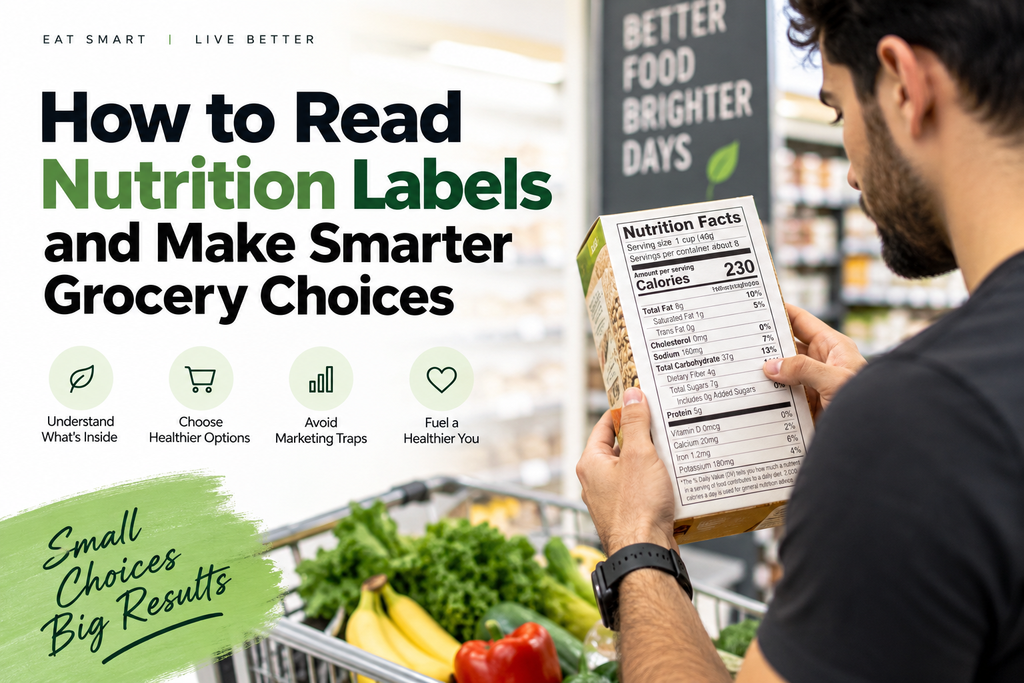
Walking through a grocery store can feel like making dozens of nutrition decisions at once. One cereal says “high protein.” Another says “made with whole grains.” A yogurt advertises “low fat,” while a snack package highlights “no added sugar.”
The problem is that the front of a package is designed to sell the product. The nutrition label and ingredient list are designed to tell you what is actually in it.
Learning how to read nutrition labels gives you a much more reliable way to compare foods. You do not need to memorize every nutrient, calculate complicated formulas, or avoid every packaged food. You need a simple system for identifying serving size, calories, protein, fiber, sugars, saturated fat, sodium, and the ingredients that make up the product.
That matters because research suggests many consumers struggle to interpret nutrition information correctly. A nationally representative U.S. study found that substantial numbers of adults had difficulty applying serving sizes, calories, and percentages on nutrition labels. Better label understanding was also associated with some healthier dietary behaviors.
This guide explains how to read a nutrition label step by step, how to compare similar products, how to interpret marketing claims, and how to turn the information into smarter grocery choices.
What Is a Nutrition Label?
A nutrition label is a standardized panel that provides information about the nutritional composition of a packaged food or drink.
Depending on the country, the exact format and nutrients displayed can differ. In the United States, for example, the Nutrition Facts label includes serving information, calories, macronutrients, selected micronutrients, and percent Daily Values. India’s food-labeling framework has its own requirements and terminology, so shoppers should always use the label applicable to the market in which the food is sold.
The purpose is not to tell you whether a food is universally “good” or “bad.” Instead, the label gives you information that can help you decide whether a particular product fits your nutritional needs.
That distinction is important.
A food can be relatively high in calories but still be useful in an athlete’s diet. A food can be low in calories but provide little protein or fiber. A product can contain sugar without being nutritionally poor, particularly when some of that sugar occurs naturally in foods such as milk or fruit.
The smarter question is not:
“Is this food healthy?”
It is:
“What does this food provide, how much am I likely to eat, and how does it fit into my overall diet?”
The 30-Second Method for Reading a Nutrition Label
You do not need to spend five minutes studying every package.
For most everyday grocery decisions, use this sequence:
- Check the serving size.
- Check how many servings are in the package.
- Look at calories per serving.
- Check protein and fiber.
- Check added sugar or total/free sugars, depending on the label.
- Check saturated fat and sodium.
- Read the ingredient list.
- Compare the product with two or three alternatives.
This approach prevents a common mistake: judging a product from one number or one marketing claim.
For example, a cereal might contain 12 grams of protein and appear impressive on the front of the box. But if a serving contains very little fiber and substantial added sugar, another cereal with slightly less protein may be a better everyday choice.
Nutrition labels work best when you read them as a complete picture.
Step 1: Start With Serving Size
Serving size is one of the most important numbers on a nutrition label.
The nutrients and calories listed on the panel generally correspond to the stated serving size. The serving size is not necessarily the amount you should eat. The FDA specifically explains that serving sizes reflect amounts typically consumed and are provided to make comparisons easier.
Consider a hypothetical snack:
| Label information | Per serving |
|---|---|
| Serving size | 30 g |
| Calories | 150 |
| Protein | 5 g |
| Carbohydrate | 18 g |
| Fat | 7 g |
If you eat 60 g, you have eaten two servings.
That means approximately:
- 300 calories
- 10 g protein
- 36 g carbohydrate
- 14 g fat
The label did not mislead you. You simply have to connect the serving size with the amount you actually consume.
Why serving size matters when comparing products
Suppose one yogurt lists nutrition per 100 g and another lists it per 150 g. Looking only at the numbers can make the products appear very different.
When comparing products, put them on the same basis whenever possible.
For packaged foods, compare equivalent serving sizes or, where available, compare values per 100 g or 100 ml. This is particularly useful when choosing between cereals, snacks, sauces, cheeses and other similar products.
Step 2: Look at Calories, But Don’t Stop There
Calories measure the energy supplied by food.
They can be useful when your goal involves weight management, maintaining weight, or deliberately increasing energy intake. But calories alone tell you very little about the nutritional quality of a product.
Two foods can contain 200 calories and have completely different nutritional profiles.
For example:
- Food A: 200 calories, 2 g fiber, 3 g protein
- Food B: 200 calories, 8 g fiber, 15 g protein
Those foods may serve very different purposes in your diet.
The FDA uses 2,000 calories per day as a general reference point for Daily Value calculations, but individual energy needs can be higher or lower depending on factors such as age, body size and physical activity.
So don’t interpret “2,000 calories” as a universal prescription.
A better question
Instead of asking:
“Is this food low calorie?”
ask:
“What am I getting for these calories?”
Step 3: Check Protein
Protein is particularly useful to watch when choosing foods intended to make up a substantial meal or snack.
Protein contributes to maintaining and building body tissues and can also help make meals more filling.
However, there is no universal protein number that makes a food healthy. A protein bar with 20 grams of protein is not automatically a better choice than a yogurt with 10 grams.
Look at protein in context.
For a snack, you might prefer a product that combines meaningful protein with fiber and relatively little added sugar.
For a staple food, you might prioritize the overall nutritional profile rather than maximizing protein.
For someone specifically trying to increase protein intake, comparing products on a protein-per-calorie basis can also be useful.
For example:
- Product A: 10 g protein, 200 calories
- Product B: 15 g protein, 180 calories
Product B provides more protein with fewer calories. That could make it more useful for someone trying to increase protein while controlling energy intake.
Step 4: Look for Fiber
Dietary fiber is another number worth checking, particularly when comparing grain products, cereals, breads, snacks and other carbohydrate-rich foods.
Fiber is found naturally in foods such as whole grains, fruits, vegetables, beans, lentils, peas, nuts and seeds. The WHO recommends that people over age 10 consume at least 25 grams of naturally occurring dietary fiber per day.
When comparing similar packaged products, a higher-fiber option can often be advantageous.
For example:
| Product | Fiber per serving |
|---|---|
| Cereal A | 2 g |
| Cereal B | 6 g |
| Cereal C | 8 g |
If calories, protein and other factors are reasonably similar, C may be the more fiber-rich choice.
But don’t assume a single number tells the whole story. A food with 8 grams of fiber may still contain substantial added sugar or sodium.
Think in terms of trade-offs.
Step 5: Understand Total Sugar vs. Added Sugar
This is one of the most useful distinctions on modern nutrition labels.
Total sugars include sugars naturally present in foods as well as added sugars.
Added sugars are sugars introduced during processing or preparation, including ingredients such as sucrose and certain syrups. The FDA explains that added sugars are included within total sugars on the label.
Plain yogurt
- Total sugars: 8 g
- Added sugars: 0 g
Much of that sugar may naturally occur as lactose in milk.
Sweetened yogurt
- Total sugars: 18 g
- Added sugars: 10 g
The second product contains both naturally occurring and added sugar.
That distinction is much more informative than simply seeing the word “sugar.”
How much added sugar is high?
On the U.S. Nutrition Facts label, the FDA’s general %DV guide considers 5% DV or less low and 20% DV or more high.
The WHO takes a somewhat broader dietary view, recommending that free sugars remain below 10% of total energy intake, with further reduction toward 5% potentially providing additional health benefits.
The important point is that added sugar should be considered across your whole diet, not treated as a binary ingredient.
Step 6: Don’t Automatically Fear Fat
“Low fat” does not automatically mean “healthier.”
Fat is an essential nutrient, and the type of fat matters.
The WHO recommends limiting saturated fat and avoiding industrially produced trans fats as part of a healthy dietary pattern. It also recommends replacing saturated and trans fats with healthier unsaturated fats where possible.
When reading a label, pay particular attention to:
- Total fat
- Saturated fat
- Trans fat
You don’t necessarily need to choose the product with the lowest total fat.
For example, nuts and seeds naturally contain considerable fat but can be valuable components of a nutritious diet.
The better question is:
“What kind of fat is present, and what else does this food provide?”
Step 7: Pay Attention to Sodium
Sodium can be surprisingly high in packaged foods, especially savory snacks, sauces, instant foods, processed meats and some ready-to-eat meals.
The WHO recommends that adults consume less than 2,000 mg of sodium per day, equivalent to less than 5 grams of salt per day.
This is where the label becomes particularly useful.
Imagine two instant noodle products:
| Product A | Product B | |
|---|---|---|
| Calories | 380 | 390 |
| Protein | 9 g | 10 g |
| Sodium | 1,400 mg | 850 mg |
The calorie difference is almost irrelevant compared with the sodium difference if sodium reduction is one of your dietary priorities.
Again, compare similar products rather than judging an isolated number.
Step 8: Learn How % Daily Value Works
The % Daily Value (%DV) tells you how much a nutrient in one serving contributes to a daily reference value.
The FDA provides a simple rule:
- 5% DV or less: generally low
- 20% DV or more: generally high
This is especially useful when comparing products.
For nutrients you generally want more of, such as dietary fiber, calcium, iron, vitamin D and potassium, a higher %DV can be useful.
For nutrients you may want to limit, such as saturated fat, sodium and added sugars, a lower %DV is generally preferable.
Never compare %DV without checking serving sizes.
Step 9: Read the Ingredient List
The ingredient list answers a different question from the nutrition panel.
The nutrition panel tells you how much of various nutrients are present.
The ingredient list tells you what the food is made from.
Under U.S. FDA labeling rules, ingredients are generally listed in descending order by weight, meaning the ingredient present in the greatest amount appears first.
That makes the first few ingredients particularly useful.
Imagine a product marketed as a “whole grain breakfast bar.”
Whole wheat flour, oats, sugar, vegetable oil…
Now imagine another:
Oats, whole wheat flour, nuts, seeds…
The marketing language may look similar, but the formulation is different.
Don’t fear unfamiliar ingredient names
A long or scientific-sounding ingredient name does not automatically mean that a food is unhealthy.
Food additives can serve legitimate technological purposes, such as improving texture, preserving freshness or stabilizing a product. Harvard’s Nutrition Source also cautions against assuming that an unfamiliar ingredient or long ingredient list automatically makes a food unhealthy.
The better approach is to ask:
What are the main ingredients, and does the overall product fit what I want to eat regularly?
Step 10: Don’t Let the Front of the Package Make the Decision
The front of a package is where marketers communicate the product’s selling points.
You might see:
- High protein
- Natural
- Multigrain
- No added sugar
- Low fat
- Source of fiber
- Made with whole grains
- Gluten-free
- Fortified with vitamins
These statements may be accurate while still giving you an incomplete picture.
For example, a cereal can be “made with whole grains” while still containing a significant amount of added sugar. A snack can be “high protein” while being high in sodium. A product can be “low fat” while containing more sugar.
Harvard’s review of food labels notes that nutrient-content and health claims can influence perceptions of healthfulness, even when the product’s overall nutritional profile is less impressive than the marketing suggests.
Front of package = advertisement.
Nutrition panel + ingredient list = evidence.
Step 11: Compare Foods, Don’t Judge Them in Isolation
One of the biggest improvements you can make to your grocery shopping is to stop asking whether a food is “healthy” and start comparing alternatives.
Suppose you’re choosing between three peanut butters.
| Peanut Butter A | Peanut Butter B | Peanut Butter C | |
|---|---|---|---|
| Calories | 190 | 180 | 200 |
| Protein | 8 g | 7 g | 9 g |
| Added sugar | 3 g | 0 g | 0 g |
| Sodium | 150 mg | 90 mg | 80 mg |
| Main ingredient | Peanuts | Peanuts | Peanuts |
If your priority is minimizing added sugar and sodium while keeping protein relatively high, C may be attractive.
But there is no need to declare A “bad.” Nutrition is about patterns, not perfection.
A Practical Grocery-Store Framework
Level 1: What type of food is this?
- Is this a minimally processed staple?
- Is it a packaged convenience food?
- Is it primarily a snack or treat?
- Is it intended to replace a meal?
Level 2: What does the label say?
- Serving size
- Calories
- Protein
- Fiber
- Added sugar
- Saturated fat
- Sodium
Level 3: What are the ingredients?
- What is the main ingredient?
- Is the product mostly what I expected?
- Are there multiple sources of added sugar?
- Does it contain an ingredient I need to avoid?
- Does the formulation make sense for the type of food?
This three-level approach is faster and more useful than obsessively reading every line.
How to Shop for Common Grocery Categories
Breakfast cereal
- Higher fiber
- Reasonable protein
- Lower added sugar
- A recognizable primary grain or whole-grain ingredient
Don’t choose a cereal solely because the box says “whole grain.”
Yogurt
- Protein
- Added sugar
- Total sugar
- Calories
- Ingredient list
Plain yogurt with fruit added at home can be an easy way to control sweetness.
Bread
- Fiber
- Protein
- Sodium
- Serving size
- First ingredients
“Brown” or “multigrain” does not automatically mean the product is primarily whole grain.
Snacks
Ask whether the snack provides something useful beyond calories. A product containing nuts, seeds, legumes or whole grains may provide protein, fiber and micronutrients alongside energy.
Sauces and condiments
These can be easy places for sodium and added sugar to accumulate because serving sizes are often small. Check the actual serving size and then consider how much you normally use.
Packaged drinks
Look particularly closely at added/free sugars, calories, serving size and protein, if relevant. A bottle may contain more than one serving even if it looks like a single drink.
What About Ultra-Processed Foods?
Nutrition labels can help you understand a packaged food, but they do not perfectly capture every aspect of food processing.
The term ultra-processed food is generally associated with the NOVA classification system, which categorizes foods according to the nature and extent of industrial processing. Research has associated high consumption of ultra-processed foods with several adverse health outcomes, but the category is broad and does not mean that every individual food within it has the same nutritional profile or health effect.
The WHO nevertheless recommends that diets be based largely on a variety of minimally processed and unprocessed foods and that foods high in unhealthy fats, free sugars and sodium be limited.
So don’t use “processed” as a simple synonym for “bad.” Frozen vegetables, pasteurized milk and canned beans are processed, but the useful question is what the processing does to the food and what role the food plays in your overall diet.
Common Nutrition Label Mistakes
Mistake 1: Ignoring serving size
The most common trap is seeing “200 calories” and assuming that represents the entire package. Always check servings per container.
Mistake 2: Choosing based on one nutrient
“High protein,” “low fat” and “low calorie” do not automatically mean better. Look at the overall nutritional profile.
Mistake 3: Treating all sugar as identical
Total sugar and added sugar answer different questions. Check both when the label provides them.
Mistake 4: Being afraid of every unfamiliar ingredient
A chemical-sounding name is not a reliable measure of whether a food is healthy. Ingredients need context.
Mistake 5: Trusting the front of the package
Marketing claims highlight selected attributes. The nutrition panel gives you a broader picture.
Mistake 6: Comparing different serving sizes
Always normalize the comparison. Otherwise, you may choose a product simply because its manufacturer uses a smaller serving size.
Mistake 7: Trying to make every grocery purchase perfect
Healthy eating is a pattern. WHO describes healthy diets in terms of adequacy, balance, moderation and diversity rather than a single perfect food or nutrient target.
The “Better Choice” Doesn’t Have to Be Perfect
One of the most useful ways to use nutrition labels is to make incremental improvements.
If you normally buy a cereal with 12 g added sugar, 2 g fiber and 3 g protein, and find a comparable cereal with 5 g added sugar, 6 g fiber and 6 g protein, you don’t need to convince yourself that the original cereal was toxic. You simply found a better everyday option for your goals.
Choose more fiber when comparing similar products, less added sugar when sweetness isn’t important, less sodium when products are otherwise comparable, more protein when protein is a priority, and more nutrient-dense ingredients when practical.
Small decisions repeated across hundreds of grocery trips can matter more than obsessing over a single food.
A Simple Nutrition Label Checklist
- Serving size: How much does the label consider one serving?
- Servings per package: Am I likely to eat one serving or several?
- Calories: How much energy am I getting?
- Protein: Does this food provide meaningful protein for its role in my diet?
- Fiber: Is there a useful amount of dietary fiber?
- Added sugar: Is the product contributing a lot of added sugar?
- Saturated fat: Is this product particularly high compared with alternatives?
- Sodium: Could this be a major source of sodium in my diet?
- Ingredients: What are the main ingredients?
- Comparison: Is there a similar product with a better overall profile?
If you can answer those ten questions, you can make a surprisingly informed grocery decision in less than a minute.
What Is the Healthiest Way to Use Nutrition Labels?
The healthiest way to use nutrition labels is not to search for a magical “perfect” product. It is to use the information to build a better overall diet.
WHO recommends a diverse dietary pattern centered on foods such as vegetables, fruits, pulses, whole grains, nuts and other nutritious foods, while limiting excess free sugars, sodium and unhealthy fats.
That means most grocery decisions should start with the food itself. Buy plenty of foods that need little or no label, such as vegetables, fruits, beans, lentils, whole grains, nuts, seeds, eggs, milk and other nutritious dairy foods, where appropriate.
Then use nutrition labels to make smarter decisions among packaged foods. That is where labels are most powerful.
Frequently Asked Questions
Are nutrition labels accurate?
Nutrition labels are regulated and standardized within their respective markets, but the exact requirements differ by country. They should be treated as useful reference information rather than laboratory measurements of the exact contents of every individual package.
What should I look for first on a nutrition label?
Start with serving size and servings per package. Then look at the nutrients most relevant to your goals, typically calories, protein, fiber, added sugar, saturated fat and sodium.
Is a food with a long ingredient list unhealthy?
Not necessarily. Ingredient-list length alone is a poor way to determine nutritional quality. Some unfamiliar ingredients are functional food additives, and their presence does not automatically make a food unhealthy.
Is added sugar worse than naturally occurring sugar?
They are not identical from a labeling perspective. Added sugars are introduced during processing or preparation, while naturally occurring sugars are found in foods such as fruit and milk.
Should I always choose foods with fewer calories?
No. Calories are only one part of a food’s nutritional profile. A higher-calorie food can provide substantial protein, fiber, healthy fats, vitamins or minerals.
What does 20% Daily Value mean?
On the U.S. Nutrition Facts label, 20% DV or more is generally considered high for a nutrient, while 5% DV or less is generally considered low.
Are front-of-package nutrition claims reliable?
They can provide useful information, but they should not replace reading the nutrition panel and ingredient list. Research suggests interpretive front-of-package labels can improve understanding and sometimes encourage healthier choices, although effects vary across studies and labeling systems.
Do I need to avoid packaged foods to eat healthily?
No. Packaged foods can be part of a healthy diet. The key is to consider the overall dietary pattern, the nutritional profile of the product and how frequently you consume it.
The Bottom Line
Reading nutrition labels is less about memorizing nutritional rules and more about learning how to ask better questions.
Start with serving size. Then look at calories, protein and fiber. Check added sugar, saturated fat and sodium based on your goals. Finally, read the ingredient list and compare the product with similar options.
Most importantly, don’t let one number or one marketing claim make the decision for you.
The smartest grocery choice is usually the product whose overall nutritional profile best fits your needs, preferences and the role that food plays in your diet.
Once you get used to this process, grocery shopping becomes much simpler. You stop trying to identify foods as universally “good” or “bad” and start making informed trade-offs.
That is ultimately what nutrition labels are for: not perfection, but better decisions, made consistently.