
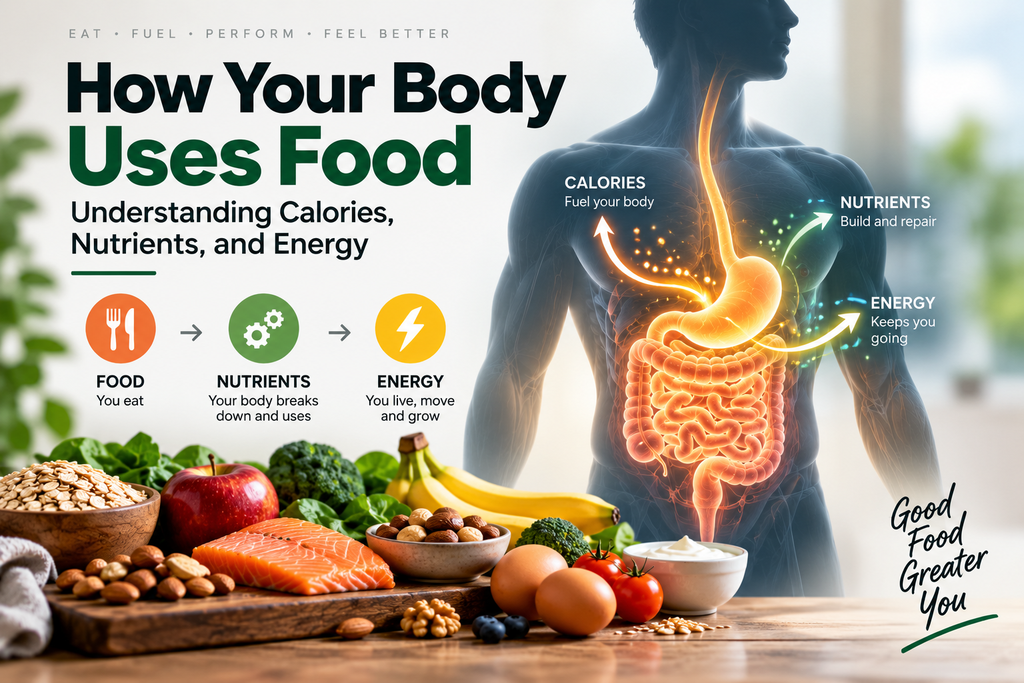
Every time you eat, your body is doing far more than simply “getting calories.”
A meal of rice, dal, vegetables, eggs, fruit, or nuts contains a mixture of carbohydrates, proteins, fats, vitamins, minerals, water, and other compounds. Your digestive system breaks that food down, absorbs useful components, and sends them into different metabolic pathways. Some are immediately used for energy. Some are stored. Some become building materials for cells and tissues. Others act as the small but essential helpers that allow thousands of chemical reactions to happen.
That is why nutrition is more complicated than simply counting calories.
Calories matter because they represent energy. But nutrients matter because your body needs specific raw materials and chemical helpers to function properly. A diet can provide enough calories while still being poor in essential nutrients.
Understanding what happens to food after you eat it makes concepts such as calories, metabolism, macronutrients, micronutrients, energy balance, and weight change much easier to understand.
What happens to food after you eat it?
The journey starts in your mouth.
Chewing physically breaks food into smaller pieces, while saliva begins digesting certain carbohydrates. Once you swallow, muscular contractions called peristalsis move food through the esophagus and into the stomach.
In the stomach, food is mixed with acid and digestive enzymes. From there, it gradually moves into the small intestine, where most digestion and nutrient absorption take place.
According to the National Institute of Diabetes and Digestive and Kidney Diseases’ overview of the digestive system, proteins are broken down into amino acids, fats into fatty acids and glycerol, and carbohydrates into simple sugars. The small intestine then absorbs these smaller molecules and transfers them into circulation.
Food → digestion → absorption → transport → cellular use or storage
But the process is not identical for every nutrient.
Glucose from digested carbohydrates can enter the bloodstream and be used by tissues for energy. Amino acids from protein can be used to build and repair proteins and other molecules. Fatty acids can be oxidized for energy or incorporated into cell structures and stored energy.
The liver also plays a major role in processing and distributing absorbed nutrients. Some fats and fat-soluble vitamins travel through the lymphatic system before reaching the bloodstream.
The important point is that your body does not use “food” as one single substance. It separates food into components and directs those components according to your body’s immediate needs.
What are calories, and why does your body need them?
A calorie is a unit of energy.
When nutrition labels talk about calories, they are usually referring to kilocalories, abbreviated as kcal. In everyday nutrition, “calorie” and “kilocalorie” are commonly used interchangeably.
Your body needs energy constantly. Even while you are sleeping, your heart is beating, your lungs are working, your brain is active, your kidneys are filtering blood, and your cells are maintaining their internal environment.
Energy is also required when you walk, exercise, digest food, maintain body temperature, grow, repair tissues, and perform countless cellular processes.
| Macronutrient | Approximate energy per gram | Main roles |
|---|---|---|
| Carbohydrate | 4 kcal | Energy, especially for brain and active muscle |
| Protein | 4 kcal | Tissue building, repair, enzymes, hormones and other functions |
| Fat | 9 kcal | Concentrated energy, cell membranes, signaling and absorption of fat-soluble vitamins |
These commonly used energy values are based on the Atwater system used for estimating food energy. Alcohol provides approximately 7 kcal per gram, although alcohol is not an essential nutrient.
This explains one reason fats are calorie-dense: a gram of fat contains more than twice as much energy as a gram of carbohydrate or protein.
But calorie density does not tell you whether a food is nutritious.
How does your body turn food into energy?
The energy contained in food is not directly equivalent to the energy your muscles or organs can immediately use.
Your cells convert chemical energy from nutrients into forms that can power cellular work. One of the most important is ATP, or adenosine triphosphate. ATP is often described as the cell’s energy currency.
Carbohydrates can be broken down into molecules such as glucose. Fatty acids can enter pathways that ultimately produce acetyl-CoA. These molecules feed into metabolic pathways including the citric acid cycle and oxidative phosphorylation.
ATP powers processes such as muscle contraction, active transport across cell membranes, protein synthesis, cellular repair, nerve signaling, chemical synthesis, and maintenance of cellular structure.
The mitochondria are particularly important because they are major sites of aerobic energy production. Some energy is also released as heat during metabolism.
The three macronutrients: carbohydrates, protein, and fat
Macronutrients are nutrients the body needs in relatively large amounts. The three energy-producing macronutrients are carbohydrates, protein, and fat. They all provide calories, but they are not interchangeable because they perform different biological roles.
Carbohydrates: a major source of usable energy
Carbohydrates include sugars, starches, and dietary fiber. Digestible carbohydrates are broken down into smaller sugars, including glucose. Glucose can then be used by cells for energy or stored, primarily as glycogen in the liver and muscles.
Carbohydrates can be particularly important during higher-intensity physical activity because muscle can rapidly access carbohydrate-derived energy.
Whole grains, legumes, fruits, and vegetables provide carbohydrates along with fiber, vitamins, minerals, and other compounds. Highly processed foods may also contain carbohydrates but can provide a very different overall nutrient profile.
What about sugar?
Sugar is a carbohydrate, but not all carbohydrate-containing foods are equivalent. Whole fruit contains naturally occurring sugars along with water, fiber, vitamins, minerals, and other compounds. Free sugars include sugars added during preparation or manufacturing as well as sugars naturally present in honey, syrups, fruit juices, and concentrates.
The practical lesson is not that you must eliminate carbohydrates. It is that the nutritional package surrounding a nutrient matters.
Protein: more than a muscle-building nutrient
Protein is often associated with muscle, but its role extends throughout the body. Proteins form structural components of tissues and serve as enzymes, transport molecules, antibodies, receptors, hormones, and signaling molecules.
During digestion, dietary proteins are broken down into amino acids and smaller peptides. These components can then be absorbed and used to synthesize new proteins and other compounds.
For someone trying to build muscle, simply eating more protein is not enough. Resistance training provides the stimulus for muscle adaptation, while sufficient protein and energy provide important nutritional support.
Fat: concentrated energy with essential functions
Fat contains approximately 9 kcal per gram, making it the most energy-dense macronutrient. But fat is much more than stored energy.
Dietary fats are involved in cell membranes, signaling pathways, and the absorption of fat-soluble vitamins such as vitamins A, D, E, and K. Some fatty acids are essential because the body cannot produce them in sufficient quantities and they therefore need to come from food.
Sources of predominantly unsaturated fats include nuts, seeds, avocados, many vegetable oils, and certain fish.
Vitamins and minerals: tiny amounts, major consequences
Micronutrients often receive less attention because the body needs them in much smaller amounts. That does not mean they are less important.
Vitamins and minerals are micronutrients that help the body perform essential physiological functions. They participate in metabolism, immune function, blood formation, bone health, nervous-system function, hormone production, antioxidant defenses, and many other biological activities.
Iron is involved in oxygen transport. Calcium is important for bones and teeth and also participates in muscle contraction and cellular signaling. Iodine is required for thyroid hormone production. Vitamin B12 is important for neurological function and blood-cell formation. Vitamin C participates in collagen formation and other physiological processes.
A person could theoretically consume enough energy while failing to obtain adequate amounts of one or more essential micronutrients.
What is energy balance?
Energy balance refers to the relationship between energy consumed and energy expended.
Energy intake − energy expenditure = change in stored energy
When energy intake and expenditure are approximately equal over time, body weight tends to remain relatively stable. When energy intake consistently exceeds expenditure, excess energy can be stored. When expenditure consistently exceeds intake, the body draws on stored energy and body mass tends to decrease over time.
However, the human body does not behave like a perfectly predictable calculator. Energy expenditure changes as body size, activity, diet, and other physiological factors change. Appetite and behavior can also respond to changes in energy availability.
Where does your daily energy expenditure go?
1. Resting energy expenditure
Your body needs energy simply to stay alive. This includes maintaining heart function, breathing, brain activity, circulation, body temperature, cellular maintenance, and organ function.
2. Physical activity
This includes structured exercise such as running, cycling, swimming, or resistance training. It also includes everyday movement such as walking, climbing stairs, standing, cleaning, shopping, and other activities.
3. Thermic effect of food
Your body also uses energy to digest, absorb, and process nutrients. This is known as the thermic effect of food. Protein generally requires more energy to process than carbohydrate or fat.
Where does excess energy go?
One important form of stored energy is glycogen, which is stored mainly in the liver and skeletal muscles. Glycogen acts as a readily accessible carbohydrate reserve.
When energy intake exceeds immediate needs and glycogen storage capacity is not sufficient to handle the additional energy, more energy can ultimately be stored as body fat. Body fat is an efficient long-term energy reserve, and storing energy is a normal biological function.
Body weight is not simply a direct reflection of how much someone ate yesterday. Changes occur over time, and body composition matters too. Two people can have the same body weight while having very different proportions of muscle, fat, bone, and water.
Calories versus nutrients: which should you prioritize?
Calories matter. Nutrients matter. Neither replaces the other.
If your goal is to lose body fat, energy balance is important. If your goal is to gain muscle, adequate energy and protein matter, along with resistance training and recovery. If your goal is general health, focusing only on calories can cause you to overlook fiber, micronutrients, protein quality, dietary fat quality, and overall food diversity.
A useful way to think about food is:
- Calories: How much energy?
- Macronutrients: What kind of energy and building material?
- Micronutrients: What chemical helpers does the body need?
- Food quality: What else comes with those nutrients?
Why the quality of your food still matters when calories are equal
Imagine two diets that each provide 2,000 calories. One is built mostly around vegetables, fruits, legumes, whole grains, nuts, seeds, dairy or other nutrient-rich protein sources, and minimally processed foods. The other provides the same number of calories mostly from foods high in refined carbohydrates, added sugars, sodium, and unhealthy fats.
The calorie totals may be identical, but the nutritional consequences do not have to be. The first diet is more likely to provide adequate amounts of fiber and a broad range of vitamins and minerals.
Foods also differ in water content, fiber, protein, texture, palatability, and energy density. These characteristics can influence how filling a meal feels and how much food a person chooses to eat.
A practical example: what happens when you eat a balanced meal?
Consider a meal containing rice, dal, vegetables, yogurt, and nuts. The rice and dal provide carbohydrates. The dal and yogurt contribute protein. The nuts provide fats, protein, minerals, and other compounds. The vegetables provide fiber, vitamins, minerals, and water.
After digestion, carbohydrates are broken into smaller sugars, proteins into amino acids, and fats into fatty acids and other components. Some glucose may be immediately oxidized for energy, some may contribute to glycogen storage, amino acids may be used to synthesize proteins, and fatty acids may be oxidized, incorporated into cellular structures, or stored.
The meal therefore does not have one single destination. Your body continuously allocates nutrients according to physiological demands.
What should you actually look for when building a healthy diet?
- Build meals around minimally processed foods. Include vegetables, fruits, legumes, whole grains, nuts, seeds, and appropriate protein sources.
- Get enough protein. Protein supports tissue maintenance and repair and is particularly relevant when building or maintaining muscle.
- Do not fear dietary fat. Focus on overall fat quality and prioritize unsaturated sources more often.
- Include fiber-rich carbohydrates. Whole grains, legumes, fruits, and vegetables provide carbohydrates together with fiber and micronutrients.
- Pay attention to micronutrient diversity. Eating a wide variety of foods makes it easier to obtain different vitamins and minerals.
- Keep highly processed foods in perspective. The bigger issue is when foods high in free sugars, sodium, unhealthy fats, or calories consistently displace more nutritious foods.
- Match energy intake to your goal. Fat loss generally requires a sustained deficit, weight gain may require a sustained surplus, and maintenance requires energy intake and expenditure to balance over time.
Common misconceptions about how the body uses food
“Calories are all that matter.”
Calories matter for energy balance, but they do not describe the complete nutritional value of food.
“Carbohydrates immediately become body fat.”
Carbohydrates are first handled through digestion and metabolism. Body-fat storage is influenced by overall energy balance and metabolic conditions, not simply the presence of carbohydrate in a meal.
“Fat makes you fat.”
Dietary fat is calorie-dense, but eating fat does not automatically translate into body-fat gain. Excess energy over time is the central issue.
“Protein is only for muscles.”
Protein is essential for many biological functions beyond muscle, including enzymes, hormones, immune proteins, transport molecules, and cellular structures.
“Healthy food means low-calorie food.”
Not necessarily. Nuts, seeds, oils, and some dairy foods can be relatively calorie-dense while also providing valuable nutrients. A healthy diet is about adequacy and balance, not simply minimizing calories.
The simplest way to understand nutrition
Think of your body as a constantly operating biological system. Food supplies the raw materials and energy required to keep that system running.
Carbohydrates can provide readily accessible energy and replenish glycogen. Fats provide concentrated energy and essential components for cells and signaling. Proteins provide amino acids needed to construct and maintain body proteins and other compounds. Vitamins and minerals enable and regulate countless biochemical processes. Water provides the environment in which many of those processes occur.
The body then decides what to use now, what to store, what to transform, and what to eliminate.
Instead of seeing food as a collection of calories to either consume or avoid, it becomes easier to see it for what it really is: a source of energy, building materials, essential nutrients, and biological signals that your body uses continuously to function, adapt, repair, and survive.
FAQs
What does the body do with food after you eat it?
Your digestive system breaks food into smaller components that can be absorbed. Carbohydrates become simple sugars, proteins become amino acids, and fats become fatty acids and glycerol. These nutrients are transported to tissues where they can be used for energy, growth, repair, cellular functions, or storage.
What are calories?
Calories are units used to measure energy. In nutrition, the term generally refers to kilocalories. Carbohydrate and protein provide approximately 4 kcal per gram, while fat provides approximately 9 kcal per gram.
What is the difference between macronutrients and micronutrients?
Macronutrients include carbohydrates, protein, and fat and are needed in relatively large quantities. Micronutrients, mainly vitamins and minerals, are needed in much smaller quantities but are essential for numerous physiological processes.
Does eating more calories always cause weight gain?
A sustained positive energy balance generally increases stored body energy, but individual changes in body weight and composition are influenced by many factors.
Are carbohydrates necessary?
Carbohydrates are not the only possible source of metabolic energy, but they are an important component of many healthy dietary patterns.
Why is protein important?
Protein supplies amino acids used to build and maintain body proteins and other compounds. It contributes to muscle, enzymes, hormones, immune proteins, transport molecules, and tissue repair.
Why can two foods with the same calories affect nutrition differently?
Calories measure energy, not the complete nutritional composition of a food. Two foods with identical calorie content can contain very different amounts of protein, fiber, vitamins, minerals, fats, and other compounds.
Is calorie counting necessary for everyone?
No. Calorie tracking can be useful for some people and goals, but it is not the only way to build a healthy diet. Food quality, dietary diversity, protein, fiber, micronutrients, hunger, preferences, and overall dietary pattern also matter.
Conclusion
Your body does not simply “burn food.” It digests food, absorbs nutrients, transports them, transforms them through metabolic pathways, uses some immediately, stores some for later, and incorporates others into the structures and systems that keep you alive.
Calories tell you how much energy food can provide. Macronutrients explain much of where that energy and building material comes from. Micronutrients help the machinery of the body operate. Food quality determines what else comes along with those calories.
Understanding those relationships makes nutrition less confusing and gives you a more useful way to think about eating for health, fitness, and everyday performance.