
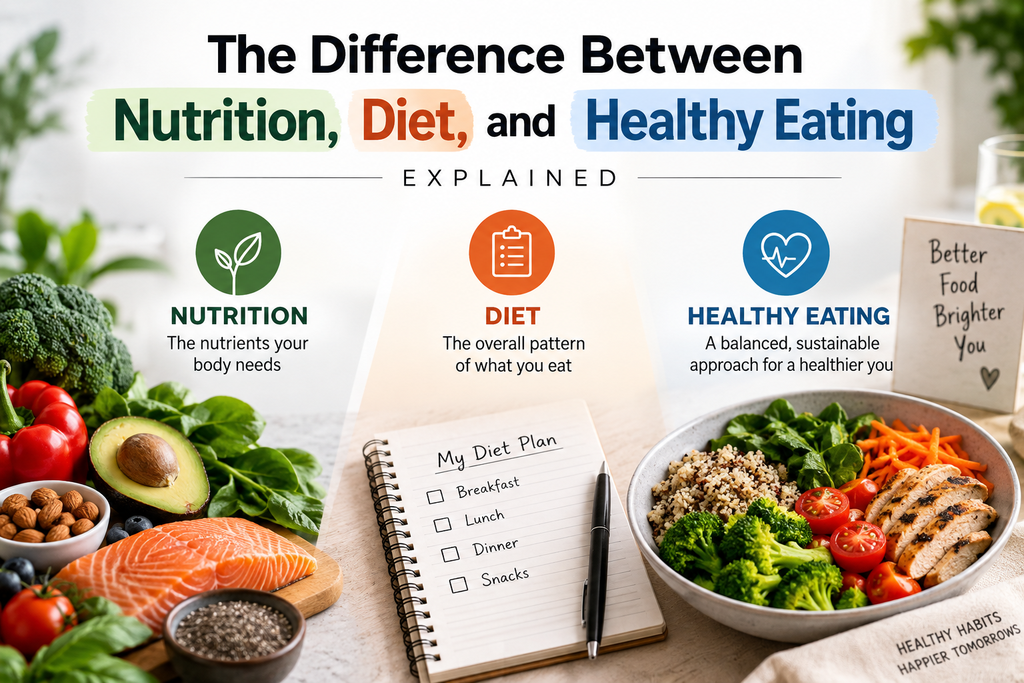
When people talk about food and health, three terms appear constantly: nutrition, diet, and healthy eating. They are often used interchangeably, but they do not mean the same thing.
Nutrition is the science and process of how the body obtains and uses nutrients. A diet is the pattern of foods and drinks a person consumes. Healthy eating is the practical behavior of choosing and consuming foods in a way that supports health, nutrient adequacy, and long-term well-being.
The distinction matters because you can have a diet without having a healthy diet, and you can follow a particular diet without necessarily understanding the nutrition behind it.
For example, someone might say, “I’m on a high-protein diet.” That describes an eating pattern. It does not automatically tell us whether that person’s diet provides enough fiber, vitamins, minerals, healthy fats, or other nutrients. Nutrition helps us understand what the food provides and what the body needs. Healthy eating connects that knowledge to everyday food choices.
The simplest way to remember the difference is:
Nutrition is the science. Diet is the pattern. Healthy eating is the practice.
Let’s break down what each term means, how they overlap, and how to use the distinction to make better food choices.
Nutrition, Diet, and Healthy Eating: The Difference at a Glance
| Term | What it means | Main focus | Example |
|---|---|---|---|
| Nutrition | The study and use of nutrients by the body | What the body needs and how it uses food | Protein supports tissue maintenance; carbohydrates provide energy |
| Diet | The foods and beverages someone regularly consumes | What and how someone eats | Vegetarian diet, Mediterranean diet, high-protein diet |
| Healthy eating | Eating practices that support adequate nutrition and health | Making balanced, sustainable food choices | Eating a variety of vegetables, fruits, whole grains, legumes and appropriate protein sources |
These concepts are connected, but they operate at different levels.
Nutrition helps explain why certain foods and nutrients matter.
Diet describes what someone actually eats.
Healthy eating describes how food choices can be organized to support health.
What Is Nutrition?
Nutrition is the process by which the body obtains, absorbs, and uses nutrients from food and beverages, as well as the scientific field that studies those processes.
The National Institute of Environmental Health Sciences describes nutrition as the process of consuming, absorbing, and using nutrients needed for growth, development, and maintenance of life.
Nutrients are substances the body needs to function. They include macronutrients such as carbohydrates, protein, and fat, along with micronutrients such as vitamins and minerals. Water is also essential for normal physiological function.
Macronutrients
Macronutrients are nutrients required in relatively large amounts.
Protein provides amino acids that the body uses to build and maintain tissues and to perform numerous physiological functions.
Carbohydrates provide a major source of energy. They are found in foods such as grains, fruits, vegetables, legumes, and dairy products.
Fats provide energy and play important structural and physiological roles. Dietary fats also help the body absorb fat-soluble vitamins.
Micronutrients
Micronutrients are vitamins and minerals required in smaller quantities, but their importance should not be confused with their quantity.
Iron, calcium, vitamin B12, folate, vitamin D, iodine, zinc, and many other micronutrients contribute to processes ranging from oxygen transport and bone health to immune function and cellular metabolism.
The important point is that nutrition isn’t simply about calories.
Two foods can contain similar amounts of calories while providing very different amounts and combinations of nutrients. That is one reason nutrition science looks beyond the number on a calorie label.
What Is a Diet?
The word diet is often associated with weight loss, but its broader meaning is much simpler.
A diet is the food and drink a person consumes over time. The term can also refer to a particular nutritional plan or eating pattern.
In other words, everyone has a diet.
You have a diet whether you consciously follow one or not.
Someone who eats rice, dal, vegetables, roti, fruit, dairy and occasional sweets has a diet. Someone who eats mostly packaged foods has a diet. Someone following a vegetarian or vegan eating pattern has a diet. Someone following a ketogenic eating pattern has a diet.
The word itself does not mean “healthy.” That distinction is easy to miss.
A diet can be healthy or unhealthy
Consider two hypothetical diets.
Diet A:
- Whole grains
- Lentils and beans
- Vegetables
- Fruit
- Nuts and seeds
- Appropriate protein sources
- Mostly minimally processed foods
- Limited highly processed foods
Diet B:
- Sugary drinks
- Refined snacks
- Processed meats
- Fried foods
- Very little fruit or vegetables
- High intake of added sugars and sodium
Both are diets. The difference is their nutritional quality and likely health implications.
This is why saying “I’m on a diet” doesn’t tell you very much by itself.
The more useful questions are:
- What foods does the diet contain?
- Does it provide enough nutrients?
- Is the overall pattern balanced?
- Can the person sustain it?
- Does it fit their health needs and circumstances?
What Is Healthy Eating?
Healthy eating is a pattern of food choices that provides adequate nutrition while supporting health and reducing the risk of diet-related disease.
There is no single menu that qualifies as healthy for every person.
The exact composition of a healthy diet varies according to factors including age, lifestyle, physical activity, cultural context, locally available foods, and dietary customs. Common principles include adequacy, balance, moderation, diversity, and food safety.
Healthy eating is not synonymous with eating “clean.” It is not necessarily low-carb, low-fat, vegetarian, vegan, high-protein, organic, gluten-free, or calorie-restricted.
A healthy eating pattern can look quite different from one person to another.
For someone in India, for example, a balanced pattern might include dal, rice, roti, vegetables, fruit, curd, nuts, seeds, eggs or other protein sources. The same nutritional principles can be applied using foods that are culturally familiar and locally available.
Nutrition vs. Diet vs. Healthy Eating
The three concepts become easier to understand when viewed as a sequence.
1. Nutrition tells you what the body needs
Nutrition asks what nutrients the body requires, how protein contributes to physiological function, what happens when someone consumes too little iron, how dietary fiber relates to health, how much energy a person requires, and how the body metabolizes carbohydrates and fats.
This is primarily the science behind food and health.
2. Diet describes what you consume
Diet asks what foods you eat, how frequently you eat them, what your overall eating pattern is, and which foods you regularly include or avoid.
This describes your actual food intake or eating pattern.
3. Healthy eating turns knowledge into behavior
Healthy eating asks how to build meals that provide adequate nutrients, eat more vegetables and whole foods, moderate foods high in sodium, added sugars, or unhealthy fats, and create an eating pattern that can be maintained.
This is the practical application.
A useful mental model is:
Nutrition → understanding
Diet → behavior/pattern
Healthy eating → applying that understanding to build a supportive pattern
Why Calories Alone Don’t Define Good Nutrition
Calories matter. Energy balance influences body weight, and energy needs vary between people. But calories do not tell the whole story.
Consider two foods that provide approximately the same energy. One might also provide protein, fiber, vitamins, minerals, and beneficial fatty acids. The other might provide substantially less nutritional value.
This is why the concept of nutrient density is useful. Nutrient-dense foods provide meaningful amounts of nutrients relative to the energy they contain.
Vegetables, fruits, legumes, whole grains, nuts, seeds, eggs, dairy products, fish, and other minimally processed foods can contribute different combinations of nutrients.
This does not mean every highly processed food is automatically “bad,” or that every minimally processed food is automatically ideal. Nutrition depends on the overall dietary pattern, quantity, frequency, individual needs, and the nutritional characteristics of the food.
The larger point is that healthy eating cannot be reduced to counting calories alone.
What Does a Healthy Diet Actually Look Like?
Healthy diets should provide adequate nutrients, support health and development, and help prevent both nutrient deficiencies and excessive intake. In practical terms, a healthy dietary pattern generally emphasizes:
- A variety of vegetables and fruits
- Legumes such as beans and lentils
- Whole grains and other nutrient-rich staples
- Appropriate sources of protein
- Nuts and seeds
- Unsaturated fats in place of excessive saturated and trans fats
- Adequate dietary fiber
- Limited free or added sugars
- Moderate sodium intake
- Safe food preparation and storage
- Variety across food groups
The exact proportions do not need to be identical for everyone. A visual plate model can be useful as a general framework rather than a rigid meal plan.
Does Healthy Eating Mean Never Eating Junk Food?
No.
One of the least useful ways to think about healthy eating is as a system of “perfect” and “bad” foods.
A person’s overall dietary pattern matters more than whether they occasionally eat pizza, dessert, fried food, or another highly processed food. That said, the amount and frequency of highly processed foods can matter.
The evidence around ultra-processed foods includes important associations with adverse health outcomes, but much of the underlying research is observational and the certainty varies by outcome. The evidence does not justify saying that every ultra-processed food is inherently harmful or that eating one occasionally causes disease.
Healthy eating is therefore better understood as a pattern of priorities rather than a list of forbidden foods.
Is a “Diet” the Same as a Meal Plan?
Not necessarily.
A meal plan is a specific schedule or arrangement of foods someone intends to eat. A diet is broader.
For example, “vegetarian diet” describes an eating pattern. A seven-day meal plan could specify exactly what that vegetarian person eats for breakfast, lunch, dinner, and snacks.
You can follow the same diet while eating completely different meals. This distinction is particularly useful in fitness and weight management.
Can a Specific Diet Be Healthy?
Yes, but the label alone doesn’t establish that.
Common dietary patterns include Mediterranean-style eating, vegetarian diets, vegan diets, DASH-style dietary patterns, higher-protein diets, and lower-carbohydrate diets.
The healthfulness of a dietary pattern depends on what actually replaces what. Reducing one food category does not automatically improve nutrition if it is replaced with foods that are low in nutritional quality.
Research on dietary patterns reinforces an important principle: overall diet quality matters.
Healthy Eating Is About the Pattern, Not One Food
This is perhaps the most useful concept to take away from the entire discussion.
Eating one apple does not make a diet healthy. Eating one burger does not make a diet unhealthy. Drinking one protein shake does not automatically make someone well-nourished. Likewise, removing sugar completely does not automatically create a nutritionally adequate diet.
Nutrition works across the entire pattern.
Healthy eating asks you to zoom out and consider the full picture of what you eat over time.
A Simple Framework for Building a Healthier Diet
Instead of trying to memorize hundreds of nutrition rules, start with five questions.
1. Is my diet varied?
Different foods provide different combinations of nutrients. Variety makes it easier to obtain a broad range of nutrients and prevents your diet from becoming unnecessarily narrow.
2. Am I getting enough protein and other essential nutrients?
Your nutritional needs depend on factors such as age, body size, activity, physiological state, and health status. Someone who exercises regularly may have different protein and energy requirements from someone who is sedentary.
3. Am I eating enough plant foods and fiber?
Vegetables, fruits, legumes, and whole grains can provide fiber and a wide range of micronutrients and other bioactive compounds.
4. How much of my diet comes from highly processed foods?
You do not need to eliminate every packaged food. Instead, look at the overall pattern and the role highly processed foods play in it.
5. Can I maintain this way of eating?
A theoretically excellent diet that someone cannot follow for more than two weeks may be less useful than a good dietary pattern they can maintain for years. A healthy diet has to work in the real world.
Common Misconceptions About Nutrition and Diet
“Diet means weight loss.”
Not necessarily. Diet simply refers to the foods and beverages someone consumes over time. Weight-loss diets are only one type of diet.
“Healthy eating means eating only clean foods.”
There is no universally agreed scientific category of “clean food.” Healthy eating is better evaluated through dietary adequacy, balance, diversity, moderation, safety, and overall dietary quality.
“If a food is natural, it must be healthy.”
Not automatically. Naturalness does not provide a complete nutritional assessment. Portion size, nutrient composition, preparation, and the rest of the diet still matter.
“Processed food is always unhealthy.”
Processing exists on a spectrum. Frozen vegetables, pasteurized milk, canned beans, whole-grain bread, and many other foods undergo processing while remaining useful parts of healthy diets.
“A diet needs to be perfect to be healthy.”
It doesn’t. Healthy eating is about the overall pattern. Consistency generally matters more than occasional perfection.
Nutrition, Diet, and Healthy Eating Work Together
The three concepts describe different parts of the same system.
Nutrition explains the relationship between food, nutrients, and the body.
Diet describes what a person eats over time.
Healthy eating applies nutritional knowledge to create a dietary pattern that supports health.
You need nutrition science to understand what food does. You need to understand diet to recognize the pattern of what you actually consume. And you need practical healthy-eating habits to translate that knowledge into everyday decisions.
The goal is not to find the most restrictive diet. It is to build a dietary pattern that provides the nutrients your body needs, fits your circumstances, and supports health over the long term.
Frequently Asked Questions
What is the main difference between nutrition and diet?
Nutrition refers to the science and physiological process involving food, nutrients, absorption, metabolism, and the body’s requirements. Diet refers to the foods and beverages a person consumes over time.
What is the difference between diet and healthy eating?
A diet is simply an eating pattern and is not automatically healthy. Healthy eating describes a dietary pattern designed to provide adequate nutrition and support health.
Is healthy eating the same for everyone?
No. Nutritional needs vary according to factors such as age, body size, physical activity, health status, culture, food availability, and individual circumstances.
Does healthy eating mean avoiding all processed foods?
No. Processing is not automatically synonymous with poor nutrition. Some processed foods can be nutritious and convenient.
Can a vegetarian or vegan diet be healthy?
Yes. A vegetarian or vegan dietary pattern can support health when it is appropriately planned to provide sufficient energy, protein, vitamins, minerals, and other nutrients.
Is calorie counting necessary for healthy eating?
Not necessarily. Calories are relevant to energy balance, but healthy eating involves more than calorie intake.
What is the easiest way to start eating healthier?
Start by improving the overall pattern rather than changing everything at once. Increase the variety of vegetables, fruits, legumes, whole grains, nuts, seeds, and appropriate protein sources, and choose changes that you can realistically maintain.
What is the simplest way to remember the difference?
Nutrition = what the body needs and how it uses food.
Diet = what you regularly eat and drink.
Healthy eating = how you organize your food choices to support health.
Final Takeaway
Nutrition, diet, and healthy eating are closely related, but they are not interchangeable.
Nutrition is the science and biological process. Diet is your overall pattern of food and beverage intake. Healthy eating is the practical approach of building a nutritionally adequate, balanced, varied, moderate, and sustainable diet.
You do not need a perfect diet or a fashionable eating plan. A more useful starting point is to ask whether your overall diet gives your body enough of what it needs, includes a wide variety of nutrient-rich foods, limits excessive amounts of less nutritious foods, and fits the way you actually live.
That is where nutrition knowledge becomes healthy eating.