
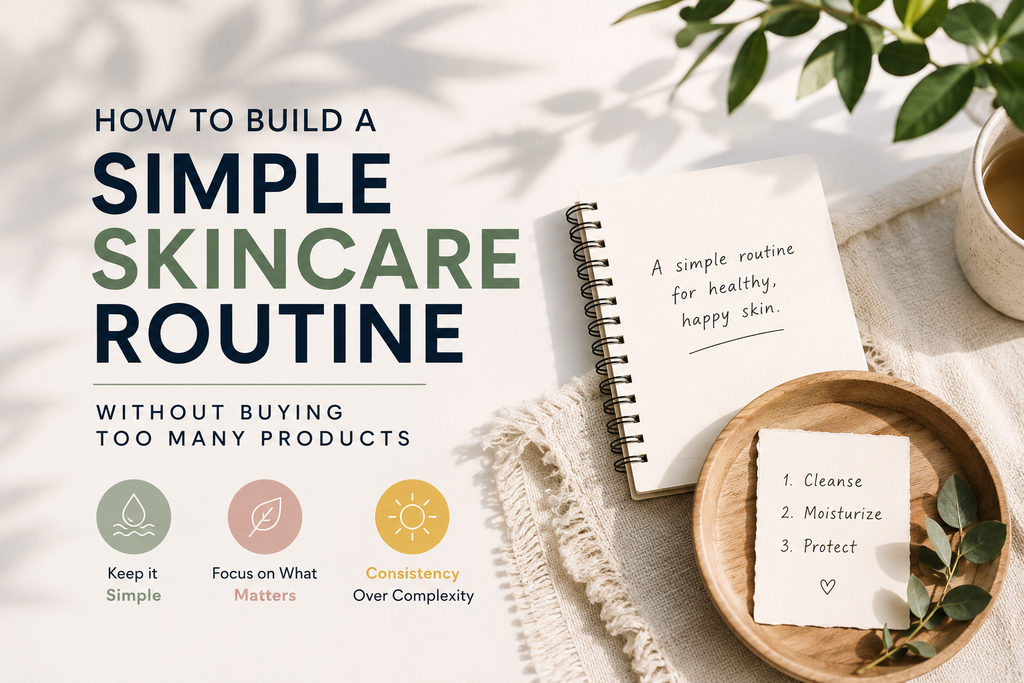
A good skincare routine does not need a bathroom shelf full of bottles.
For most people, a practical routine can be built around three things: cleansing, moisturizing, and protecting the skin from the sun. After those basics are established, you can add one targeted treatment if you have a specific concern such as acne, dark spots, or signs of photoaging.
The challenge is that skincare marketing often makes the process feel much more complicated. Cleansers, toners, essences, serums, exfoliants, masks, eye creams, face oils and multiple moisturizers can make it seem as though healthy skin requires a dozen separate steps.
It doesn’t.
A simpler approach is often easier to follow, less expensive, and less likely to overwhelm your skin with unnecessary products. Dermatologists at the American Academy of Dermatology recommend a basic approach built around cleansing, moisturizing and sun protection, with additional products chosen according to individual skin concerns.
The goal of a simple skincare routine isn’t to own fewer products for the sake of minimalism. It is to make sure that every product you use has a clear job.
What Is a Simple Skincare Routine?
A simple skincare routine is a small number of products selected to perform the essential functions your skin needs, with additional treatments added only when there is a specific reason to use them.
For most adults, that means:
Morning
- Gentle cleanser, if needed
- Moisturizer, if needed
- Broad-spectrum sunscreen SPF 30 or higher
Evening
- Gentle cleanser
- Moisturizer
That is enough to establish a strong foundation.
You do not automatically need a toner, essence, facial mist, exfoliating scrub, eye cream, face mask, multiple serums or a separate product for every part of your face.
This doesn’t mean those products are useless. Some can be helpful for specific concerns. The point is that they are optional additions rather than requirements.
Why Buying More Skincare Products Isn’t Necessarily Better
Skincare is an unusual category because more products can sometimes make it harder to determine what is actually helping.
Suppose you start using a cleanser, vitamin C serum, niacinamide serum, exfoliating acid, retinoid and a new moisturizer at the same time. Your skin improves.
Which product helped?
You won’t know.
The opposite can happen too. If your skin becomes dry, red or irritated, you have several possible suspects.
A minimalist routine therefore has an important advantage: it creates clarity.
You can introduce one meaningful change at a time, observe how your skin responds, and keep only what earns its place in your routine.
The Three Products That Form the Core of a Simple Routine
If you want to dramatically simplify your skincare shopping, start with these three categories.
1. A Gentle Cleanser
The job of a cleanser is straightforward: remove dirt, excess oil, sweat, sunscreen and other substances from the skin without unnecessarily disrupting it.
You don’t need a cleanser that leaves your face feeling extremely tight or “squeaky clean.” That sensation isn’t proof that the product is working better.
The American Academy of Dermatology recommends a gentle, non-abrasive cleanser without alcohol. It also recommends using lukewarm rather than hot water, applying cleanser with your fingertips and avoiding aggressive scrubbing.
How often should you cleanse?
For many people, cleansing once in the evening is sufficient. Others may prefer cleansing in the morning as well, particularly if they wake up oily or have used an overnight treatment.
The AAD generally recommends limiting face washing to twice a day and after sweating.
If your skin becomes tight, uncomfortable or unusually dry after cleansing, your cleanser may be too harsh or you may simply be cleansing more than necessary.
What should you look for?
You don’t need an impressive ingredient list.
Look for a cleanser that:
- Cleans without leaving your skin uncomfortable
- Is appropriate for your skin type
- Doesn’t cause persistent irritation
- Is easy enough to use consistently
If you have acne-prone skin, a non-comedogenic product may be useful. If you have sensitive or dry skin, a gentle, fragrance-free option may be more comfortable.
2. A Moisturizer
Moisturizer isn’t just something for people with visibly dry skin.
The skin barrier helps regulate water loss and protects the body from external environmental factors. Moisturizers can support this barrier through different mechanisms involving humectants, emollients and occlusive ingredients.
A 2023 review of skin-barrier function and moisturization explains that moisturizers can influence several components of the skin barrier and reduce transepidermal water loss.
In practical terms, a good moisturizer can make skin feel more comfortable, reduce dryness and help support the barrier, particularly when your skin is exposed to drying conditions or potentially irritating treatments.
Do oily skin types need moisturizer?
Often, yes.
Oily skin and dehydrated skin aren’t the same thing. Someone can produce plenty of sebum while still experiencing dryness or irritation.
If you have oily or acne-prone skin, look for a lightweight moisturizer labeled oil-free or non-comedogenic. The AAD specifically recommends these types of descriptions for people concerned about breakouts.
What ingredients are worth looking for?
You don’t need to memorize dozens of ingredients, but several categories are useful:
- Humectants, such as glycerin, help attract and retain water.
- Emollients help soften and smooth the skin.
- Occlusives help reduce water loss.
- Ceramides can support the lipid structures involved in the skin barrier.
Research on ceramide-containing moisturizers is promising, particularly for dry and barrier-impaired skin, although ceramides aren’t automatically superior to every other moisturizer.
For example, a 2021 review of clinical evidence on ceramide-containing preparations found evidence that these products can improve dry skin and barrier function in patients with atopic dermatitis, while also noting the need for larger, well-designed studies.
The takeaway is simple: choose a moisturizer your skin tolerates and that you will actually use. You don’t need to buy the most expensive formulation.
3. Sunscreen
If there is one skincare product that deserves a permanent place in most daytime routines, it’s sunscreen.
Broad-spectrum protection matters because it covers both UVA and UVB radiation.
UV exposure is relevant not only to sunburn and skin cancer but also to photoaging and pigmentation.
One particularly useful piece of evidence comes from a randomized trial published in Annals of Internal Medicine. The study followed adults for 4.5 years and found that the group assigned to daily sunscreen use showed 24% less skin aging than the group using sunscreen at their discretion.
That’s an important distinction: sunscreen isn’t merely an “anti-aging product.” It is fundamentally a preventive product.
How much sunscreen do you need?
The AAD recommends applying sunscreen to exposed skin and reapplying approximately every two hours when outdoors, or after swimming or sweating.
You also don’t have to rely on sunscreen alone. Shade, clothing, hats and sunglasses can all contribute to sun protection.
What about darker skin tones?
Sun protection matters across skin tones.
Visible light can contribute to hyperpigmentation, particularly in people with darker skin. The AAD notes that tinted sunscreens containing iron oxide may provide additional protection against visible-light-induced darkening.
So if pigmentation is a major concern, a tinted sunscreen may be worth considering.
Your Basic Morning and Night Routine
Once you understand the role of each product, the routine becomes remarkably simple.
Morning
Step 1: Cleanse if necessary
Use a gentle cleanser if your skin benefits from morning cleansing.
If your skin is dry or sensitive and doesn’t feel dirty or oily when you wake up, you may not need an elaborate cleansing step.
Step 2: Moisturize
Apply moisturizer if your skin feels dry or if your sunscreen doesn’t provide enough hydration.
You don’t necessarily need a separate moisturizer if your sunscreen is sufficiently moisturizing and comfortable on your skin.
Step 3: Sunscreen
Apply a broad-spectrum SPF 30+ sunscreen as the final skincare step before makeup.
That’s it.
Evening
Step 1: Cleanse
Remove sunscreen, makeup, sweat, oil and accumulated debris.
Step 2: Moisturize
Apply moisturizer while the skin is still slightly damp if that works well for you.
The AAD recommends moisturizing after washing because it helps trap water in the skin.
That’s your basic routine.
When Should You Add a Serum or Treatment?
This is where many skincare routines become unnecessarily complicated.
Instead of asking, “What serum should I buy?”, ask:
What specific problem am I trying to solve?
If you don’t have a particular concern, you may not need a treatment product at all.
If you do have one, choose one primary concern and add one appropriate treatment.
If Acne Is Your Main Concern
Acne can require more than basic cleansing and moisturizing.
Depending on the type and severity of acne, evidence-based topical treatments can include ingredients such as benzoyl peroxide, salicylic acid, adapalene and other retinoids.
The important point is not to throw every acne ingredient at your skin simultaneously.
Start with an appropriate treatment, use it consistently and give your skin time to respond.
Moisturization can also matter when treating acne. Dryness and irritation can make acne treatment harder to tolerate, and a dermatology review found that moisturizers can help reduce irritation associated with acne treatment.
If you have painful, deep, widespread or persistent acne, professional evaluation is more appropriate than continually adding products.
If Dark Spots or Uneven Pigmentation Are Your Main Concern
Pigmentation is one area where people often buy too many products.
They may combine vitamin C, niacinamide, exfoliating acids, retinoids, brightening masks and spot treatments, while neglecting the product that helps prevent ongoing UV-related pigmentation: sunscreen.
A simpler approach is:
- Establish daily sun protection.
- Keep cleansing and moisturizing consistent.
- Add one targeted ingredient if needed.
- Give it enough time to evaluate the response.
For people prone to hyperpigmentation, particularly darker skin tones, consistent sun protection can be especially important because visible light can contribute to darkening.
If pigmentation is new, rapidly changing, extensive or difficult to diagnose, a dermatologist can determine whether it is actually melasma, post-inflammatory hyperpigmentation, another pigmentary condition or something else.
If Your Main Concern Is Premature Skin Aging
You don’t need a ten-step anti-aging routine.
Start with sunscreen and moisturizer.
Then, if you want a treatment with substantial evidence behind it, topical retinoids are one of the better-established options.
Tretinoin, in particular, has been studied extensively for photoaging. A systematic review of randomized controlled trials found consistent evidence that topical tretinoin can improve clinical features of photoaging, including wrinkles and mottled pigmentation.
But there is an important caveat: stronger treatments aren’t automatically better for everyone.
Retinoids can cause irritation, dryness and peeling, particularly when first introduced. Prescription tretinoin should be used according to medical advice.
If you’re building a simple routine, you don’t need to start with a retinoid. Establish the basics first.
Do You Need a Toner?
Usually, no.
Toners can contain useful ingredients, but the category itself isn’t an essential step.
If a toner provides hydration or contains a treatment ingredient that you specifically want to use, it can have a purpose.
But if you’re buying toner simply because you’ve been told a skincare routine is incomplete without it, you can probably skip it.
Ask what it contributes that your cleanser, moisturizer or treatment doesn’t already provide.
If the answer is “nothing specific,” don’t buy it.
Do You Need an Eye Cream?
Not necessarily.
The skin around the eyes is delicate, and some products are specifically formulated for this area. But the existence of a separate eye-cream category doesn’t mean everyone needs one.
A basic moisturizer may be sufficient for simple hydration.
If you have a specific concern around the eyes, such as persistent eczema, significant pigmentation, swelling or another condition, the appropriate solution may be medical assessment rather than a more expensive cosmetic product.
Do You Need Face Masks?
Masks can be enjoyable, but enjoyment and necessity are different things.
The AAD describes facial masks as potentially useful additions but emphasizes that they aren’t substitutes for the core routine of cleansing, moisturizing and sun protection. It also warns against combining masks with other active ingredients in ways that may increase irritation.
So use a mask because you enjoy it or have a specific reason to use one, not because you believe healthy skin requires it.
Do You Need Exfoliation?
Not automatically.
Your skin naturally sheds dead cells. Additional exfoliation can sometimes help with rough texture, clogged pores or certain pigmentation concerns, but excessive exfoliation can irritate the skin.
This is another reason a minimalist routine can work well.
If your skin is already comfortable, smooth and healthy-looking, there may be no reason to add an exfoliating acid.
If you do introduce one, don’t simultaneously introduce several other active ingredients. Give your skin a chance to show you whether the product is useful.
A Better Way to Choose Skincare Products
Instead of building your routine around product categories, build it around jobs.
| Job | Product category | Is it essential? |
| Remove dirt, oil and sunscreen | Gentle cleanser | Usually |
| Reduce dryness and support the barrier | Moisturizer | Often |
| Protect against UV | SPF 30+ broad-spectrum sunscreen | Yes for daytime protection |
| Treat acne | Targeted active | Only if needed |
| Address pigmentation | Targeted treatment | Optional |
| Address photoaging | Retinoid/other treatment | Optional |
| Add hydration or cosmetic benefits | Toner/essence | Optional |
| Occasional cosmetic treatment | Mask | Optional |
| Specialized eye-area care | Eye cream | Optional |
This framework prevents a common mistake: confusing a product category with a skincare requirement.
A toner is not necessary simply because toners exist.
A serum is not necessary simply because serums exist.
An eye cream is not necessary simply because companies sell eye creams.
Every product should answer a question:
What specific job is this product doing for my skin?
How to Build a Routine for Different Skin Types
Your basic routine can stay the same while the texture and formulation of your products change.
Dry Skin
Prioritize gentle cleansing and a richer moisturizer.
Look for products that contain ingredients such as glycerin, ceramides and other moisturizing agents.
Avoid aggressively cleansing or scrubbing the skin.
The AAD recommends applying moisturizer after washing and emphasizes that creams and ointments can be particularly useful for dry skin.
Oily Skin
You still need moisturizer.
Choose lighter textures and look for “oil-free” or “non-comedogenic” labeling when appropriate.
Your sunscreen can also be a lightweight gel or fluid if that makes daily use easier.
Combination Skin
You don’t necessarily need separate products for every section of your face.
Start with one gentle cleanser, one moisturizer and one sunscreen.
If some areas are significantly oilier or drier, adjust how much moisturizer you use rather than immediately buying another product.
Sensitive Skin
Keep things boring.
That is often a compliment.
Choose gentle, fragrance-free products where possible and introduce new products slowly.
Avoid stacking multiple active ingredients when your skin is already irritated.
If products repeatedly cause burning, swelling, significant redness or persistent irritation, stop experimenting and seek professional advice.
The “One New Product at a Time” Rule
One of the easiest ways to simplify skincare is to stop changing everything simultaneously.
When introducing a new product:
- Keep the rest of your routine stable.
- Introduce the new product gradually when appropriate.
- Monitor your skin’s response.
- Don’t immediately add another active.
- Decide whether the product is actually providing a meaningful benefit.
This approach has a practical advantage that isn’t discussed enough: you learn your own skin.
Over time, you can determine which products make a visible difference and which ones simply occupy space on your shelf.
How to Avoid Wasting Money on Skincare
A minimalist routine doesn’t mean buying the cheapest product available.
It means spending money where it matters.
Spend more attention on formulation than packaging
A beautiful bottle doesn’t improve your skin.
Look at:
- Active ingredients when you’re buying a treatment
- SPF and broad-spectrum protection for sunscreen
- Skin compatibility
- Texture
- Fragrance
- Whether the product irritates you
- Whether you’ll actually use it consistently
Don’t buy products because they are trending
TikTok, Instagram and beauty content can introduce useful products, but popularity isn’t evidence that your skin needs something.
A product can be excellent and still be unnecessary for you.
Don’t confuse expensive with effective
A simple moisturizer that keeps your skin comfortable may be more valuable to you than a luxury cream containing dozens of ingredients.
Use multipurpose products when appropriate
The AAD specifically suggests considering dual-function products, such as a moisturizer with sunscreen, as one way to simplify skincare and reduce cost.
However, make sure a combination product still provides the level of protection and comfort you need.
A Simple 3-Product Shopping List
If you are starting from scratch and want to keep your spending under control, your initial shopping list can be surprisingly short.
Product 1: Gentle cleanser
Choose something appropriate for your skin type that doesn’t leave your face excessively dry or irritated.
Product 2: Moisturizer
Choose a formulation that makes your skin comfortable without causing problems such as excessive greasiness or breakouts.
Product 3: Sunscreen
Choose broad-spectrum SPF 30 or higher, preferably water resistant, and select a texture you’ll actually use consistently.
Then stop shopping.
Use those products for a while before deciding whether you need anything else.
If you later identify a specific problem, add one targeted product for that problem.
That is a much more rational approach than buying ten products on day one.
The Minimalist Skincare Routine in One Minute
If you want the shortest possible version:
Morning:
Moisturizer if needed → sunscreen
Night:
Cleanser → moisturizer
For a specific concern:
Add one targeted treatment.
That’s the framework.
Everything else is optional.
The routine can become more sophisticated as your needs change, but sophistication should come from solving a real problem, not from accumulating more bottles.
Common Mistakes That Make Skincare More Complicated
Changing products too frequently
If you switch products every few days, you never establish a baseline.
Using several active ingredients at once
This can make irritation more likely and makes it difficult to identify the cause when your skin reacts.
Scrubbing aggressively
Physical scrubbing isn’t necessary for healthy skin and can irritate it. Dermatologists recommend gentle cleansing rather than aggressive scrubbing.
Skipping sunscreen because you use other anti-aging products
Retinoids and other treatments don’t replace sun protection.
Assuming oily skin doesn’t need moisturizer
Oil production doesn’t eliminate the need to support the skin barrier.
Buying a product before identifying the problem
This is perhaps the biggest mistake.
Instead of:
“I need a serum.”
Start with:
“I have persistent dark spots. What evidence-based options address them?”
The second question leads to a much better buying decision.
When a Simple Routine Isn’t Enough
A basic skincare routine is appropriate for everyday maintenance, but it isn’t a substitute for diagnosing or treating every skin condition.
Consider seeing a dermatologist if you have:
- Persistent or severe acne
- Painful cysts or nodules
- A rash that doesn’t resolve
- Significant or recurring irritation
- Persistent redness
- Rapidly changing pigmentation
- A new or changing mole or skin growth
- Symptoms that don’t improve despite a sensible routine
The goal of minimalist skincare isn’t to avoid professional care. It is to avoid unnecessary cosmetic complexity when your skin doesn’t require it.
Frequently Asked Questions
How many products do you really need for a skincare routine?
For a basic routine, three product categories are usually enough: a gentle cleanser, moisturizer and broad-spectrum SPF 30+ sunscreen. Some people can simplify further by using a moisturizing sunscreen during the day.
Additional products should address specific concerns rather than fill predetermined steps.
Is a 10-step skincare routine better than a simple routine?
No. More steps don’t automatically mean better results.
A routine should contain products that serve useful purposes for your skin. Adding unnecessary products can increase cost and, in some circumstances, irritation.
What is the most important skincare product?
For daytime skin protection, sunscreen is one of the most important products. Consistent sunscreen use has evidence supporting its role in reducing UV-related skin damage and slowing photoaging. A randomized trial found 24% less skin aging in participants assigned to daily sunscreen use compared with discretionary use over 4.5 years.
Do I need a serum?
No.
A serum can be useful when it delivers a specific active ingredient for a specific concern, but it isn’t an essential skincare category by itself.
Can I use only moisturizer and sunscreen?
For some people, yes, particularly if they don’t need a treatment and their sunscreen removes the need for a separate morning moisturizer.
You still need to cleanse appropriately, particularly at night and after significant sweating.
Do I need different skincare products for morning and night?
Not necessarily.
The main difference is that sunscreen belongs in your daytime routine. Your evening routine can focus on cleansing and moisturizing, with an optional treatment if needed.
How long should I wait before adding another product?
There isn’t one universal waiting period for every product. The important principle is to avoid changing several variables simultaneously.
Give yourself enough time to understand how your skin responds before introducing another new active product.
Can a simple routine improve my skin?
Yes, depending on what you’re trying to achieve.
A basic routine can support cleansing, hydration, barrier function and sun protection. However, conditions such as moderate-to-severe acne, significant pigmentation or inflammatory skin disease may require targeted medical treatment.
The Best Skincare Routine Is the One You Can Actually Maintain
Skincare doesn’t have to become a hobby unless you want it to be one.
For most people, the better starting point is surprisingly ordinary: clean your skin gently, moisturize when needed, protect it from the sun, and add targeted treatments only when you have a specific reason to do so.
That approach has another benefit beyond saving money. It gives you a clearer understanding of what your skin actually needs.
Start with three products.
Use them consistently.
Then ask what, if anything, is missing.
If you eventually discover that you need a treatment for acne, pigmentation, photoaging or another concern, add it deliberately. Don’t build a 12-step routine simply because the skincare industry has created 12 categories of products.
A simple routine isn’t about doing less for your skin.
It’s about doing what matters, consistently, without buying things you don’t need.