
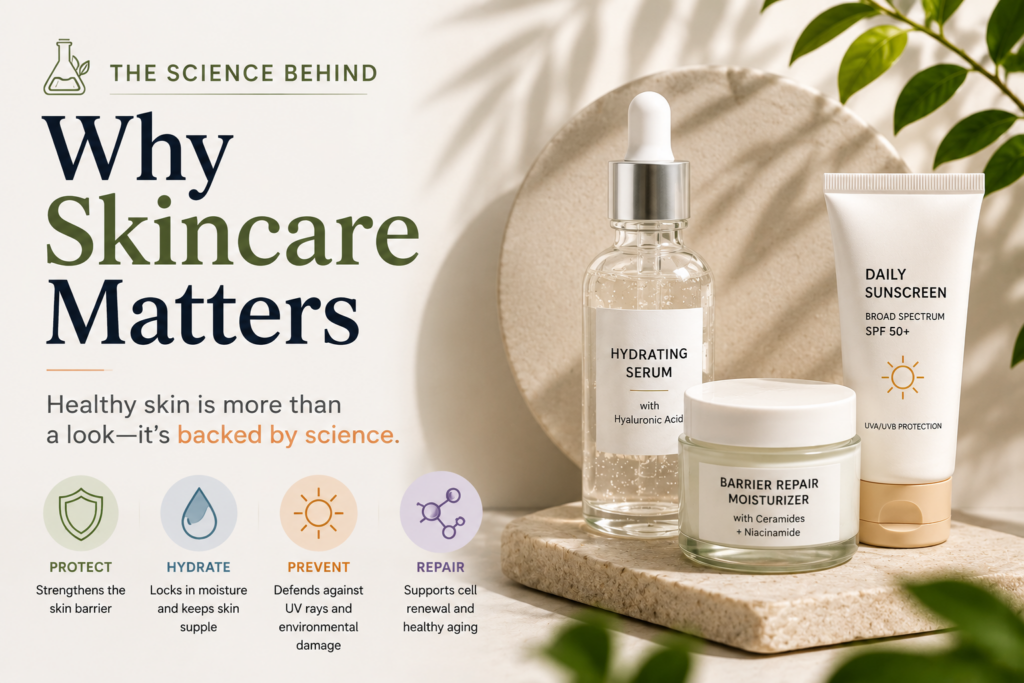
Healthy, glowing skin is not simply about appearance. Skincare matters because your skin is a living protective barrier that helps regulate water loss, protect against environmental stressors, and defend the body from external irritants and microorganisms.
A good skincare routine supports these functions by helping maintain the skin barrier, keeping the skin hydrated, limiting unnecessary irritation, and protecting against ultraviolet (UV) radiation.
The good news is that effective skincare does not have to be complicated. For most people, a simple routine built around gentle cleansing, moisturizing, and sun protection provides a strong foundation for healthy skin. The American Academy of Dermatology (AAD) similarly recommends focusing on a few appropriate products and using them consistently rather than following an unnecessarily complicated routine.
What Does “Healthy Skin” Actually Mean?
Healthy skin does not necessarily mean perfectly smooth, poreless, or completely blemish-free skin.
Healthy skin generally has an intact protective barrier, adequate hydration, relatively normal shedding of skin cells, and the ability to respond appropriately to environmental stress.
Healthy skin can still have:
- Visible pores
- Fine lines
- Moles and freckles
- Occasional pimples
- Uneven pigmentation
- Texture
- Natural variation in color
The goal of skincare should therefore be healthy and resilient skin, rather than trying to achieve an unrealistic “perfect skin” appearance.
Why Does Skincare Matter?
Skincare matters because everyday exposure to sunlight, pollution, weather, cleansing products, friction, and other environmental factors can affect the skin.
A well-designed skincare routine can help:
- Maintain the skin’s protective barrier
- Reduce excessive water loss
- Keep skin hydrated
- Remove sweat, oil, dirt, and other debris
- Reduce irritation
- Protect against UV damage
- Manage specific skin concerns
- Support healthier-looking skin as you age
Skincare is therefore both preventive and supportive. It is not only something you do after a problem develops.
The Science of the Skin Barrier
One of the most important concepts in modern skincare is the skin barrier.
The outermost layer of the epidermis is called the stratum corneum. It plays a major role in preventing excessive water loss and protecting the body from external substances.
Researchers often describe the structure of the stratum corneum using a “brick-and-mortar” model. The skin cells act like the bricks, while lipids between the cells act like mortar.
These lipids include:
- Ceramides
- Cholesterol
- Free fatty acids
Together, they help create a barrier that controls the movement of water and other substances through the skin. Research published through the National Library of Medicine describes the stratum corneum as a critical component of the skin’s permeability barrier.
Why Is the Skin Barrier Important?
A functioning skin barrier helps keep water inside the skin while limiting the entry of unwanted external substances.
When the barrier is disrupted, the skin can lose more water. This can contribute to:
- Dryness
- Roughness
- Flaking
- Tightness
- Increased sensitivity
- Irritation
Scientists can measure one aspect of barrier function using transepidermal water loss (TEWL), which refers to the movement of water through the skin and into the surrounding environment. Increased TEWL is associated with impaired barrier function.
This explains why a skincare routine should not simply focus on adding more active ingredients. Protecting the barrier is just as important as treating individual skin concerns.
What Do Ceramides Have to Do With Healthy Skin?
Ceramides are naturally occurring lipids found in the stratum corneum.
They are important components of the skin’s barrier because they help organize the lipid structures between skin cells and support water retention.
Research reviews have found evidence that topical formulations containing ceramides can improve hydration and skin barrier function, particularly in people with dry or barrier-impaired skin.
A randomized controlled study involving adults with dry, eczema-prone skin also found that a formulation containing ceramides, triglycerides, and cholesterol improved measures of skin barrier integrity, hydration, and dryness compared with a reference emollient.
This does not mean everyone needs to buy a ceramide product. However, it explains why barrier-supporting moisturizers are commonly recommended in skincare.
How Does Moisturizer Help the Skin?
Moisturizer is more than a cosmetic product.
Moisturizers can help increase the water content of the outer layers of skin and reduce water loss. Some formulations contain ingredients that attract water, while others help reduce evaporation by forming a protective layer over the skin.
The AAD recommends moisturizing as part of basic skincare, particularly when the skin feels dry. Applying moisturizer after washing can help trap water in the skin.
Why Can Moisturized Skin Look More “Glowy”?
Hydrated skin can appear smoother and more supple because the outer layer of the skin contains more water.
Moisturization can also temporarily make fine lines less noticeable and improve the overall appearance of the skin. The AAD notes that moisturizer can help reduce the appearance of fine lines and make the complexion look brighter.
However, this is different from permanently changing the structure of the skin.
Hydration can improve the appearance of skin, but it does not make every sign of aging disappear.
Why Is Sunscreen One of the Most Important Skincare Products?
If there is one part of skincare that has especially strong scientific and preventive importance, it is sun protection.
Ultraviolet radiation from the sun can damage skin cells. Repeated UV exposure contributes to premature skin aging and increases the risk of skin cancer.
The CDC states that reducing exposure to UV radiation can lower the risk of skin cancer and recommends making sun protection an everyday habit.
The AAD recommends using a broad-spectrum, water-resistant sunscreen with SPF 30 or higher when spending time outdoors.
What Does UV Radiation Do to Skin?
UV radiation can contribute to:
- Sunburn
- Pigmentation changes
- Freckles and age spots
- Collagen breakdown
- Wrinkles
- Uneven skin tone
- DNA damage
- Skin cancer
Sunburn is particularly important because it is a visible sign of UV-related skin damage. The CDC states that sunburn increases a person’s risk of developing skin cancer.
Does Sunscreen Really Help Prevent Skin Aging?
Research suggests that regular sunscreen use can reduce photoaging.
One randomized controlled trial followed 903 adults younger than 55 and compared daily sunscreen use with discretionary sunscreen use. The study found that regular sunscreen use resulted in less skin aging over the study period.
This is an important distinction:
Sunscreen does not make your skin younger. It helps reduce one of the major external causes of premature skin aging: UV exposure.
What Causes Skin to Look Dull?
“Dull skin” is not a precise medical diagnosis. It is usually used to describe skin that appears less bright, smooth, or even than usual.
Several factors can contribute to a dull appearance.
Dehydration
When the outer layer of the skin lacks sufficient water, it can appear rough or less supple.
Moisturization can help improve the appearance of dehydrated skin.
Accumulation of Dead Skin Cells
The skin continuously sheds cells. When dead cells accumulate on the surface, skin can appear rough or uneven.
This is one reason exfoliating ingredients are used in some skincare products.
However, more exfoliation is not necessarily better.
UV Exposure
Repeated UV exposure can contribute to uneven pigmentation, rough texture, wrinkles, and other signs of photoaging.
Irritation
Overusing active ingredients, harsh cleansers, or aggressive exfoliation can irritate the skin and potentially compromise the barrier.
This is why a skincare routine should be designed around what the skin needs, rather than the number of products being used.
How Does Skincare Support Healthy Aging?
Skin naturally changes as we age.
Over time, the skin can become:
- Thinner
- Drier
- Less elastic
- More prone to wrinkles
- More susceptible to environmental damage
Some of these changes are intrinsic, meaning they are part of biological aging. Others are influenced by external factors such as UV exposure and smoking.
The AAD recommends sunscreen and moisturizer as foundational products for reducing visible signs of premature skin aging.
What About Retinoids?
Retinoids are vitamin A-derived ingredients used in dermatology for several purposes, including acne and signs of photoaging.
The AAD explains that retinoids can increase skin-cell turnover and stimulate collagen-related changes that can improve skin tone and reduce the appearance of fine lines and wrinkles.
However, retinoids can cause dryness and irritation, particularly when someone starts using them too aggressively.
They are therefore an example of why effective skincare is about appropriate use, not simply using the strongest available ingredient.
Why Is More Skincare Not Always Better?
The skincare industry often promotes increasingly complicated routines.
But adding more products does not automatically produce healthier skin.
Using multiple active ingredients simultaneously can increase the risk of irritation. The AAD specifically advises introducing anti-aging products carefully because using several products too quickly can irritate the skin.
A simple routine is often easier to maintain and easier to troubleshoot.
For most beginners, the foundation is:
Cleanse → Moisturize → Protect
Additional treatments can be added according to individual needs.
What Is the Best Basic Skincare Routine?
A basic routine can be divided into morning and evening.
Morning Routine
1. Gentle cleanser
Remove overnight sweat, oil, and other buildup without unnecessarily stripping the skin.
2. Moisturizer
Use a moisturizer appropriate for your skin type if your skin needs it.
3. Sunscreen
Finish with broad-spectrum sunscreen, ideally SPF 30 or higher, when you will be exposed to daylight outdoors.
Night Routine
1. Cleanser
Remove sunscreen, makeup, sweat, oil, and environmental debris.
2. Targeted treatment, if needed
This could include an acne treatment, retinoid, or another product selected for a specific concern.
3. Moisturizer
Support hydration and the skin barrier overnight.
How Does Lifestyle Affect Skin Health?
Skincare products are only one part of healthy skin.
Lifestyle factors can also influence skin health and appearance.
Sleep
Adequate sleep supports overall health and normal physiological processes. Poor sleep can also affect how rested and healthy the skin appears.
Smoking
Smoking accelerates skin aging. The AAD lists avoiding smoking among its recommendations for healthier-looking skin.
Sun Exposure
Repeated unprotected UV exposure is one of the most important external factors contributing to premature skin aging and skin cancer risk.
Nutrition
A balanced diet supports overall health, which in turn supports normal skin function.
However, it is important to be cautious about claims that individual foods or supplements can dramatically transform skin. Healthy skin is influenced by multiple biological and environmental factors.
Skincare and Acne: Why the Basics Still Matter
Acne is a common skin condition involving hair follicles and sebaceous glands.
A basic routine can support acne management by keeping cleansing gentle, avoiding unnecessary irritation, and maintaining hydration.
People with acne-prone skin may prefer products labeled:
- Oil-free
- Non-comedogenic
- Won’t clog pores
The AAD notes that moisturizer can be useful for people with acne, particularly because some acne treatments can dry or irritate the skin.
However, persistent, painful, severe, or scarring acne may require treatment from a dermatologist.
Can Skincare Give You “Glowing Skin”?
Yes, skincare can help skin look healthier, smoother, and more radiant, but “glowing skin” is not a medical condition or a guarantee that every product can deliver.
A healthy-looking complexion is influenced by:
- Skin hydration
- Surface texture
- Pigmentation
- UV exposure
- Inflammation
- Natural skin characteristics
- Age
- Genetics
- Lifestyle
A practical approach is to focus on improving the underlying health and condition of the skin rather than chasing an unrealistic appearance.
The 5 Most Important Science-Backed Skincare Principles
If you remember only five things from this article, remember these:
1. Protect Your Skin Barrier
Avoid unnecessarily harsh cleansing and excessive use of irritating products.
2. Keep Your Skin Hydrated
Use an appropriate moisturizer when your skin needs it. Moisturization can support hydration and improve the appearance of dryness and fine lines.
3. Protect Against UV Radiation
Use broad-spectrum sunscreen and combine it with shade, clothing, hats, and sunglasses when appropriate.
4. Treat Specific Problems With Specific Ingredients
Acne, pigmentation, wrinkles, dryness, and sensitivity do not necessarily require the same products.
Choose treatments based on the actual concern.
5. Be Consistent
A simple routine that you follow consistently is generally more practical than a complicated routine that you abandon after a few weeks.
The AAD explicitly emphasizes consistency over a 10-step routine.
Common Skincare Myths About Healthy, Glowing Skin
Myth 1: More Products Mean Better Skin
Not necessarily.
More products can mean more opportunities for irritation, especially when several active ingredients are combined.
Myth 2: Oily Skin Does Not Need Moisturizer
False.
Oily skin can still become dehydrated or irritated. Lightweight, non-comedogenic moisturizers can be appropriate for acne-prone or oily skin.
Myth 3: Sunscreen Is Only Necessary at the Beach
False.
UV exposure occurs during everyday outdoor activities. The AAD recommends sun protection whenever you are outside during the day.
Myth 4: Natural Ingredients Are Automatically Safer
Not necessarily.
“Natural” does not automatically mean non-irritating, effective, or appropriate for every skin type.
Skin can react to natural ingredients just as it can to synthetic ingredients.
Myth 5: You Should Feel Your Skincare Working
Not necessarily.
Burning, excessive stinging, peeling, or persistent redness is not proof that a product is working better.
Some active ingredients can cause temporary irritation, but persistent or severe irritation is a reason to stop and reassess the product with a healthcare professional when appropriate.
How Long Does It Take to See Skincare Results?
The timeline depends on the product and the skin concern. Some moisturizers can make skin feel softer and more hydrated almost immediately, while other changes require weeks or months.
The AAD notes that many skincare products take at least several weeks to show results, with some requiring up to three months. This is why constantly changing products can make skincare difficult to evaluate.
Give a suitable routine enough time to work unless it causes significant irritation or another adverse reaction.
When Should You See a Dermatologist?
Skincare products are useful for maintaining healthy skin, but they are not a replacement for medical diagnosis or treatment.
Consider consulting a dermatologist if you experience:
- Severe or persistent acne
- Painful acne
- Significant acne scarring
- Persistent rash
- Severe itching
- Recurrent skin irritation
- Unexplained changes in pigmentation
- A changing mole
- A new or unusual skin growth
- A sore that does not heal
- Persistent symptoms that do not improve with basic skincare
A dermatologist can determine whether the problem is cosmetic or related to an underlying skin condition.
Frequently Asked Questions (FAQs)
Why is skincare important?
Skincare is important because it helps maintain the skin barrier, hydration, cleanliness, and protection from environmental damage. Sun protection is particularly important because UV exposure contributes to premature skin aging and increases skin cancer risk.
What is the science behind skincare?
The science of skincare involves maintaining the skin barrier, regulating hydration, reducing environmental damage, and using specific ingredients to address particular skin concerns. The outer skin layer, called the stratum corneum, plays a major role in preventing water loss and protecting the body from external substances.
What makes skin look healthy and glowing?
Healthy-looking skin is influenced by hydration, an intact skin barrier, relatively even texture and pigmentation, and protection from environmental damage. Moisturizers can improve hydration and temporarily make skin appear smoother and brighter.
Is skincare actually necessary?
A complicated skincare routine is not necessary for everyone, but basic skin care can be beneficial. Gentle cleansing, appropriate moisturization, and sun protection provide a strong foundation for maintaining healthy skin.
What is the most important part of skincare?
Sun protection is one of the most important preventive aspects of skincare because UV exposure contributes to skin cancer and premature skin aging. A basic routine should also include appropriate cleansing and moisturizing.
Does moisturizer really improve skin?
Yes. Moisturizers can increase skin hydration, reduce dryness, and improve the appearance of fine lines. Some formulations also support the skin barrier.
Can skincare prevent wrinkles?
Skincare cannot stop natural aging, but it can help reduce some external factors that accelerate visible aging. In particular, sunscreen helps reduce UV-related skin damage, while moisturizers can temporarily improve the appearance of fine lines.
Does sunscreen really prevent premature aging?
Evidence supports the role of regular sunscreen use in reducing photoaging. A randomized trial involving 903 adults found that daily sunscreen use resulted in less skin aging than discretionary use.
Are expensive skincare products better?
Not necessarily. Product effectiveness depends on the formulation, ingredients, suitability for your skin, and consistent use. Dermatologists generally recommend choosing products based on your skin type and concerns rather than price alone.
Can skincare repair the skin barrier?
Appropriate skincare can support barrier recovery, particularly through gentle cleansing and moisturizing. Research has found that certain ceramide-containing formulations can improve hydration and barrier function in dry or barrier-impaired skin.
How can I get glowing skin naturally?
Focus on fundamentals rather than trying to achieve instant results: use gentle skincare, moisturize when needed, protect your skin from UV exposure, avoid smoking, maintain healthy lifestyle habits, and use targeted treatments when appropriate.
The Bottom Line: Healthy Skin Starts With the Basics
The science behind skincare is ultimately simpler than the beauty industry can make it seem.
Your skin is a biological barrier that constantly interacts with the environment. Good skincare supports that barrier, maintains hydration, limits unnecessary irritation, and protects against UV damage.
You do not need dozens of products to support healthy skin.
Start with the fundamentals:
- Cleanse gently.
- Moisturize appropriately.
- Protect your skin from the sun.
- Treat specific concerns thoughtfully.
- Stay consistent.
Healthy, glowing skin is less about finding one miracle product and more about protecting the biology of your skin over time.