
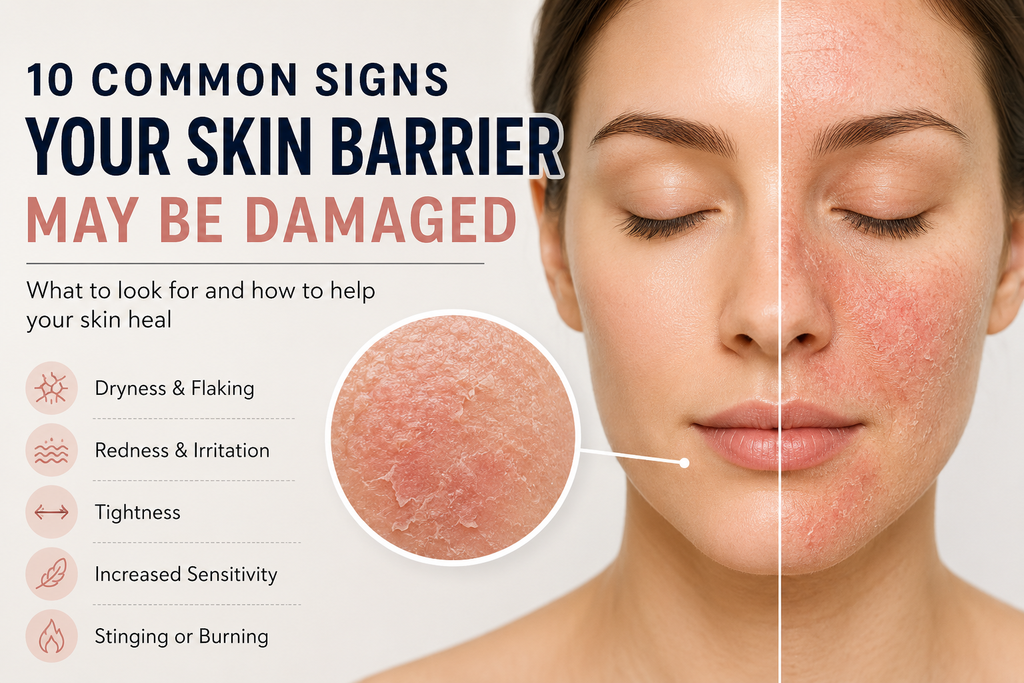
Your skin can look perfectly normal one week and suddenly become dry, tight, red, flaky, or unusually sensitive the next. A moisturizer that once felt soothing may start to sting. Your usual cleanser may leave your face feeling uncomfortably tight. Even products you’ve used for months can suddenly seem irritating.
These changes are often described as a damaged or compromised skin barrier.
The skin barrier is not simply a skincare marketing term. The outermost part of the epidermis, particularly the stratum corneum, plays a critical role in limiting water loss and protecting the body from external irritants, allergens, microorganisms, and physical stress. Its structure depends on skin cells surrounded by an organized mixture of lipids, including ceramides, cholesterol, and fatty acids.
When that barrier is disrupted, the consequences can show up as changes in both how your skin looks and how it feels.
But there is an important distinction: having dry skin, getting a few pimples, or experiencing occasional redness does not automatically mean your skin barrier is damaged. Many skin conditions can produce similar symptoms.
So what should you actually look for?
The most useful clue is usually a pattern of several changes occurring together, particularly if they appeared after introducing stronger skincare products, increasing exfoliation, washing more frequently, experiencing harsh weather, or otherwise irritating the skin.
This guide explains the common signs, why they happen, what can trigger barrier disruption, and when symptoms may indicate something that needs professional evaluation.
What Is the Skin Barrier?
The skin barrier refers primarily to the protective functions of the outermost epidermis, especially the stratum corneum.
A useful way to understand it is as a highly organized wall. The corneocytes, or flattened cells in the stratum corneum, act somewhat like bricks. Between them is a lipid matrix containing substances such as ceramides, cholesterol, and free fatty acids.
This structure helps perform two essential jobs:
- Keeping water inside the skin
- Limiting the penetration of unwanted substances from the outside
Scientific reviews describe the stratum corneum as the body’s major permeability barrier against excessive water loss. Its lipid structure is particularly important because the organized lipids restrict the outward movement of water.
The barrier also interacts with the skin’s immune defenses and microbiological environment. Changes to barrier function can therefore have consequences beyond simple dryness.
For example, research on atopic dermatitis has shown that barrier dysfunction can involve changes in ceramides, filaggrin, other structural proteins, skin pH, permeability, and immune activity.
This is why the phrase “skin barrier” describes a biological system rather than a single substance or layer that can simply be switched on or off.
The Most Common Signs of a Damaged Skin Barrier
There is no single symptom that proves your skin barrier is damaged. Instead, look for a cluster of changes.
Common signs include:
- Persistent dryness or dehydration
- Tightness, especially after cleansing
- Flaking or peeling
- Rough or uneven texture
- Increased sensitivity
- Stinging or burning when applying products
- Persistent redness or irritation
- Itching
- Cracking or fissures
- Skin that reacts to products it previously tolerated well
The American Academy of Dermatology lists dryness, flaking, roughness, itching, and cracking among the symptoms of excessively dry skin, while contact dermatitis can cause burning, stinging, tenderness, redness, and excessive dryness.
The important point is that these symptoms are not specific to barrier damage. Eczema, contact dermatitis, allergies, acne treatments, environmental exposure, and other dermatological conditions can produce overlapping symptoms.
With that distinction in mind, here are the signs worth paying attention to.
1. Your Skin Feels Tight After Cleansing
One of the earliest changes people notice is an uncomfortable feeling of tightness after washing their face.
Your skin may feel “squeaky clean,” stretched, or as though it needs moisturizer immediately.
This can happen when cleansing removes some of the substances that help maintain the skin’s surface. Hot water, frequent washing, aggressive scrubbing, and harsh cleansers can make dryness worse.
The American Academy of Dermatology recommends using lukewarm rather than hot water and a gentle cleanser for dry skin. It also recommends applying moisturizer while the skin is still damp after bathing.
A single episode of tightness does not necessarily mean your barrier is damaged. But if your skin consistently feels tight after cleansing, especially when this is a new development, it is worth examining your routine.
Ask yourself:
- Did I recently change cleansers?
- Am I washing more frequently?
- Did I start using hotter water?
- Am I scrubbing or exfoliating more often?
- Does the tightness occur even with products I previously tolerated?
The answers can help identify whether your routine is contributing to the problem.
2. Your Skin Becomes Unusually Dry or Dehydrated
Another common sign is persistent dryness.
You may notice that your skin feels rough, looks dull, or requires moisturizer much more frequently than before. Fine lines may also become more noticeable when the skin loses water.
The underlying biology makes sense. A weakened permeability barrier can allow greater transepidermal water loss, meaning more water moves from inside the skin and evaporates from the surface.
Research into skin-barrier dysfunction has consistently linked increased transepidermal water loss with impaired barrier function.
This also explains why simply applying more moisturizer is not always the complete answer.
Moisturizers can help reduce water loss and improve hydration, but if something in your routine continues to irritate the skin, the underlying problem may persist.
Dry skin and dehydrated skin are not exactly the same
Dryness generally describes a skin condition associated with insufficient lipids or oil, while dehydration refers specifically to reduced water content.
A person can have oily skin and still experience dehydration.
That distinction matters because someone may respond to dehydration by repeatedly applying lightweight hydrating products while continuing to use a harsh cleanser or excessive exfoliation that keeps disrupting the skin.
3. Your Skin Starts Flaking or Peeling
Flaking is another visible sign that the skin surface is struggling.
You may notice small flakes around the nose, cheeks, forehead, mouth, or other areas. The skin may look uneven or rough rather than smooth.
When the stratum corneum loses sufficient water and its normal organization is disturbed, the surface can become rough and scaly.
The American Academy of Dermatology notes that excessively dry skin can flake and develop a rough texture.
However, peeling should not automatically be interpreted as proof that a skincare product is “working.”
This is particularly relevant with exfoliating acids and retinoids. Peeling can represent irritation rather than successful skin renewal.
If your skin becomes increasingly dry, painful, red, or sensitive after introducing an active ingredient, continuing to increase the frequency may make the situation worse.
4. Products That Never Used to Sting Suddenly Burn
This is one of the more useful clues that your skin has become unusually reactive.
Suppose you have used the same moisturizer for months without any discomfort. Suddenly, it tingles, stings, or burns when you apply it.
Or perhaps even water feels uncomfortable on the affected area.
Burning and stinging can occur with irritated skin and conditions such as contact dermatitis. The American Academy of Dermatology specifically identifies burning, stinging, tenderness, and pain among the possible symptoms of contact dermatitis.
This does not prove barrier damage by itself. But a sudden loss of tolerance across several previously comfortable products is a meaningful signal that your skin needs a closer look.
If multiple products start causing discomfort at the same time, consider simplifying your routine rather than adding another “soothing” active.
5. Your Skin Becomes More Sensitive Than Usual
You may notice that your skin suddenly reacts to things it previously handled without difficulty.
For example:
- A familiar moisturizer starts tingling.
- Your cleanser feels harsher than usual.
- Wind makes your face uncomfortable.
- Sweating causes irritation.
- Shaving becomes more irritating.
- A previously tolerated active ingredient now causes burning.
- Temperature changes cause more redness.
This heightened reactivity makes biological sense when the protective functions of the stratum corneum are impaired.
The barrier normally helps regulate the movement of substances between the external environment and deeper skin. Barrier abnormalities can increase permeability and susceptibility to irritants and allergens.
A useful practical question is:
“Has my skin become more reactive than it normally is?”
If the answer is yes, look for other symptoms rather than treating sensitivity in isolation.
6. Redness Starts Lasting Longer
Redness can occur for many reasons, including acne, rosacea, eczema, allergies, sun exposure, irritation, and contact dermatitis.
However, persistent or newly increased redness can accompany barrier disruption because the skin becomes more vulnerable to irritation and inflammatory responses.
Research into skin-barrier dysfunction describes a relationship between increased permeability, irritant exposure, and inflammatory signaling.
You might notice that your cheeks remain red after cleansing or that your skin looks increasingly blotchy after using several active ingredients.
The pattern matters.
Temporary redness after exercise is very different from redness that repeatedly appears after skincare application and takes a long time to settle.
If redness is persistent, painful, swollen, spreading, or associated with significant itching or a rash, don’t assume that “barrier damage” is the explanation. A dermatologist may need to evaluate the underlying condition.
7. Your Skin Feels Rough Instead of Smooth
A compromised skin surface may feel rough or uneven when you run your fingers over it.
You might notice:
- Small rough patches
- Uneven texture
- Dry areas around the nose or mouth
- Increased surface flaking
- Skin that feels less flexible
The outer layer of the skin normally undergoes an organized process of cell maturation and shedding. Barrier dysfunction can affect this organization.
In conditions associated with barrier abnormalities, such as atopic dermatitis, researchers have identified changes in corneocyte organization, lipids, natural moisturizing factors, and other structural components.
This is one reason aggressively exfoliating rough skin can sometimes backfire.
If the roughness is caused or worsened by irritation, repeatedly removing surface cells does not address the underlying problem. It may add another source of stress.
8. Your Skin Starts Cracking
More severe dryness can lead to visible cracks or fissures.
These are particularly common on areas such as the hands, heels, lips, and other places exposed to repeated washing, friction, dry air, or environmental stress.
The American Academy of Dermatology explains that as excessively dry skin loses moisture and shrinks, cracks can develop and may sometimes become deep enough to bleed.
Cracked skin also deserves more attention because the physical barrier is no longer intact.
In people with eczema, for example, cracks in the skin can contribute to increased water loss and make the skin more vulnerable to irritation and infection.
If cracks are painful, bleeding repeatedly, producing fluid, developing yellow crusts, or showing other signs of infection, medical evaluation is appropriate.
9. Itching Becomes More Frequent
Itching can accompany a compromised skin barrier, particularly when dryness and inflammation are present.
The relationship between barrier dysfunction and itch is particularly well studied in atopic dermatitis. The American Academy of Dermatology describes itching as a defining symptom of atopic dermatitis and notes that scratching can create raw or damaged skin.
This creates a potentially frustrating cycle:
Barrier disruption → dryness/irritation → itching → scratching → additional skin damage → more inflammation
That is one reason constantly scratching an itchy area can make the problem progressively harder to control.
But again, itching has many possible causes. New or persistent itching without an obvious explanation should not automatically be attributed to a damaged barrier.
10. Your Skin Seems to React to Almost Everything
A particularly useful pattern is when several of the signs appear together.
For example:
Your skin feels tight after cleansing, begins flaking around the nose, becomes red after applying products, and your usual moisturizer suddenly stings.
That combination is more informative than any one symptom alone.
Recent clinical guidance and dermatology resources similarly emphasize that dryness, irritation, burning, cracking, and increased sensitivity can overlap with conditions such as contact dermatitis and eczema.
Think of it as a change in skin behavior rather than a single cosmetic defect.
Your skin is telling you that something about its current environment or routine is no longer working well.
What Commonly Damages the Skin Barrier?
Barrier disruption can happen for many reasons. Sometimes the trigger is obvious. Sometimes several small factors accumulate.
Over-cleansing
Washing too frequently or using harsh cleansing products can contribute to dryness and irritation.
Hot water
Hot water can worsen dryness by affecting the skin’s surface lipids and increasing irritation. Dermatologists generally recommend warm or lukewarm water for people with dry or sensitive skin.
Excessive exfoliation
Using multiple exfoliating acids, scrubs, or other potentially irritating products too frequently can increase irritation.
Strong active ingredients
Retinoids, exfoliating acids, acne treatments, and other active ingredients can cause irritation, particularly when introduced too quickly or combined aggressively.
Fragrance and other irritants
Fragrance can irritate sensitive skin. The American Academy of Dermatology recommends fragrance-free products for people dealing with dry or sensitive skin and distinguishes “fragrance-free” from “unscented.”
Environmental conditions
Cold, dry air, heat, wind, and low indoor humidity can increase dryness and make already-irritated skin harder to manage.
Underlying skin conditions
Barrier dysfunction is also involved in several dermatological conditions.
Atopic dermatitis is a well-established example. Research has identified abnormalities involving lipids, filaggrin, permeability, pH, and immune function in affected skin.
This is important because sometimes the barrier is not the original problem. It can be part of a larger disease process.
What Should You Do If You Think Your Skin Barrier Is Damaged?
The instinct when skin starts looking worse is often to add another product.
That may not be the best first move.
A simpler approach is often more appropriate.
1. Reduce unnecessary products
Temporarily simplify your routine if several products are causing irritation.
Instead of using multiple exfoliants, serums, masks, and treatments simultaneously, return to a basic routine that your skin already tolerates.
2. Use a gentle cleanser
Choose a mild, fragrance-free cleanser and avoid aggressive scrubbing.
The American Academy of Dermatology recommends gentle cleansing and advises against using excessively harsh products on dry skin.
3. Moisturize consistently
Moisturizers help reduce water loss and improve the feel and hydration of dry skin.
Creams and ointments are generally more effective for very dry skin than lighter lotions because they provide greater occlusion.
Ingredients such as petrolatum, glycerin, dimethicone, and other moisturizing agents can be useful depending on the formulation and your skin’s needs.
4. Consider barrier-supportive ingredients
Ceramides are particularly relevant because they are a major component of the lipid matrix in the stratum corneum.
A review of clinical research found that ceramide-containing formulations can improve hydration and, in several studies, reduce transepidermal water loss or improve measures of barrier function.
That does not mean every product containing ceramides will work equally well. Formulation, concentration, the rest of the ingredient system, and the underlying skin condition all matter.
5. Temporarily reduce irritating actives
If a particular active ingredient clearly coincides with increased burning, redness, peeling, or sensitivity, consider pausing it rather than trying to push through worsening irritation.
When symptoms settle, products can be reintroduced gradually if appropriate.
6. Protect your skin from the environment
Sun exposure, wind, cold, and very dry air can all add stress to already-irritated skin.
The American Academy of Dermatology recommends broad-spectrum sunscreen as part of everyday skin care and advises protecting dry skin from environmental factors.
How Long Does It Take for a Damaged Skin Barrier to Recover?
There is no universal recovery timeline.
It depends on what caused the disruption, how severe it is, whether the irritant has been removed, and whether an underlying skin condition is involved.
A mild episode of irritation may improve relatively quickly after the trigger is removed. More significant or recurring inflammation can take considerably longer.
This is another reason to avoid promises such as “repair your barrier in exactly seven days.” Skin biology does not work according to a universal countdown.
The more useful goal is to watch for gradual improvement:
- Less tightness
- Less stinging
- Reduced redness
- Less flaking
- Better tolerance of basic skincare
- Improved comfort after cleansing
If the trend is consistently moving in the wrong direction, the problem may not simply be a temporarily damaged barrier.
Damaged Skin Barrier vs. Other Skin Problems
One of the biggest mistakes is assuming every episode of dryness or redness is barrier damage.
Several conditions can look similar.
| Symptom | Possible explanations |
| Dry, flaky skin | Dryness, eczema, irritation, psoriasis, environmental exposure |
| Burning or stinging | Irritation, contact dermatitis, active-product reaction |
| Redness | Irritation, eczema, rosacea, allergy, sun exposure |
| Itching | Dry skin, eczema, allergy, infection, other conditions |
| Cracking | Severe dryness, eczema, irritant dermatitis |
| New breakouts | Acne, product reaction, irritation, occlusion, other causes |
For example, irritant contact dermatitis can cause burning, pain, dryness, cracking, redness, and inflammation. DermNet notes that chronic irritant contact dermatitis often begins with dryness and cracking before inflammatory changes develop.
That is why “my skin barrier is damaged” should be treated as a useful description of a possible functional problem, not as a medical diagnosis.
When Should You See a Dermatologist?
Consider professional evaluation if:
- Symptoms are severe or worsening.
- Your skin is significantly painful.
- You develop substantial swelling.
- There are blisters or widespread rash.
- Cracks repeatedly bleed.
- You notice yellow crusting, pus, or other possible signs of infection.
- Symptoms persist despite simplifying your routine.
- A new product causes a significant reaction.
- You repeatedly experience unexplained flares.
- You are unsure whether the problem is irritation, eczema, allergy, acne, rosacea, or another condition.
The American Academy of Dermatology recommends dermatological assessment when dry skin is severe or does not improve with appropriate care, and it highlights signs such as infection in people with eczema that warrant medical attention.
Frequently Asked Questions
What is the biggest sign of a damaged skin barrier?
There is no single definitive sign. A combination of new tightness, dryness, flaking, redness, stinging, and increased sensitivity is more suggestive than one symptom alone. A sudden loss of tolerance to products that previously felt comfortable can be particularly useful as a practical warning sign.
Can a damaged skin barrier cause acne?
Barrier disruption and acne can coexist, but a breakout alone does not prove that the skin barrier is damaged. Irritation, changes in products, occlusive formulations, acne itself, and other factors can contribute to breakouts. It is better to look for a broader pattern of dryness, sensitivity, irritation, and changes in product tolerance.
Can moisturizer repair a damaged skin barrier?
Moisturizers can support barrier function by increasing hydration and reducing water loss, but they are not a universal treatment for every cause of skin irritation. Ceramide-containing formulations have evidence for improving hydration and some measures of barrier function.
Should I stop all skincare products if my skin barrier is damaged?
Not necessarily. A better approach is usually to simplify the routine and remove products that appear to be irritating your skin. A gentle cleanser, suitable moisturizer, and sun protection can form a basic routine while the skin settles.
Are ceramides good for a damaged skin barrier?
Ceramides are important components of the stratum corneum’s lipid matrix, and clinical research supports the use of some ceramide-containing formulations for improving hydration and barrier-related measures. However, the effectiveness of a product depends on its overall formulation and the individual’s skin condition.
Can hot showers damage the skin barrier?
Frequent or prolonged hot showers can worsen dryness and irritation. Dermatologists generally recommend warm or lukewarm water, especially for people with dry or sensitive skin.
How can I tell whether my skin is dry or my barrier is damaged?
Dryness is one possible sign of barrier disruption, but it does not automatically mean the barrier is damaged. A stronger clue is a recent change in several symptoms together, such as persistent tightness, flaking, redness, burning, and reduced tolerance of products that previously worked well.
Is a damaged skin barrier permanent?
Usually, barrier disruption is not necessarily permanent. The skin has ongoing repair mechanisms, and removing irritants while supporting hydration can help. However, persistent symptoms may be caused by an underlying dermatological condition and should be assessed rather than repeatedly treated as simple “barrier damage.”
Final Takeaway
A compromised skin barrier rarely announces itself with one unmistakable symptom. More often, the change is gradual: your skin becomes tighter after cleansing, drier between moisturizers, rougher to the touch, more prone to flaking, redder than usual, or unexpectedly sensitive to products you’ve used comfortably for months.
The key is to look for the pattern.
The science behind the skin barrier is well established. The stratum corneum helps limit water loss and protects against external stressors, with organized lipids such as ceramides, cholesterol, and fatty acids playing important structural roles. When barrier function is disrupted, increased water loss and greater susceptibility to irritation can follow.
If your skin suddenly becomes reactive, the solution is not necessarily another active ingredient or a more complicated routine. Often, the more sensible first step is to remove unnecessary irritation, cleanse gently, moisturize consistently, and give the skin time to recover.
And if the problem is persistent, painful, severe, or accompanied by signs of infection or a significant rash, don’t assume it is simply a damaged barrier. That’s when identifying the underlying skin condition matters more than adding another product.