
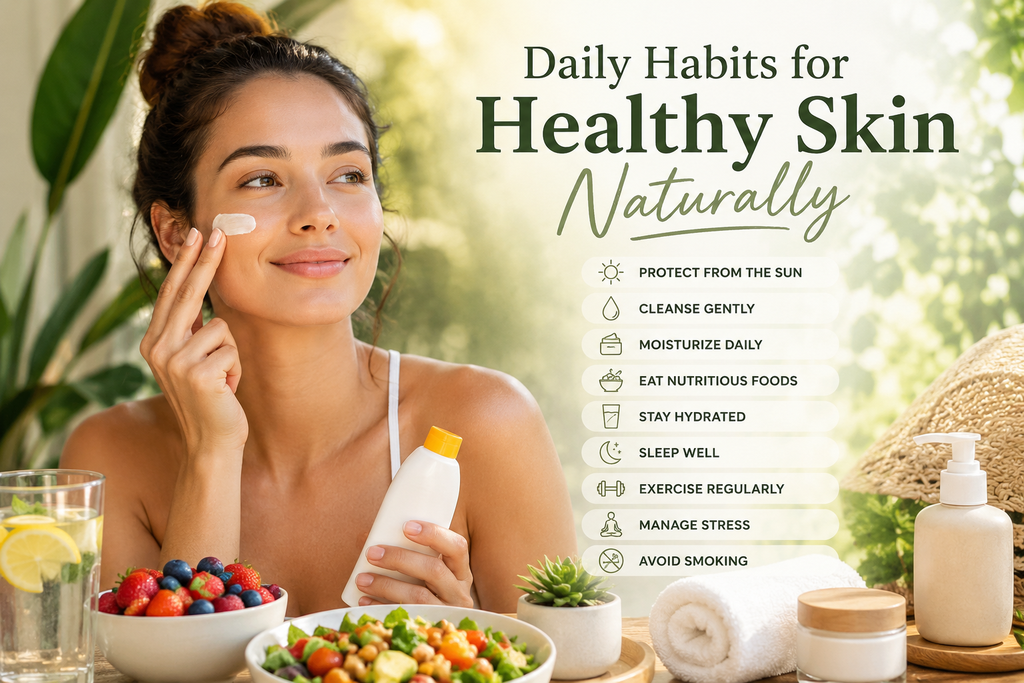
Healthy skin is rarely the result of one expensive product or an elaborate 12-step routine. More often, it reflects what you do consistently: how you protect your skin from the sun, how gently you cleanse it, whether you moisturize when needed, what you eat, how well you sleep, and which habits you avoid.
That is good news because most of these behaviors are simple. You do not need a bathroom shelf full of products to build a sensible skin-care routine.
The most useful approach is to think about skin health from two directions. First, protect the skin barrier and reduce avoidable damage from the environment. Second, support the body’s normal ability to maintain and repair skin through healthy lifestyle habits.
Dermatologists generally emphasize a few fundamentals: gentle cleansing, appropriate moisturization, daily sun protection, avoiding smoking, managing stress, and maintaining healthy lifestyle habits. The American Academy of Dermatology (AAD), for example, recommends broad-spectrum SPF 30 or higher sunscreen, gentle cleansing, avoiding excessive scrubbing, and washing after heavy sweating. American Academy of Dermatology’s skin-care basics
Here are the daily habits that matter most.
1. Protect Your Skin From the Sun Every Day
If there is one skin-care habit worth making non-negotiable, it is protecting your skin from ultraviolet (UV) radiation.
UV exposure contributes to sunburn, pigmentation changes, premature skin aging, and skin cancer. It also contributes to photoaging, the cumulative damage that causes features such as wrinkles, uneven pigmentation and loss of elasticity.
The AAD recommends using a broad-spectrum, water-resistant sunscreen with SPF 30 or higher on exposed skin when you are outdoors. It also recommends combining sunscreen with shade, protective clothing, a wide-brimmed hat and UV-protective sunglasses. AAD guidance on sunscreen and sun protection
The important point is that sunscreen should not be treated as something reserved for beach vacations.
Walking to work, driving, exercising outdoors, sitting on a terrace or spending time outside during the day all contribute to cumulative UV exposure. How much exposure you receive depends on factors such as location, season, time of day, weather and how much skin is uncovered.
Make sun protection automatic
A practical routine looks like this:
- Apply sunscreen as the final step of your morning skin-care routine.
- Cover exposed areas rather than focusing only on your face.
- Reapply approximately every two hours when you remain outdoors, and after swimming or heavy sweating.
- Use shade whenever practical.
- Wear clothing that covers more skin when you expect prolonged sun exposure.
The CDC similarly recommends using sunscreen alongside shade and protective clothing rather than treating sunscreen as the only form of protection. CDC sun-safety guidance
This habit matters for appearance as well as health. UV radiation generates oxidative stress and contributes to changes in collagen and other components of the skin’s extracellular matrix. A review of the molecular processes involved in skin aging describes UV exposure as an important contributor to photoaging and oxidative damage. Review of oxidative events and skin aging
In other words, sunscreen is not simply an anti-aging product. It is damage prevention.
2. Cleanse Gently Instead of Trying to Make Your Skin “Squeaky Clean”
Cleansing removes sweat, excess oil, dirt, environmental particles, sunscreen and other substances from the skin’s surface. But more cleansing is not necessarily better.
Aggressive scrubbing and harsh products can irritate the skin. That is particularly relevant for people with acne, sensitive skin or conditions in which the skin barrier is already compromised.
The AAD recommends using a gentle, non-abrasive cleanser, lukewarm water and your fingertips rather than scrubbing tools. It also recommends limiting face washing to twice a day and after heavy sweating. AAD’s face-washing guidance
A simple routine is therefore enough:
Morning: cleanse gently if your skin needs it.
After exercise: wash away sweat when practical, particularly after heavy sweating.
Night: cleanse to remove sunscreen, makeup, accumulated dirt and excess oil.
You do not need to scrub harder because your skin feels oily. You also do not need to wash repeatedly throughout the day unless there is a specific reason.
The goal is to remove what needs removing while leaving the skin’s protective barrier as undisturbed as possible.
3. Moisturize According to Your Skin’s Needs
Moisturizer is sometimes dismissed as a cosmetic extra, but maintaining adequate hydration is part of supporting the skin barrier.
When the outer layer of skin becomes excessively dry, it can feel tight, rough, itchy or irritated. Moisturizers help reduce water loss from the skin and can improve its feel and appearance.
The important distinction is that everyone does not necessarily need the same moisturizer.
Someone with oily or acne-prone skin may prefer a lightweight, non-comedogenic formulation. Someone with dry skin may benefit from a richer cream or ointment. Someone with sensitive skin may need a simpler formulation with fewer potential irritants.
The AAD recommends choosing products according to skin type and notes that moisturizer is one of the fundamental products dermatologists recommend for maintaining healthier-looking skin. AAD guidance on choosing anti-aging skin-care products
A useful rule is:
Choose the simplest moisturizer that keeps your skin comfortable without causing problems.
You do not need to keep adding products simply because a social-media routine contains them.
4. Stop Treating Your Skin Like It Needs to Be Scrubbed Into Submission
Exfoliation can have a place in skin care, but excessive physical scrubbing is a common mistake.
People sometimes assume that roughness, acne or dullness means they need to scrub harder. In reality, mechanical irritation can aggravate the skin.
The AAD specifically advises against scrubbing because irritation can worsen skin conditions, including acne. AAD dermatologist tips for healthier-looking skin
This is particularly relevant when several potentially irritating products are being combined. For example, someone might simultaneously use a strong cleanser, physical scrub, exfoliating acid and retinoid and then wonder why their skin has become red and sensitive.
Healthy skin care is not about maximizing the number of things you can do to your skin.
It is about doing enough to support it without constantly irritating it.
5. Eat a Diet That Gives Your Skin the Nutrients It Needs
Your skin is living tissue. It needs energy, protein, essential fatty acids, vitamins, minerals and other nutrients to maintain its structure and normal functions.
That does not mean there is a magical “skin diet.” It means that the same dietary pattern that supports general health is generally a better foundation than relying on isolated foods or supplements.
The World Health Organization recommends a diet built around foods such as fruits, vegetables, legumes, nuts and whole grains, with at least 400 grams of fruits and vegetables per day for adults. World Health Organization healthy-diet guidance
For practical purposes, think about building meals around:
- Vegetables of different colors
- Whole fruits
- Beans, lentils and other legumes
- Whole grains
- Nuts and seeds
- Adequate protein
- Sources of unsaturated fats
- Adequate overall nutrition
This approach gives you a broad range of nutrients instead of relying on one supposed “beauty food.”
What about sugar and acne?
The relationship between diet and acne is more complicated than social media often makes it sound.
A systematic review published in the Journal of the American Academy of Dermatology found that higher-glycemic diets and greater glycemic load were associated with acne, while the evidence concerning dairy was mixed and appeared to vary among populations. Systematic review of diet and acne
A newer 2025 systematic review and meta-analysis examining the Mediterranean diet found an association between greater adherence and lower acne severity, but not a statistically significant reduction in the odds of developing acne. The researchers also rated the available evidence as low quality and highlighted the small number of studies and methodological limitations. 2025 systematic review and meta-analysis of the Mediterranean diet and acne
That distinction matters.
It would be an overstatement to tell everyone with acne to eliminate sugar, dairy or specific foods. A better approach is to eat a generally nutritious diet and pay attention to consistent personal patterns.
6. Drink Enough Water, But Don’t Expect Water Alone to Transform Your Skin
Hydration is important for overall health, and severe dehydration can affect many physiological processes. But the internet often turns water into a miracle skin treatment.
There is some evidence that increasing water intake can influence skin hydration measurements, particularly in people whose usual intake is relatively low. One study involving healthy adults investigated additional mineral-water intake and found changes in measures related to skin hydration and barrier function. Study of additional water intake and skin hydration
However, this does not mean that drinking excessive amounts of water will automatically clear acne, erase wrinkles or produce dramatically younger-looking skin.
A sensible habit is simply to drink regularly according to thirst, activity, climate and individual needs.
If you exercise heavily or live in a hot climate, your fluid requirements can be higher.
The useful takeaway is straightforward:
Stay adequately hydrated, but don’t mistake hydration for a complete skin-care strategy.
7. Get Consistent, Good-Quality Sleep
Sleep is not just downtime for the brain. Skin has its own circadian biology, and sleep interacts with processes involved in skin homeostasis and repair.
A 2023 review published through the British Association of Dermatologists examined the relationship between sleep deprivation and skin and highlighted the interaction between sleep, circadian rhythms and skin homeostasis. Review on sleep deprivation and the skin
The relationship also works in the opposite direction. Skin conditions can interfere with sleep, while poor sleep can make living with some dermatological conditions more difficult.
This means you should not think of sleep as a cosmetic treatment. It is a basic health behavior that supports the systems your skin depends on.
For most adults, a practical sleep routine means:
- Maintain a relatively consistent bedtime and wake time.
- Give yourself enough time to sleep.
- Keep the bedroom comfortable and dark.
- Avoid turning late-night screen use into a nightly habit.
- Address persistent sleep problems rather than accepting them as normal.
You do not need a special “beauty sleep” schedule. You need regular, sufficient sleep.
8. Exercise Regularly
Exercise is not a direct acne treatment or an anti-aging cream, but regular physical activity supports overall cardiovascular and metabolic health, which matters to the body as a whole.
Recent research reviewing lifestyle factors and skin aging found associations between regular exercise and processes including dermal thickness, collagen synthesis and inflammatory signaling, although the authors also emphasized the need for more longitudinal and interventional research to establish causality. 2026 review of lifestyle factors and skin aging
The practical implication is not that you need a specific workout to get better skin.
It is that regular movement belongs in a healthy lifestyle.
There is one skin-specific consideration for people who exercise: do not leave heavy sweat sitting on your skin indefinitely.
The AAD recommends washing after sweating, particularly when sweat is trapped under hats or helmets. AAD face-washing guidance
So exercise regularly, but rinse or cleanse afterward when appropriate.
9. Don’t Smoke
Smoking is one of the clearest lifestyle habits to avoid if you care about healthy-looking skin.
Tobacco smoke exposes the body to numerous compounds that contribute to oxidative stress and vascular and tissue changes. Research has also linked smoking with premature skin aging.
A review published in the Journal of Dermatological Science found evidence that tobacco smoke contributes to premature skin aging, including through impaired collagen production and increased activity of enzymes involved in degradation of the skin’s connective-tissue matrix. Research on tobacco smoke and premature skin aging
Another review describes smoking as an independent predictor of facial wrinkling and discusses mechanisms involving oxidative stress and impaired collagen biosynthesis. Research on the molecular basis of tobacco-related skin aging
This is a good example of why lifestyle habits can matter more than adding another cosmetic product.
A serum cannot fully compensate for a behavior that repeatedly exposes the skin to damaging factors.
If you smoke, quitting is one of the most meaningful things you can do for your overall health, with benefits that extend far beyond your skin.
10. Manage Chronic Stress Instead of Expecting Your Skin to Ignore It
Stress is not simply a matter of “feeling worried.” Chronic psychological stress can interact with immune, hormonal and inflammatory pathways.
Dermatologists frequently see relationships between stress and skin problems, and the AAD includes stress management among its general recommendations for healthier-looking skin. AAD dermatologist tips for healthier-looking skin
That does not mean every breakout is caused by stress.
Skin conditions have multiple causes, and claiming that stress alone causes acne, eczema or other conditions would be an oversimplification.
Instead, think of stress management as another supportive habit.
You could:
- Exercise regularly.
- Spend time outdoors.
- Maintain social connections.
- Practice meditation or breathing exercises.
- Take regular breaks during demanding work.
- Maintain hobbies that help you decompress.
- Protect your sleep schedule.
The best stress-management technique is the one you can realistically maintain.
11. Keep Your Skin-Care Routine Simple Enough to Follow
One of the biggest practical mistakes in modern skin care is confusing complexity with effectiveness.
A person may buy five new products after watching a skincare video, use all of them simultaneously, experience irritation and then buy another product to fix the irritation.
That cycle is unnecessary.
Dermatologists generally recommend building a basic routine first and then introducing targeted products based on an actual concern. The AAD notes that using too many products, particularly multiple anti-aging products, can irritate the skin. AAD guidance on skin-care product order
A basic routine can be surprisingly short.
Morning
- Gentle cleansing, if needed.
- Moisturizer if your skin needs it.
- Broad-spectrum SPF 30+ sunscreen.
After exercise
- Wash or rinse away heavy sweat.
- Moisturize if needed.
Night
- Gentle cleanser.
- Any dermatologist-recommended treatment.
- Moisturizer.
That’s enough of a foundation for many people.
Specific concerns such as acne, melasma, eczema, rosacea, hyperpigmentation or significant photoaging may require additional treatments. Those should be selected based on the problem rather than added simply because they are trending.
12. Pay Attention to What Your Skin Is Telling You
Healthy skin does not look identical on everyone.
Genetics, age, skin tone, hormones, climate, occupation, medications and underlying medical conditions all influence how skin behaves.
That means your friend’s routine may not work for you.
If a product consistently causes burning, redness, itching, swelling or worsening irritation, don’t assume that discomfort means the product is “working.”
Similarly, persistent acne, changing moles, unexplained rashes, non-healing sores, severe itching or sudden changes in your skin deserve professional evaluation rather than an endless sequence of home remedies.
Daily habits are excellent for maintaining skin health, but they are not substitutes for medical care when a genuine skin condition is present.
A Simple Daily Skin-Health Checklist
If you want to strip everything down to the habits with the highest practical value, start here:
| Habit | What to do | Why it matters |
| Sun protection | Use broad-spectrum SPF 30+ and seek shade | Reduces UV-related damage and skin-cancer risk |
| Gentle cleansing | Cleanse without aggressive scrubbing | Removes buildup while minimizing irritation |
| Moisturizing | Use a moisturizer suited to your skin | Supports comfort and the skin barrier |
| Nutritious diet | Prioritize plants, whole grains, legumes, nuts and adequate protein | Provides nutrients needed for normal body function |
| Hydration | Drink enough fluids for your individual needs | Supports overall hydration |
| Sleep | Maintain consistent, sufficient sleep | Supports normal physiological and skin processes |
| Exercise | Move regularly | Supports overall health and may benefit skin-aging processes |
| No smoking | Avoid tobacco | Reduces exposure to factors linked with premature skin aging |
| Stress management | Build sustainable ways to decompress | Helps support overall health and skin well-being |
| Consistency | Keep your routine manageable | Makes beneficial habits sustainable |
Common Skin-Care Habits That Can Backfire
Some habits seem sensible but can create problems when taken too far.
Washing your face repeatedly
More washing does not necessarily mean cleaner or healthier skin. Excessive cleansing can irritate the skin.
Scrubbing aggressively
Rough physical exfoliation can worsen irritation, particularly if you already have acne or sensitive skin.
Skipping sunscreen because you’re indoors all day
The relevance of UV exposure depends on your environment and how much time you actually spend outdoors. If you are going outside during daylight, sun protection becomes much more important.
Buying products because they are expensive
Price does not automatically determine effectiveness. The AAD notes that effective skin-care products are available across price ranges. AAD guidance on choosing anti-aging products
Changing your routine every week
Constantly switching products makes it difficult to determine what works and can increase irritation.
Believing “natural” automatically means safer
Natural substances can still irritate skin or cause allergic reactions. “Natural” is not a scientific guarantee of safety or effectiveness.
The better goal is not to eliminate every synthetic ingredient. It is to choose products and habits that are appropriate for your skin and supported by reasonable evidence.
The 80/20 Approach to Naturally Healthy Skin
If your skin-care routine feels overwhelming, focus on the behaviors that provide the greatest return.
First: protect your skin from UV radiation.
Use sunscreen, seek shade and cover exposed skin when appropriate.
Second: protect the skin barrier.
Clean gently, avoid unnecessary irritation and moisturize when your skin needs it.
Third: take care of the rest of your body.
Eat a nutritious diet, stay adequately hydrated, exercise regularly, sleep well and avoid smoking.
Fourth: stop chasing every new trend.
A routine that you can follow for years is more valuable than a complicated routine you abandon after three weeks.
This is perhaps the most important point about maintaining healthy skin naturally: there is no single “natural skin-care hack” that overrides everything else.
Healthy skin is the result of many small inputs accumulated over time.
FAQs About Keeping Skin Healthy Naturally
What is the best daily habit for healthy skin?
Daily sun protection is one of the most valuable habits because UV exposure contributes to premature skin aging and skin cancer. Use broad-spectrum SPF 30 or higher and combine sunscreen with shade and protective clothing when appropriate. American Academy of Dermatology sun-protection recommendations
Can drinking more water make your skin clear?
Adequate hydration is important for overall health, and some research suggests that increased water intake can affect skin-hydration measurements. However, drinking excessive water is not a proven treatment for acne, wrinkles or other skin conditions. Your overall lifestyle and skin-care routine matter much more.
What foods are good for healthy skin?
There is no single food that guarantees healthy skin. A balanced diet containing vegetables, fruits, legumes, whole grains, nuts and adequate protein provides a broad range of nutrients. The WHO recommends at least 400 grams of fruits and vegetables per day for adults. WHO healthy-diet recommendations
Does sugar cause acne?
The evidence is more nuanced than a simple yes or no. Higher-glycemic diets have been associated with acne in research, and randomized trials provide some support for the relationship. However, individual responses vary and acne has multiple causes. Systematic review of diet and acne
How often should I wash my face?
The AAD generally recommends washing your face twice a day and after heavy sweating, using a gentle cleanser and avoiding aggressive scrubbing. People with particular skin conditions may need individualized advice. AAD face-washing recommendations
Is natural skin care better than regular skin care?
Not necessarily. “Natural” describes an ingredient’s origin, not whether it is effective or safe. Some natural substances can irritate skin or cause allergic reactions. Choose products based on your skin type, goals, tolerability and evidence rather than the word “natural” alone.
Does lack of sleep affect your skin?
Research suggests that sleep and skin health are interconnected, with sleep deprivation affecting processes related to skin homeostasis and disease burden. The evidence is not a reason to treat sleep as a cosmetic cure, but consistent, sufficient sleep is a sensible part of overall health. Review of sleep deprivation and skin health
When should I see a dermatologist?
See a dermatologist for persistent or worsening acne, severe or unexplained rashes, significant irritation, changing moles, non-healing sores, unusual growths or other skin changes that concern you. Daily habits can support healthy skin, but they cannot diagnose or treat every skin condition.
Final Takeaway
Keeping your skin healthy naturally does not require an elaborate routine.
Protect it from unnecessary UV exposure. Clean it gently. Moisturize when needed. Eat a varied, nutrient-rich diet. Stay adequately hydrated. Sleep consistently. Exercise. Avoid smoking. Manage chronic stress. Most importantly, give these habits time to work.
The biggest mistake is looking for one extraordinary intervention when skin health is largely built through ordinary behaviors repeated consistently.
You do not need perfect skin. You need skin that is protected, supported and treated according to what it actually needs.
And if a problem persists despite sensible daily care, that is the point at which professional dermatological advice becomes more useful than another skincare trend.