
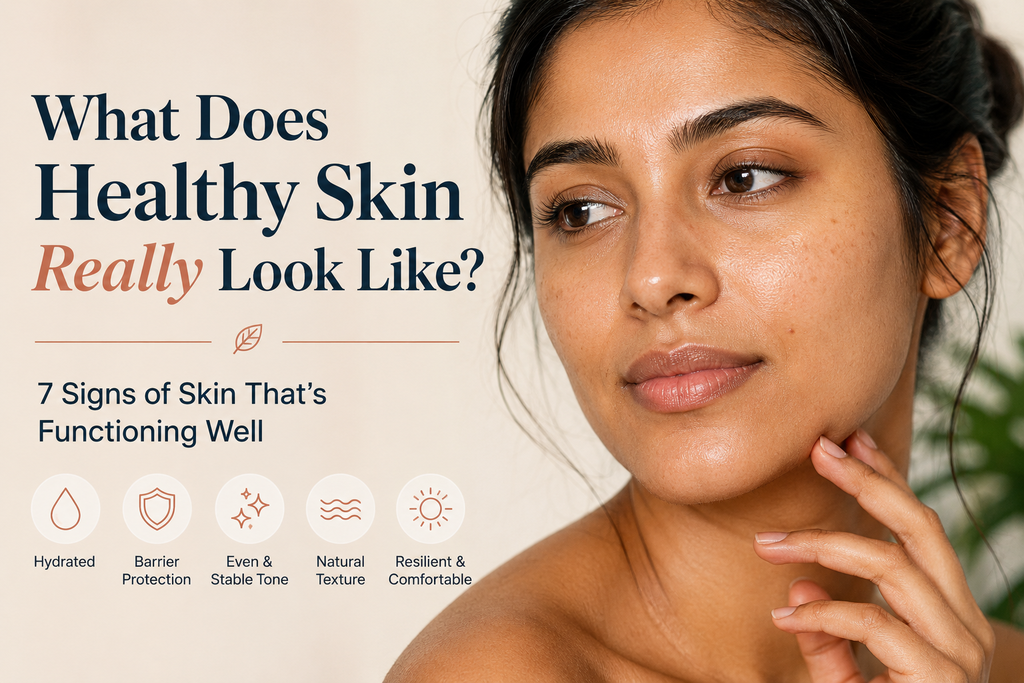
Healthy skin is often pictured as perfectly smooth, poreless, glossy, and completely free of spots. Real skin rarely looks that way.
Healthy skin can have visible pores, fine lines, freckles, scars, pigmentation, small blemishes, facial hair, and changes in texture. It can also look different from one person to another because skin color, age, genetics, environment, and anatomy all influence its appearance.
So what does healthy skin actually look like?
Healthy skin is better defined by how well it functions than by how flawless it appears. It generally has an intact skin barrier, adequate hydration, relatively even and stable texture, and no persistent symptoms such as significant itching, cracking, inflammation, or unexplained changes. Its natural color and pigmentation can vary enormously and do not need to conform to a particular beauty standard.
Understanding that distinction matters. It changes the goal of skincare from trying to create “perfect” skin to maintaining skin that is comfortable, resilient, and functioning properly.
What Is Healthy Skin?
Healthy skin is skin that is performing its protective and regulatory functions effectively while remaining relatively comfortable and stable.
The outermost layer of the skin, called the stratum corneum, plays a major role in this process. It helps limit water loss and protects the body from external irritants and potentially harmful substances. A 2023 review of skin-barrier science describes the barrier as involving interconnected physical, chemical, microbiological, and immunological components. research on the skin barrier and moisturization
That means healthy skin is not simply a cosmetic concept.
It is skin that can:
- Retain water effectively
- Provide a physical barrier against the environment
- Recover from everyday environmental stress
- Maintain an appropriate level of surface hydration
- Support a balanced microbial ecosystem
- Regulate inflammation appropriately
- Protect against excessive external damage
From an appearance perspective, healthy skin often looks comfortable, hydrated, relatively smooth, and consistent with the person’s natural pigmentation. But there is no single visual template that defines it.
7 Signs of Healthy Skin
If you are trying to assess whether your skin is healthy, these characteristics are more meaningful than whether it looks like a filtered photograph.
1. The skin feels comfortable
Healthy skin generally should not constantly feel itchy, burning, painfully tight, or irritated.
Occasional sensitivity can happen to anyone. For example, cold weather, excessive cleansing, shaving, sweating, or exposure to an irritating product can temporarily make skin uncomfortable.
The concern is persistent or significant symptoms.
Excessively dry skin, for example, can produce noticeable dehydration, roughness, flaking, cracking, and itching, according to the American Academy of Dermatology. American Academy of Dermatology: signs and symptoms of dry skin
Comfort is therefore an underrated indicator of skin health.
A face does not have to look perfectly smooth to be healthy. But skin that constantly burns, itches, cracks, or feels painfully tight deserves more attention.
2. The skin barrier is functioning properly
Your skin barrier is one of the most important indicators of skin health, even though you cannot directly see it.
Think of it as a protective interface between your body and the outside world.
One way researchers assess barrier function is through transepidermal water loss (TEWL), which measures water escaping through the skin. Higher TEWL is generally associated with impaired barrier function, although there is no single “normal” value that applies to every person or every part of the body. A systematic review found that TEWL varies substantially depending on anatomical location and other factors. systematic review of transepidermal water loss in healthy adults
A healthy barrier helps the skin retain water while limiting unnecessary water loss.
When the barrier becomes disrupted, you may notice:
- Persistent dryness
- Flaking
- Rough texture
- Increased sensitivity
- Stinging when products are applied
- Tightness
- Increased irritation
This is why someone can have an extensive skincare routine yet still have unhealthy-feeling skin. More products do not necessarily mean a stronger barrier.
3. Skin has natural texture
Healthy skin is not supposed to be completely smooth.
Human skin contains pores, hair follicles, sebaceous glands, microscopic lines, and variations in texture. Pores can be particularly visible around areas such as the nose, cheeks, and forehead.
Fine lines are also a normal part of skin biology and aging.
Trying to eliminate every visible pore or line can therefore create an unrealistic standard.
A better question is:
Does the texture seem stable and appropriate for my skin, or has it suddenly changed?
A stable pore pattern, fine lines, freckles, or small scars are not automatically signs of unhealthy skin.
4. Skin has an even-enough appearance for that individual
“Even skin tone” is often used in skincare marketing, but it needs context.
Healthy skin does not have to be one uniform color.
Natural skin pigmentation is determined largely by melanin and varies widely between individuals and populations. Research on pigmentation diversity shows that human skin color represents substantial biological variation, including differences in melanin production, distribution, and response to ultraviolet radiation. research on human skin pigmentation diversity
Healthy skin can therefore be pale, brown, deep brown, olive, tan, or virtually any natural variation in between.
The more useful concept is relative stability.
A person may naturally have freckles, darker areas around certain facial regions, or pigmentation differences between body sites. Those characteristics do not automatically indicate poor skin health.
However, new, rapidly developing, or unexplained pigmentation changes may deserve evaluation.
This distinction is particularly important for people with darker skin tones. Pigmentation disorders such as post-inflammatory hyperpigmentation and melasma are common concerns in populations with pigmented skin, including Indian populations. review of hyperpigmentation in the Indian population
5. The skin is not persistently inflamed
Occasional redness is normal.
Your skin can become temporarily red after exercise, heat exposure, shaving, using certain products, or experiencing environmental changes.
Persistent redness, swelling, burning, warmth, scaling, or inflammation is different.
Healthy skin should generally not remain chronically irritated without an identifiable reason.
Persistent inflammation can occur with conditions such as acne, rosacea, eczema, psoriasis, allergic reactions, and other dermatological disorders. Determining the cause is more useful than simply trying to conceal the redness with cosmetic products.
6. The skin is adequately hydrated
Hydrated skin usually has a more supple and flexible appearance and tends to feel less rough.
Skin hydration is strongly connected to the stratum corneum. Natural moisturizing factors within skin cells and lipids between cells help maintain water within the outer layer of the skin. Research has shown that adequate hydration is important for normal skin maturation and desquamation. research on skin hydration and its molecular mechanisms
That does not mean healthy skin needs to look wet or glossy.
“Glazed” or extremely shiny skin is a beauty aesthetic, not a medical definition of hydration.
Likewise, oily skin and hydrated skin are not the same thing. Skin can produce plenty of oil while still experiencing barrier disruption or dehydration.
7. The skin can handle normal environmental exposure
Healthy skin is not completely unaffected by the environment.
Sun, wind, cold temperatures, low humidity, pollution, friction, shaving, sweat, and cleansing can all place stress on the skin.
Healthy skin has mechanisms that help it respond to these challenges.
That is another reason resilience is a useful way to think about skin health.
A person whose skin can tolerate a simple routine, normal washing, and everyday environmental exposure without constantly becoming painful or irritated may have a healthier barrier than someone whose skin looks exceptionally smooth but reacts badly to almost everything.
Healthy Skin Does Not Mean Perfect Skin
One of the biggest misconceptions in modern skincare is that healthy skin should be flawless.
It should not.
Healthy skin can have pores
Pores are normal anatomical structures. They cannot and do not need to disappear.
Healthy skin can have acne
Acne is a common inflammatory skin condition, and having acne does not mean a person has “dirty” or fundamentally unhealthy skin.
Someone can have acne and otherwise have a functioning skin barrier.
Healthy skin can have scars
Scars represent the skin’s response to injury. Their presence alone does not mean the surrounding skin is unhealthy.
Healthy skin can have wrinkles
Wrinkles are a normal part of aging. The appearance and timing of skin aging vary between individuals and are influenced by genetics, environmental exposure, and other factors.
A systematic review of skin aging found that aging characteristics vary considerably among populations and that skin color alone does not provide a simple explanation for differences in aging. systematic review of skin aging and its risk factors
Healthy skin can have freckles and pigmentation
Pigmentation is a fundamental characteristic of human skin.
It should not automatically be treated as a defect.
Healthy skin can have facial hair
Hair follicles are normal components of skin. Facial and body hair vary naturally between individuals.
The important question is not whether skin resembles an edited photograph.
The important question is whether it is functioning well and whether something has changed unexpectedly.
What Healthy Skin Looks Like on Different Skin Tones
There is no universal color that healthy skin should be.
This is especially important because many skincare discussions have historically treated lighter skin as the default.
Skin pigmentation is biologically diverse, and melanin influences both appearance and the way skin responds to ultraviolet radiation. scientific review of pigmentation diversity and UV response
For darker skin tones, some forms of inflammation may appear less obviously red and can instead be associated with changes in pigmentation or other visual characteristics.
People with darker skin can also experience hyperpigmentation after inflammation or injury. In other words, a pimple may disappear while leaving a dark mark that persists considerably longer.
This does not necessarily mean the skin is unhealthy overall.
Similarly, aging does not look identical across all skin types. Reviews of aging in skin of color describe differences in pigmentation, wrinkles, elasticity, and other features across populations. review of aging differences in ethnic skin
A useful principle is:
Healthy skin should be evaluated against the person’s own baseline, not against someone else’s complexion.
The Skin Microbiome Is Part of Skin Health
There is another part of healthy skin that you cannot see directly: the skin microbiome.
The skin is home to communities of bacteria, fungi, viruses, and other microorganisms. These organisms interact with the skin and its immune system and contribute to the overall skin environment.
Recent dermatology research emphasizes that the skin microbiome is complex and highly variable between people and body sites. Researchers are still working out exactly how microbial changes relate to specific diseases in humans. 2024 review of the human skin microbiome in health
This is an area where skincare marketing can get ahead of the evidence.
It is tempting to think of the microbiome as something that simply needs to be “balanced,” but there is no single ideal microbial composition that applies to everyone.
The practical takeaway is simpler:
Healthy skin depends partly on a functioning relationship between the skin barrier, immune system, and microorganisms living on the skin.
That is another reason extremely aggressive cleansing or unnecessarily complicated routines are not automatically better.
What Can Make Skin Look Less Healthy?
Many different factors can temporarily or chronically change how skin looks and feels.
Environmental exposure
Cold, dry air can increase skin dryness. Heat, sweating, wind, and environmental irritants can also affect the skin.
Excessive cleansing
Cleansing removes dirt, sweat, cosmetics, and excess oils, but excessive washing or harsh products can contribute to irritation and barrier disruption.
Ultraviolet radiation
UV exposure is particularly important because its effects extend beyond temporary tanning or sunburn.
The CDC states that most skin cancers are caused by excessive exposure to ultraviolet radiation and recommends protecting skin from UV exposure throughout the year. CDC guidance on sun safety and skin cancer prevention
The American Academy of Dermatology recommends broad-spectrum, water-resistant sunscreen with SPF 30 or higher, alongside shade and protective clothing. American Academy of Dermatology guidance on healthier-looking skin
Sun protection is therefore not simply an anti-aging strategy. It is part of protecting skin health.
Smoking
Smoking is associated with accelerated skin aging and other adverse effects on skin. The American Academy of Dermatology includes avoiding smoking among its general recommendations for healthier-looking skin. American Academy of Dermatology: healthier-looking skin
Irritating skincare products
A product can be popular and still be unsuitable for your skin.
Fragrance, aggressive exfoliation, excessive use of active ingredients, and poorly tolerated products can all contribute to irritation in susceptible individuals.
How to Maintain Healthy-Looking Skin
Healthy skin usually does not require a 12-step routine.
A sensible foundation is remarkably simple.
1. Cleanse appropriately
Use a cleanser that removes what needs to be removed without leaving your skin persistently tight, burning, or uncomfortable.
2. Moisturize when needed
Moisturizers can help reduce water loss and support the skin barrier. The American Academy of Dermatology recommends applying moisturizer after washing while the skin is still slightly damp, particularly when dealing with dry skin. AAD guidance on relieving dry skin
3. Protect against UV exposure
Use sun protection appropriate to your environment and skin needs. Sunscreen is one component; shade, clothing, hats, and avoiding unnecessary intense UV exposure also matter.
4. Avoid constantly changing products
If your skin is doing well, there is little reason to introduce several new products simultaneously.
When multiple products are introduced at once and irritation develops, it becomes difficult to identify the cause.
5. Treat persistent skin problems rather than hiding them
Persistent acne, eczema, unexplained rashes, pigmentation changes, or recurring irritation may require a medical diagnosis rather than another cosmetic product.
Healthy Skin vs. “Perfect” Skin
| Healthy skin | “Perfect” skin |
| Can have visible pores | Often portrayed as poreless |
| Can have wrinkles | Expected to be wrinkle-free |
| Can have freckles or pigmentation | Often portrayed as uniformly toned |
| Can have occasional blemishes | Expected to be completely clear |
| Focuses on barrier function | Focuses primarily on appearance |
| Can vary naturally between people | Often based on a narrow beauty standard |
| May show signs of normal aging | Often presented as permanently youthful |
| Can have scars or texture | Often presented as completely smooth |
The distinction is important because pursuing cosmetic perfection can sometimes encourage people to over-exfoliate, over-cleanse, use too many active ingredients, or repeatedly change products.
The goal should not be to make your skin look artificial.
The goal is to help your skin function well while addressing specific concerns that genuinely matter to you.
When Is a Skin Change Worth Getting Checked?
Not every spot or change is dangerous. Many are completely benign.
But persistent or evolving changes should not automatically be dismissed as a skincare problem.
The American Academy of Dermatology recommends seeing a dermatologist if you notice a spot that is different from others, or one that changes, itches, or bleeds. American Academy of Dermatology guidance on checking skin for cancer
For pigmented lesions, the commonly used ABCDE framework can help identify changes that warrant professional evaluation:
- A — Asymmetry: One half does not resemble the other.
- B — Border: The border is irregular, ragged, notched, or poorly defined.
- C — Color: The color varies within the lesion.
- D — Diameter: The lesion is changing in size; although melanomas are often larger than 6 mm when diagnosed, they can be smaller.
- E — Evolving: The spot is changing over time.
The National Cancer Institute emphasizes that melanoma can present as a new or changing pigmented area and that the ABCDE characteristics can help identify suspicious changes. National Cancer Institute information on moles and melanoma risk
The same principle applies to people with darker skin. Skin cancer can occur in all skin tones, and suspicious changes can appear on areas such as the palms, soles, nails, or other less sun-exposed areas. AAD guidance on finding skin cancer in darker skin tones
A skincare article cannot diagnose an individual skin condition. If something is new, persistent, rapidly changing, painful, bleeding, or otherwise concerning, professional evaluation is the appropriate next step.
The Most Useful Definition of Healthy Skin
If you strip away skincare advertising, social media filters, and unrealistic beauty standards, healthy skin becomes much easier to understand.
Healthy skin does not have to be:
- Poreless
- Completely clear
- Extremely shiny
- Free of wrinkles
- One uniform color
- Free of freckles
- Free of scars
- Permanently youthful
Instead, healthy skin is generally:
- Comfortable
- Adequately hydrated
- Relatively resilient
- Protected by an intact barrier
- Free from persistent unexplained inflammation
- Capable of maintaining its protective functions
- Stable relative to your normal baseline
And perhaps most importantly, healthy skin looks different from person to person.
A 20-year-old with freckles, a 40-year-old with fine lines, a person with deep brown skin and uneven pigmentation, and someone with naturally visible pores can all have healthy skin.
The visual definition of beauty changes constantly. Skin biology does not. That is why the best way to judge your skin is not to ask whether it looks perfect.
Ask whether it feels comfortable, functions well, is reasonably resilient, and whether anything has changed in a way that deserves attention. Healthy skin is living tissue, not a photograph.
Frequently Asked Questions
What does healthy skin look like?
Healthy skin generally looks comfortable, hydrated, relatively smooth, and stable for the individual. It can still have pores, wrinkles, freckles, pigmentation, scars, or occasional blemishes. There is no single appearance that defines healthy skin.
Does healthy skin have to be clear?
No. Healthy skin can have occasional pimples, freckles, scars, visible pores, or other normal variations. Acne is a skin condition, but having an occasional blemish does not automatically mean that the skin barrier or overall skin function is unhealthy.
Should healthy skin have visible pores?
Yes. Pores are normal anatomical structures. Their visibility varies between people and across different areas of the face. The absence of visible pores is not a requirement for healthy skin.
Can skin with pigmentation be healthy?
Yes. Natural pigmentation varies substantially among individuals. Freckles, darker or lighter areas, and differences in skin tone do not automatically indicate poor skin health. However, new or rapidly changing pigmentation should be evaluated when appropriate.
What are signs that the skin barrier may be damaged?
Common signs include persistent dryness, flaking, roughness, tightness, burning, stinging, increased sensitivity, and cracking. Excessively dry skin can also become itchy. Persistent symptoms may warrant evaluation by a dermatologist.
Is shiny skin a sign of healthy skin?
Not necessarily. Shiny skin may reflect oil production, skincare products, lighting, or cosmetics. Hydration and oiliness are different characteristics, so a glossy appearance should not be used as a standalone measure of skin health.
How can I keep my skin healthy?
Start with the basics: cleanse appropriately, moisturize when needed, protect your skin from ultraviolet radiation, avoid smoking, and avoid unnecessarily irritating skincare practices. If you have persistent acne, irritation, rashes, unusual pigmentation, or changing lesions, consider professional dermatological advice.
When should I see a dermatologist about a skin change?
See a dermatologist when a spot is new or changing, particularly if it is different from your other spots, itches, bleeds, or develops concerning characteristics. Persistent rashes, unexplained inflammation, severe dryness, or symptoms that do not improve with basic care also deserve professional attention.
The Bottom Line
Healthy skin is not necessarily flawless skin.
It can have pores, pigmentation, wrinkles, freckles, scars, and occasional blemishes. What matters more is whether the skin is comfortable, adequately hydrated, resilient, and able to perform its protective functions.
A healthy complexion should therefore be judged by skin function and individual baseline, not by an artificial standard of perfection.
Protect it from excessive UV exposure, maintain the barrier, avoid unnecessary irritation, and pay attention to meaningful changes.
The healthiest skin is not the skin that looks perfect.
It is the skin that is functioning well, adapting to its environment, and staying healthy over time.