
A skincare routine can look unnecessarily complicated. Cleanser, toner, essence, serum, moisturizer, eye cream, exfoliant, sunscreen: suddenly, washing your face seems to require a flowchart.
But these products do not all serve the same purpose. Some are foundational, some are optional, and some are mainly delivery systems for specific ingredients.
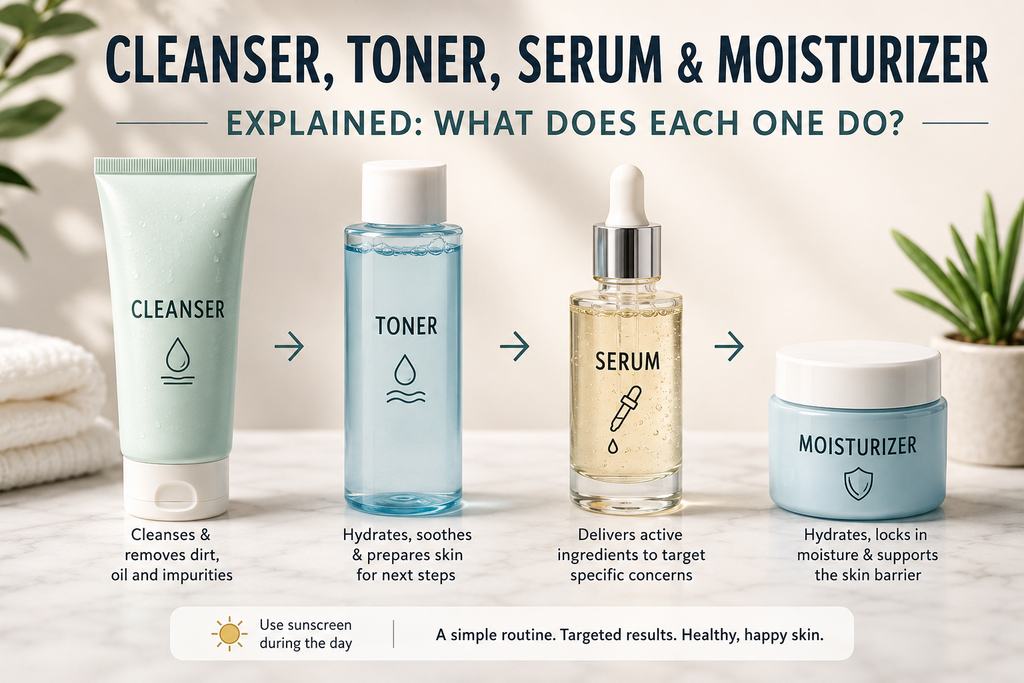
The simplest way to understand a skincare routine is to think about four different jobs:
- Cleanser: removes dirt, excess oil, sweat, makeup, and other substances from the skin.
- Toner: an optional post-cleansing product that can hydrate, soothe, lightly exfoliate, or deliver other ingredients.
- Serum: a concentrated treatment product designed to target a particular skin concern.
- Moisturizer: hydrates the skin and helps reduce water loss while supporting the skin barrier.
The important distinction is that you do not automatically need all four.
Dermatologists from the American Academy of Dermatology emphasize that a simple routine built around cleansing, moisturizing, and sun protection can be enough for many people. They also caution that using too many products can increase irritation.
So what does each product actually do, when should you use it, and which ones are worth keeping?
The Short Answer: Cleanser vs. Toner vs. Serum vs. Moisturizer
| Product | Main purpose | Usually essential? | Typical position |
| Cleanser | Removes dirt, oil, sweat, makeup and debris | Yes, for most routines | First |
| Toner | Hydrates, soothes, exfoliates or delivers ingredients | No | After cleansing |
| Serum | Targets specific concerns with concentrated ingredients | Optional | After cleansing/toner |
| Moisturizer | Hydrates and supports the skin barrier | Usually yes | After treatments |
| Sunscreen | Protects against UV radiation | Yes during daytime | Last skincare step |
The key is not the number of products. It is whether each product has a useful job.
A person with dry, sensitive skin might get better results from a gentle cleanser and moisturizer than from using seven products containing acids and active ingredients. Someone dealing with acne or pigmentation may benefit from adding a targeted serum or treatment.
The right routine is therefore concern-driven rather than product-driven.
What Does a Cleanser Do?
A cleanser is a product designed to remove unwanted substances from the skin’s surface, including excess sebum, sweat, dirt, environmental debris, makeup and sunscreen.
It is the preparation step for everything that follows.
Your skin naturally produces oils and accumulates substances throughout the day. Cleansing removes these materials so that the skin is clean and comfortable and subsequent topical products can be applied to a clean surface.
But there is an important catch: a cleanser should remove unwanted material without unnecessarily damaging the skin barrier.
Research on cleansing has shown why formulation matters. Surfactants in cleansers interact with proteins and lipids in the outer layer of the skin. Some cleansing agents are more irritating than others, and harsh cleansing can contribute to dryness, tightness and barrier disruption. A review in the Journal of Cosmetic Dermatology explains the distinction between traditional soaps and milder synthetic detergents, known as syndets.
What should a good cleanser feel like?
A cleanser does not need to leave your face feeling “squeaky clean.”
In fact, that extremely tight feeling after washing can be a warning sign that the product is removing too much from the skin.
The American Academy of Dermatology recommends using a gentle, non-abrasive cleanser, washing with lukewarm rather than hot water, avoiding aggressive scrubbing, and limiting face washing to twice daily and after heavy sweating.
For dry or sensitive skin, fragrance-free and gentle formulations are generally preferable. People with acne can also benefit from cleansers designed to minimize irritation, particularly when they are simultaneously using potentially drying acne treatments.
A review of skincare for acne notes that acne itself can involve barrier dysfunction, while several acne medications can further contribute to dryness and irritation. Appropriate cleansers and moisturizers can therefore be useful companions to acne treatment.
Do you need a different cleanser in the morning and evening?
Usually, no.
A simple gentle cleanser can work for both. However, someone with very dry or sensitive skin may not need an aggressive morning cleanse at all.
The goal is to clean the skin sufficiently, not repeatedly strip it.
What Does a Toner Do?
A toner is a liquid skincare product applied after cleansing.
Unlike cleansers and moisturizers, toners do not have one universally defined function. Modern toners can be formulated to do very different things.
Depending on its ingredients, a toner might:
- Add hydration
- Soothe the skin
- Deliver antioxidants or other active ingredients
- Provide mild exfoliation
- Reduce the feeling of dryness after cleansing
- Remove small amounts of residual makeup or product
- Provide additional oil-control benefits
This is why asking “What does toner do?” has no single answer.
The ingredients matter more than the word toner printed on the bottle.
Dermatology expert Zoe Diana Draelos has described modern toners as products that have diversified according to different skin types and concerns. Hydrating versions may contain humectants such as glycerin or hyaluronic acid, while others may contain ingredients intended for oily or acne-prone skin.
Cleveland Clinic similarly describes modern toners as generally more varied than the older alcohol-heavy products historically associated with the category. Some can hydrate or help remove residual material after cleansing.
Is toner necessary?
No.
This is probably the most important thing to understand about toners.
A toner can be useful, but it is not a mandatory step for healthy skin.
If your cleanser leaves your skin comfortable, your serum or treatment provides the ingredients you need, and your moisturizer keeps your skin hydrated, there may be little reason to add another product.
Draelos notes that many of the functions traditionally associated with toners can also be achieved through serums or moisturizers.
What about alcohol-based toners?
This is where toner history becomes relevant.
Older-style toners and astringents were often designed to remove oil aggressively and could contain substantial amounts of alcohol. That could create a temporary feeling of tightness and dryness.
A modern hydrating toner is a different proposition.
If you have dry, sensitive or irritated skin, an alcohol-heavy or strongly fragranced toner may be more likely to cause problems than solve them. The broader evidence on skin barrier care supports minimizing unnecessary irritation and favoring gentle formulations.
So don’t choose a toner because it makes your face feel tight. Tight does not automatically mean clean or healthy.
What Does a Serum Do?
A serum is a skincare treatment product formulated to deliver specific active ingredients for a particular skin concern.
Unlike the broad protective role of a moisturizer, a serum is usually more targeted.
For example, a serum might be formulated around:
- Vitamin C for antioxidant support and pigmentation concerns
- Niacinamide for several concerns including redness and uneven pigmentation
- Hyaluronic acid and other humectants for hydration
- Salicylic acid for acne-prone skin
- Retinoids for acne and photoaging
- Azelaic acid for acne and pigmentation
- Other antioxidants or specialized cosmetic ingredients
The word serum itself does not guarantee that a product is effective. It describes a category and formulation style, not a particular active ingredient.
That means a ₹300 serum and a ₹3,000 serum are not automatically going to produce dramatically different results.
The ingredient, concentration, formulation, stability, tolerability and evidence behind the ingredient matter much more.
A 2025 Delphi consensus study involving dermatologists identified several topical ingredients commonly recommended by cosmetic dermatologists for specific concerns, including retinoids, azelaic acid, salicylic acid, niacinamide and vitamin C.
What does a vitamin C serum do?
Topical vitamin C is commonly used in products intended to address oxidative stress, uneven pigmentation and signs of photoaging.
A review of topical vitamin C derivatives found that vitamin C has several biological roles relevant to skin health, while also highlighting an important limitation: different derivatives have been developed partly because stability and penetration can be challenges with topical vitamin C.
So “vitamin C serum” is not enough information to judge a product. The specific form and formulation matter.
What does a niacinamide serum do?
Niacinamide, also called nicotinamide, is a form of vitamin B3 used in skincare for several purposes.
Dermatologists included niacinamide among ingredients with consensus support for concerns such as redness and dark spots in the 2025 Delphi study.
It can therefore make sense as a targeted ingredient when those are your concerns, rather than simply because niacinamide is trending.
What does a retinol serum do?
Retinoids are among the more extensively studied topical ingredients used for acne and photoaging.
A review of topical approaches to photoaging identifies photoprotection and topical retinoids as core components of topical anti-aging care, while vitamin C, niacinamide and alpha-hydroxy acids can be considered for particular concerns.
But stronger does not always mean better.
Retinoids can cause dryness and irritation, particularly when introduced too aggressively. A routine that you can tolerate consistently is usually more useful than an aggressive routine that you abandon after two weeks.
What Does a Moisturizer Do?
A moisturizer is designed to increase skin hydration and reduce water loss while supporting the skin barrier.
This is important even if your skin is oily.
The outermost layer of the skin, particularly the stratum corneum, plays a major role in controlling water loss and protecting the body from the external environment. When this barrier becomes disrupted, skin can become dry, irritated and more susceptible to external irritants.
A 2023 review of the skin barrier and moisturization describes moisturizers as working through several mechanisms, including the actions of humectants, emollients and occlusives.
Humectants
Humectants attract and hold water.
Common examples include:
- Glycerin
- Hyaluronic acid
- Urea
- Some forms of lactic acid
Think of humectants as ingredients that help increase the water content of the outer skin.
Emollients
Emollients help smooth and soften the skin by filling spaces between skin cells and improving the feel of the skin surface.
They can be particularly useful when skin feels rough or flaky.
Occlusives
Occlusives form a barrier that reduces water loss from the skin.
Petrolatum is a classic example.
This is one reason applying moisturizer while the skin is still slightly damp can be useful. The American Academy of Dermatology recommends moisturizing after washing, while the skin retains some moisture.
What about ceramides?
Ceramides are lipids naturally found in the skin barrier.
Moisturizers containing ceramides are frequently used in barrier-focused skincare. A 2023 dermatologist consensus review concluded that gentle skincare with near-physiologic pH and ceramides can help support a healthy skin barrier in several populations and inflammatory skin conditions.
That does not mean everyone needs a ceramide moisturizer. It means ceramides are one useful ingredient category, particularly when barrier support is a priority.
Why Moisturizer Matters Even If You Have Oily or Acne-Prone Skin
One of the most persistent skincare misconceptions is that oily skin should not be moisturized.
That is not generally true.
Acne treatments such as benzoyl peroxide, salicylic acid and topical retinoids can cause dryness and irritation. The American Academy of Dermatology notes that moisturizer can help people tolerate these treatments and recommends looking for products labeled oil-free or non-comedogenic when acne is a concern.
In other words, the objective isn’t to eliminate every trace of oil.
The objective is to maintain a healthy skin environment while addressing the actual problem.
Cleanser vs. Toner vs. Serum vs. Moisturizer: The Real Difference
The easiest way to remember the four products is to think about their primary jobs:
Cleanser = remove
It removes unwanted substances from the skin.
Toner = supplement
It adds an optional layer of hydration, soothing or targeted ingredients after cleansing.
Serum = treat
It delivers targeted ingredients for a particular concern.
Moisturizer = protect and hydrate
It helps maintain hydration and supports the skin barrier.
This distinction also explains why a skincare routine doesn’t have to contain all four.
If your main concern is dryness, adding three different treatment serums may accomplish less than choosing a gentle cleanser and an effective moisturizer.
If your concern is pigmentation, a targeted treatment may make more sense than adding a toner simply because skincare routines on social media contain one.
What Order Should You Apply Cleanser, Toner, Serum and Moisturizer?
A practical routine generally follows this order:
Cleanser → Toner, if using one → Serum/treatment → Moisturizer → Sunscreen in the morning
The American Academy of Dermatology recommends cleansing first, applying medication or treatment next, and then applying moisturizer and/or sunscreen.
The reason is fairly intuitive.
You cleanse first because you want a clean surface. Treatment products then go on before heavier moisturizing products. Moisturizer follows to support hydration and the barrier. Sunscreen goes on during the day as the final skincare step.
Morning routine
- Gentle cleanser
- Toner, if useful
- Serum, if needed
- Moisturizer
- Broad-spectrum sunscreen
Evening routine
- Cleanser
- Toner, if useful
- Serum or prescribed treatment
- Moisturizer
You don’t necessarily need every step every morning and evening.
Do You Need All Four Products?
For most people, no.
A basic routine can be surprisingly short.
The American Academy of Dermatology recommends a simple approach centered on cleansing, moisturizing and protecting the skin from the sun.
A useful way to build a routine is to start with the minimum and add products only when there is a reason.
If you are a complete beginner
Start with:
- Gentle cleanser
- Moisturizer
- Broad-spectrum SPF 30+ sunscreen
Use these consistently before worrying about more complicated routines.
If your skin is dry
Prioritize:
- Gentle cleanser
- Hydrating moisturizer
- Sunscreen
A hydrating toner or serum can be added if you want additional hydration, but it isn’t automatically necessary.
If your skin is oily
Prioritize:
- Gentle cleanser
- Lightweight moisturizer
- Sunscreen
You can add a targeted product containing an appropriate active ingredient if oiliness or acne remains a concern.
If you have acne
A basic routine can still include:
- Gentle cleanser
- Appropriate acne treatment
- Non-comedogenic moisturizer
- Sunscreen
Some acne medications can cause dryness, so stripping your skin further with harsh cleansers or astringents may be counterproductive.
If you have pigmentation or signs of photoaging
A reasonable foundation is:
- Gentle cleanser
- Targeted treatment or serum
- Moisturizer
- Daily sunscreen
Topical retinoids, vitamin C, niacinamide and other actives may have a role depending on the concern and the individual’s tolerance.
Common Skincare Mistakes to Avoid
1. Using a cleanser that leaves your skin painfully tight
Clean does not mean stripped.
If your face feels dry, tight or irritated immediately after cleansing, consider whether the cleanser is too harsh or whether you are cleansing too frequently.
2. Treating toner as mandatory
Toner can be useful, but it is optional.
If you cannot identify what your toner is contributing to your routine, you may not need it.
3. Adding multiple active serums at once
If you introduce vitamin C, retinoids, exfoliating acids and other actives simultaneously, irritation becomes harder to diagnose.
The AAD recommends introducing new skincare products carefully, including testing products on small areas before widespread use when appropriate.
4. Assuming expensive products are automatically better
Price is not a reliable shortcut for effectiveness.
Ingredient selection, formulation, tolerability and consistent use matter.
5. Skipping moisturizer because your skin is oily
Oily skin can still become dehydrated or irritated. Acne treatments in particular can increase dryness, making appropriate moisturization useful.
6. Forgetting sunscreen
You can have an excellent cleanser, serum and moisturizer and still undermine your routine by ignoring UV protection.
The AAD recommends broad-spectrum, water-resistant SPF 30 or higher for sun protection.
The “More Products = Better Skin” Myth
Modern skincare makes it easy to believe that every concern requires another bottle.
Dryness? Add a serum.
Dullness? Add another serum.
Texture? Add an exfoliant.
Pores? Add a toner.
Fine lines? Add retinol.
Then add a sleeping mask, eye cream and facial mist.
The problem is that skincare is not a competition to see how many products your skin can tolerate.
The AAD specifically warns that using too many products can irritate the skin, and its dermatologist guidance emphasizes that consistency matters more than complicated routines.
A useful framework is:
Foundation → Concern → Adjustment
Foundation: cleanser, moisturizer and sunscreen.
Concern: add one targeted treatment if you actually have a concern to address.
Adjustment: change frequency, formulation or product choice based on how your skin responds.
This approach is usually more rational than copying someone else’s 10-step routine.
A Simple Way to Decide What You Actually Need
Before buying another skincare product, ask four questions:
1. What problem am I trying to solve?
Dryness? Acne? Pigmentation? Fine lines? Irritation?
2. Which product category is actually designed to address it?
A cleanser primarily cleans. A moisturizer primarily hydrates and supports the barrier. A serum may deliver a targeted active.
3. Am I already getting this function from another product?
If your moisturizer already contains the ingredient or function you want from your toner, another product may add little value.
4. Can my skin tolerate it consistently?
An effective ingredient is not useful if repeated irritation prevents you from using it consistently.
This last point is often overlooked. Skincare is not just about theoretical ingredient performance. Tolerability and adherence matter.
Frequently Asked Questions
Is toner necessary in a skincare routine?
No. Toner is an optional step. Depending on its formulation, it may hydrate, soothe, exfoliate lightly or deliver other ingredients, but a well-designed cleanser, treatment and moisturizer can often provide the same core functions.
Can I use serum without toner?
Yes. Toner is not required before serum. A simple routine can go from cleanser directly to serum and then moisturizer.
Should I use moisturizer if I have oily skin?
Yes, in many cases. Oily skin can still become dry or irritated, particularly when using acne treatments. Look for lightweight, oil-free or non-comedogenic products if clogged pores are a concern.
Which comes first, serum or moisturizer?
Generally, serum or another treatment goes before moisturizer. The American Academy of Dermatology recommends applying treatments after cleansing and then applying moisturizer and/or sunscreen.
Can I skip cleanser in the morning?
Some people with dry or sensitive skin may find a less intensive morning cleansing routine more comfortable. There is no universal requirement to use a strong cleanser twice every day. The AAD recommends limiting facial washing to twice daily and after sweating, while emphasizing gentle cleansing.
Can toner replace moisturizer?
Usually, no. Some hydrating toners contain humectants and can add water to the skin, but a moisturizer is specifically formulated to support hydration and reduce water loss through combinations of humectants, emollients and/or occlusives.
Should I use all four products every day?
Not necessarily. The best routine depends on your skin type, concerns, products and tolerance. A basic cleanser, moisturizer and sunscreen routine can be enough for many people, with targeted treatments added when needed.
When should I see a dermatologist instead of changing my skincare routine?
If you have persistent acne, significant redness, burning, itching, a rash, severe dryness, painful lesions, scarring or a skin problem that is not improving, a dermatologist can help identify the underlying condition rather than having you experiment with increasingly complex products.
The Bottom Line
Cleanser, toner, serum and moisturizer are not four mandatory steps in a skincare checklist. They are four different product categories with different jobs.
A cleanser cleans the skin while ideally minimizing disruption to the skin barrier. A toner is an optional product whose function depends heavily on its formulation. A serum is generally used to deliver targeted ingredients for specific concerns. A moisturizer helps maintain hydration and support the skin barrier.
For many people, the smartest routine is not the longest one.
Start with the foundation: gentle cleansing, appropriate moisturization and daily sun protection. Then add a targeted treatment if you have a specific concern you want to address. Choose products based on their ingredients and formulation rather than the number of steps they add to your routine.
Good skincare is less about owning more bottles and more about understanding what each product is actually doing.
SEO Information
Primary Keyword
cleanser toner serum moisturizer
Secondary Keywords
- cleanser vs toner vs serum vs moisturizer
- skincare routine steps
- what does cleanser do
- what does toner do
- what does serum do
- what does moisturizer do
- skincare product order
- toner vs serum
- serum vs moisturizer
- when to use toner and serum
- skincare routine for beginners
- how to layer skincare products
- daily skincare routine
- skin barrier moisturizer
- skincare products explained
Search Intent
Informational with practical decision-making intent.
The reader wants to understand the purpose of common skincare products, how they differ, whether each one is necessary, and how to arrange them in a routine.
Target Audience
Adults and skincare beginners who understand basic skincare terminology but are confused about the role of individual products and whether they need a multi-step routine.
Content Angle
Explain skincare by function rather than by marketing category.
Instead of treating cleanser, toner, serum and moisturizer as mandatory steps, the article explains what each category actually does, what evidence supports its role, when it is useful, and when it can reasonably be skipped.
SEO Title
Cleanser, Toner, Serum & Moisturizer: What They Do
Meta Description
Learn what cleansers, toners, serums, and moisturizers actually do, which products you need, and the correct order for your skincare routine.
Suggested URL Slug
/cleanser-toner-serum-moisturizer-explained/
Suggested Featured Image Concept
A simple, clean flat-lay showing four skincare bottles labeled Cleanser, Toner, Serum, and Moisturizer, arranged from left to right with subtle visual cues representing their functions: cleansing, hydration, treatment and barrier support.