
Choosing a facial cleanser sounds simple until you stand in front of a shelf filled with gel cleansers, cream cleansers, foaming washes, oil cleansers, exfoliating cleansers, acne cleansers, fragrance-free formulas, and products labeled for every possible skin type.
The problem is that the best facial cleanser is not necessarily the one that produces the most foam, removes the most oil, or leaves your face feeling extremely “clean.” A cleanser’s job is to remove excess oil, sweat, dirt, sunscreen, makeup, and other substances from the skin without unnecessarily disrupting the skin barrier.
That distinction matters because cleansing itself can affect the outermost layer of the skin. Research on skin-cleansing formulations shows that some surfactants can interact with and remove components of the stratum corneum, potentially contributing to dryness, irritation, and barrier disruption.
So, how do you choose the right facial cleanser?
The simplest approach is to start with your skin’s behavior, then consider the cleanser’s formulation, ingredients, and the specific concerns you want to address. Someone with dry, sensitive skin may need a very different cleanser from someone with oily, acne-prone skin. And someone with combination skin may need something in between.
This guide explains how to make that decision without getting distracted by marketing claims.
What Is a Facial Cleanser?
A facial cleanser is a product formulated to remove substances such as excess sebum, sweat, dirt, environmental pollutants, sunscreen, makeup, and other surface impurities from the skin.
Most cleansers work through surfactants, molecules that help loosen substances that water alone cannot easily remove. Because many substances on the skin are not water-soluble, simply rinsing your face with water is not always enough to remove them effectively.
However, cleansing involves a trade-off.
You want a cleanser to remove unwanted substances without excessively removing or disrupting components that help the skin maintain its barrier.
The outermost part of the skin, the stratum corneum, contains corneocytes surrounded by an organized mixture of lipids. This structure helps regulate water loss and protects the skin from external irritants. Surfactants can interact with these components during cleansing, which is why cleanser formulation and mildness matter.
A good facial cleanser therefore should not simply maximize cleansing power. It should provide effective cleansing with as little unnecessary irritation as possible.
The First Step: Identify Your Skin Type
Before choosing a cleanser, determine how your skin behaves when you are not wearing moisturizer, sunscreen, or other skincare products.
The American Academy of Dermatology describes common skin types as:
- Dry skin: flaky, itchy, or rough
- Oily skin: shiny or greasy
- Combination skin: oily in some areas and dry in others
- Normal skin: generally clear and not sensitive
- Sensitive skin: may sting or burn after product use
Your skin type is useful, but it should not be treated as a permanent label.
Your skin can change with weather, age, hormones, medications, climate, skincare products, and medical conditions. A person may also have oily skin that is simultaneously irritated or dehydrated.
That is why choosing a cleanser solely because a bottle says “for oily skin” or “for dry skin” can be misleading.
Instead, think about two things:
How much oil does your skin produce?
and
How easily does your skin become dry or irritated?
These two questions give you a much better starting point.
How to Choose a Cleanser for Dry Skin
Dry skin generally benefits from a cleanser that prioritizes gentleness and barrier preservation rather than aggressive oil removal.
If your face frequently feels tight after washing, becomes flaky, or feels uncomfortable without moisturizer, a strong foaming cleanser may not be the best choice.
Dermatologists recommend gentle cleansing for dry skin, and the AAD specifically advises using a gentle cleanser and avoiding excessive lather when dealing with dry skin.
What to look for
A cleanser for dry skin may be better suited to you if it is:
- Gentle
- Fragrance-free
- Creamy, lotion-like, or emulsion-based
- Designed for sensitive or dry skin
- Non-abrasive
- Formulated with moisturizing or barrier-supporting ingredients
Ingredients such as glycerin, ceramides, and other humectant or skin-conditioning ingredients can be useful in formulations designed to minimize dryness.
The goal is not to make your face feel completely stripped after washing.
In fact, that extremely tight feeling is not evidence that a cleanser is working better.
Research comparing cleansing systems has found that harsh surfactant interactions can contribute to changes in skin proteins and lipids, while milder cleansing systems are designed to reduce these effects.
A useful test
After washing, ask yourself:
Does my skin feel comfortably clean, or does it feel tight, squeaky, itchy, or uncomfortable?
If your skin consistently feels tight immediately after cleansing, your cleanser may be too aggressive for your skin or you may be cleansing too frequently.
How to Choose a Cleanser for Oily Skin
Oily skin produces more sebum, so removing excess oil is an important part of cleansing.
But there is a common mistake here: assuming that oily skin needs the strongest cleanser possible.
It doesn’t.
Over-cleansing can irritate the skin, and irritation can make acne-prone skin particularly difficult to manage. The American Academy of Dermatology recommends gently washing acne-prone skin up to twice a day and after sweating, while avoiding abrasive cleansing and scrubbing.
What to look for
If your skin becomes shiny quickly and you frequently deal with clogged pores, consider:
- Lightweight gel cleansers
- Gentle foaming cleansers
- Non-comedogenic formulas
- Oil-free formulations where appropriate
- Salicylic acid cleansers if you specifically need help with clogged pores or acne
A cleanser containing salicylic acid can be useful for some people with oily, acne-prone skin because salicylic acid can help unclog pores. The AAD notes that salicylic acid cleansers may help with clogged pores and can be incorporated into routines for acne-prone skin.
However, more active ingredients do not automatically mean better results.
If a salicylic acid cleanser leaves your skin dry, irritated, or uncomfortable, alternating it with a mild cleanser may be more appropriate.
The objective is to control excess oil without turning cleansing into an irritation cycle.
How to Choose a Cleanser for Combination Skin
Combination skin can be tricky because different parts of your face behave differently.
The T-zone, particularly the forehead, nose, and chin, may become oily while the cheeks feel normal or dry.
This does not necessarily mean you need two separate cleansers.
Start with a mild, balanced cleanser that removes excess oil without leaving the drier areas uncomfortable.
If you have significant oiliness or clogged pores in your T-zone, you could consider using an active cleanser such as salicylic acid periodically rather than using a highly aggressive cleanser across your entire face.
The important principle is to treat the skin you actually have rather than trying to eliminate every trace of oil.
Some facial oil is normal. The objective is not to make your skin completely oil-free.
How to Choose a Cleanser for Sensitive Skin
Sensitive skin requires a different approach because irritation becomes one of the most important factors in cleanser selection.
Signs that your skin may be sensitive include:
- Stinging after applying products
- Burning
- Redness
- Frequent irritation
- Tightness after cleansing
- Reactions to fragranced products
- Difficulty tolerating active ingredients
For sensitive skin, prioritize mildness over complexity.
Look for:
- Fragrance-free products
- Gentle cleansers
- Minimal unnecessary ingredients
- Non-abrasive formulas
- Products labeled for sensitive skin
The American Academy of Dermatology recommends fragrance-free products for people with rosacea and sensitive skin and warns that several common cosmetic ingredients can trigger irritation in susceptible individuals.
One useful distinction is the difference between fragrance-free and unscented.
“Unscented” does not necessarily mean that a product contains no fragrance-related ingredients. If fragrance is a known trigger for your skin, a product specifically labeled fragrance-free is generally the more useful label to look for.
How to Choose a Cleanser for Acne-Prone Skin
Acne-prone skin often needs a cleanser that removes excess oil and impurities without causing additional irritation.
This is where cleanser selection becomes more complicated.
A cleanser can support acne management, but it is not necessarily a complete acne treatment.
For mild acne, dermatologists may recommend cleansers containing ingredients such as salicylic acid or benzoyl peroxide, depending on the type of acne and the overall treatment plan.
Salicylic acid cleanser
Salicylic acid is particularly useful when clogged pores, blackheads, and whiteheads are a major concern.
It is a beta hydroxy acid that can help loosen material within pores.
Benzoyl peroxide cleanser
Benzoyl peroxide has antibacterial activity and is used in acne treatment. Some benzoyl peroxide formulations are designed as wash-off products.
However, acne treatments can also cause dryness and irritation.
That is why the AAD advises people with acne to avoid aggressive scrubbing, excessive washing, and attempts to deliberately dry out the skin.
A useful rule is:
Choose the least aggressive cleanser that adequately addresses your problem.
If a treatment cleanser causes persistent burning or excessive dryness, the answer is not necessarily to tolerate it because “acne products are supposed to be harsh.”
How to Choose a Cleanser for Rosacea-Prone Skin
Rosacea-prone skin can be particularly reactive.
People with rosacea may experience redness, flushing, burning, stinging, and acne-like breakouts. The AAD recommends gentle skincare and identifying products that trigger irritation or flare-ups.
For this type of skin, consider:
- Mild cleansers
- Fragrance-free products
- Products designed for sensitive skin
- Non-comedogenic formulations
- Cream or emulsion-style cleansers where appropriate
Avoid unnecessarily aggressive scrubbing, exfoliating tools, and harsh cleansers.
The AAD specifically recommends applying a mild cleanser gently with the fingertips and rinsing thoroughly, rather than using washcloths, facial sponges, or abrasive tools.
If your skin consistently burns or flushes after cleansing, that is a reason to reconsider the product rather than assuming your skin simply needs to “adjust.”
Soap vs. Facial Cleanser: Does It Matter?
Yes, the distinction can matter.
Traditional soaps are generally alkaline and can have a greater effect on skin pH and barrier properties than many modern synthetic detergent-based cleansers, commonly called syndets.
A review published in Molecules explains that soap-based cleansing can cause barrier disruption, lipid dissolution, and pH alteration, while appropriately formulated syndets can be milder.
That does not mean every product called “soap” will inevitably damage your skin or that every syndet is automatically gentle.
Formulation matters.
Still, if your goal is facial cleansing, a facial cleanser specifically formulated for the face is generally a more sensible starting point than using a conventional body or hand soap.
What Are Surfactants and Why Do They Matter?
Surfactants are among the most important components of a cleanser because they help remove substances that water alone cannot easily eliminate.
They have both water-attracting and oil-attracting portions. This allows them to interact with oily substances and help disperse them in water so they can be rinsed away.
The problem is that surfactants can also interact with components of the skin barrier.
Research has shown that surfactant interactions can affect proteins and lipids within the stratum corneum. The type, concentration, combination, and formulation of surfactants can influence how irritating a cleanser is.
This is why looking for one “bad” surfactant in an ingredient list can be an oversimplification.
The entire formulation matters.
Two products can contain related surfactants but behave very differently because of differences in concentration, surfactant combinations, pH, emollients, humectants, polymers, and rinsability.
A 2026 comparative study of eight facial cleansers also found differentiated irritation potential between formulations, reinforcing the idea that facial cleansers cannot simply be judged by one ingredient in isolation.
Does Cleanser pH Matter?
Yes, but it should not become another marketing obsession.
Healthy skin has a naturally acidic surface environment, often referred to as the acid mantle. Research on cleansing has found that highly alkaline products can alter the stratum corneum and potentially contribute to barrier disruption.
This is one reason modern facial cleansers are often formulated closer to the skin’s physiological environment than traditional alkaline soaps.
A near-physiological or mildly acidic cleanser may be a sensible choice, particularly if you have dry, sensitive, or compromised skin.
However, don’t assume that a product is automatically superior simply because its marketing highlights a specific pH number.
The full formulation and your skin’s response still matter.
Which Cleanser Texture Should You Choose?
The texture of a cleanser can provide a useful starting point, although it is not a perfect predictor of how a product will perform.
| Cleanser type | Often suited to | Potential benefit |
| Gel cleanser | Oily or combination skin | Lightweight cleansing |
| Foaming cleanser | Oily skin | Effective removal of excess oil |
| Cream cleanser | Dry or sensitive skin | Generally more comfortable for dry skin |
| Lotion/emulsion cleanser | Dry or sensitive skin | Gentle cleansing |
| Micellar cleanser | Sensitive or dry skin, makeup removal | Convenient low-friction cleansing |
| Oil cleanser | Makeup/sunscreen removal | Helps dissolve oil-soluble products |
| Exfoliating cleanser | Selected acne or texture concerns | Adds an active exfoliating ingredient |
These are starting points, not rigid rules.
A person with oily skin may prefer a cream cleanser. Someone with dry skin may tolerate a gentle gel cleanser perfectly well.
Your skin’s response matters more than the label on the bottle.
How to Read a Facial Cleanser Label
You do not need a chemistry degree to make a reasonable cleanser choice.
Start by looking for four things.
1. Skin-type positioning
Look for terms such as:
- Dry skin
- Sensitive skin
- Oily skin
- Acne-prone
- Non-comedogenic
These claims can help narrow the choices, but they should not be treated as guarantees.
2. Fragrance
If you are prone to irritation, fragrance-free is often a safer starting point.
3. Active ingredients
If you specifically want acne or pore-related benefits, check whether the cleanser contains an appropriate active such as salicylic acid or benzoyl peroxide.
4. How your skin responds
This may be the most important test of all.
If a cleanser consistently causes burning, excessive tightness, redness, or flaking, it is probably not a good match even if the packaging says it is designed for your skin type.
“Squeaky Clean” Is Not the Goal
One of the most persistent misconceptions about facial cleansing is that a cleanser is working well if your skin feels extremely tight afterward.
That feeling can actually indicate that the cleansing process has removed too much of the skin’s surface material or has otherwise irritated the barrier.
The scientific literature on mild cleansing repeatedly emphasizes the importance of removing unwanted substances while minimizing disruption to the stratum corneum.
Think of the ideal result as:
Clean, comfortable, and balanced.
Not:
Completely stripped and squeaky.
How Often Should You Wash Your Face?
For many people, cleansing once or twice daily is sufficient.
The AAD generally recommends washing the face up to twice daily and after heavy sweating. It also recommends using lukewarm water, applying cleanser with your fingertips, avoiding scrubbing, and gently patting the skin dry.
However, there is an important nuance.
If your skin is very dry or sensitive, twice-daily cleansing with a cleanser may not always be necessary. The AAD notes that people with dry or sensitive skin may find once-daily evening cleansing sufficient.
Your routine should therefore reflect your skin rather than an arbitrary rule.
How to Wash Your Face Correctly
Even an excellent cleanser can cause unnecessary irritation if you use it aggressively.
A simple routine is:
- Wet your face with lukewarm water.
- Apply a small amount of cleanser.
- Gently massage it using your fingertips.
- Avoid scrubbing or using abrasive tools.
- Rinse thoroughly with lukewarm water.
- Pat your skin dry with a clean, soft towel.
- Apply moisturizer while the skin is still comfortable and slightly damp when appropriate.
These steps closely follow dermatologists’ recommendations for gentle facial cleansing.
You do not need to massage your cleanser into your skin for several minutes.
More friction does not equal better cleansing.
Five Common Facial Cleanser Mistakes
1. Choosing the strongest cleanser available
More aggressive cleansing is not automatically better. Harsh cleansing can contribute to dryness and irritation.
2. Washing your face repeatedly
Repeated washing can irritate the skin, particularly if you already have acne or sensitive skin.
3. Scrubbing to remove oil or acne
Scrubbing can increase irritation without addressing the underlying causes of acne.
4. Changing products too frequently
If you constantly switch cleansers, it becomes difficult to determine what is helping or irritating your skin. This is especially relevant for acne-prone skin, where dermatologists recommend giving treatments adequate time to work.
5. Choosing based entirely on marketing
Words such as “deep cleansing,” “detox,” “pore minimizing,” or “natural” do not tell you everything you need to know about how a cleanser will interact with your skin.
Look at the formulation and, most importantly, how your skin responds.
A Simple Framework for Choosing the Right Facial Cleanser
If you are overwhelmed by the choices, use this five-step framework.
Step 1: Identify your dominant skin behavior
Is your skin:
- Dry?
- Oily?
- Combination?
- Sensitive?
- Acne-prone?
Step 2: Identify your primary problem
Are you mainly trying to manage:
- Dryness?
- Excess oil?
- Clogged pores?
- Acne?
- Irritation?
- Makeup or sunscreen removal?
Step 3: Choose the mildest formulation that solves the problem
If you simply need basic cleansing, a gentle cleanser may be enough.
If you have clogged pores, an appropriately formulated salicylic acid cleanser may be worth considering.
If you have acne, an acne-focused cleanser may be useful as part of a broader routine.
If your skin is sensitive, prioritize mildness and fragrance-free formulations.
Step 4: Watch what happens after cleansing
Your skin should feel clean without persistent burning, excessive tightness, or irritation.
Step 5: Give the product enough time
Don’t judge your entire skincare routine after one wash, but don’t ignore immediate signs of irritation either.
If a product consistently causes discomfort, reconsider it.
What Is the Best Facial Cleanser for Your Skin?
There is no universally best facial cleanser.
The best choice depends on your skin type, sensitivity, concerns, other skincare products, and how your skin responds to the formulation.
A useful starting point is:
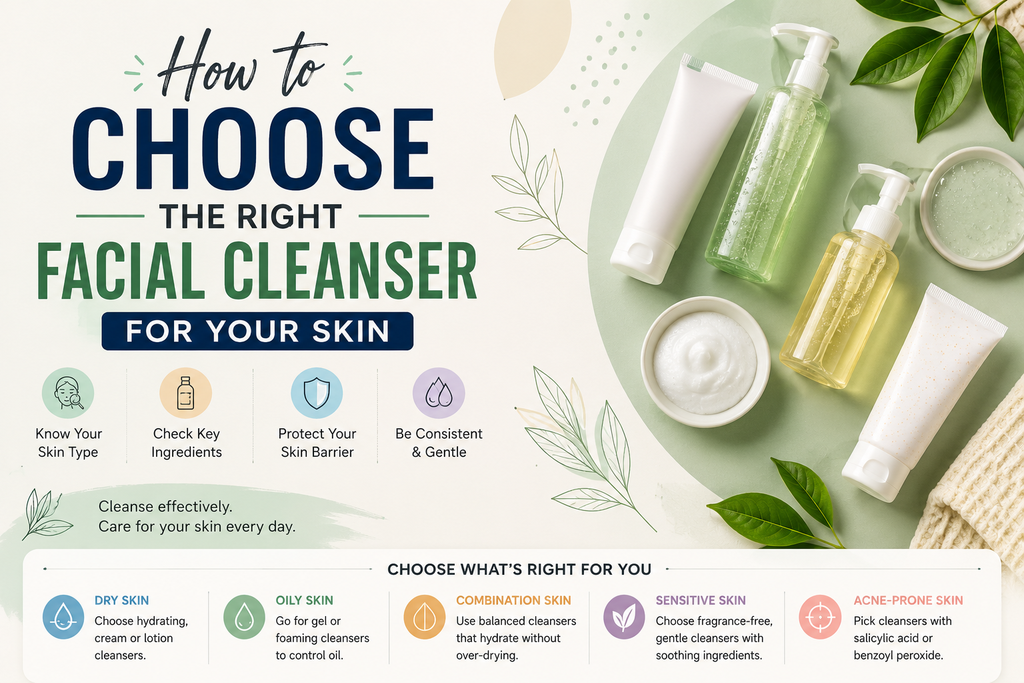
| Your skin | Look for |
| Dry | Gentle, hydrating or cream/lotion cleanser |
| Oily | Gentle gel or foaming cleanser |
| Combination | Mild cleanser that controls oil without drying |
| Sensitive | Fragrance-free, mild cleanser |
| Acne-prone | Gentle non-comedogenic cleanser; consider salicylic acid or benzoyl peroxide when appropriate |
| Rosacea-prone | Mild, fragrance-free cleanser designed for sensitive skin |
These categories are starting points rather than strict prescriptions.
If you have persistent acne, rosacea, eczema, severe irritation, or another diagnosed skin condition, cleanser selection should be considered alongside appropriate medical treatment rather than as a substitute for it.
Frequently Asked Questions
How do I know if my facial cleanser is too harsh?
Persistent tightness, burning, stinging, redness, excessive dryness, or flaking after cleansing can indicate that your cleanser is irritating your skin. A cleanser should remove unwanted substances without leaving your skin consistently uncomfortable.
Is a foaming cleanser bad for dry skin?
Not necessarily. The texture alone does not determine whether a cleanser is harsh. However, some foaming formulations may be more drying depending on their surfactants and overall formulation. If you have dry skin, choose based on how your skin responds rather than assuming that every foaming cleanser is unsuitable.
Should oily skin use a strong cleanser?
Usually, no. Oily skin needs effective removal of excess sebum, but overly aggressive cleansing can irritate the skin. Dermatologists recommend gentle cleansing for acne-prone skin rather than scrubbing or repeatedly washing the face.
Is salicylic acid cleanser good for acne?
It can be useful, particularly for clogged pores, blackheads, and whiteheads. However, salicylic acid can also cause dryness or irritation in some people. If that happens, reducing frequency or alternating with a gentle cleanser may be more appropriate.
Should sensitive skin use fragrance-free cleanser?
Fragrance-free is generally a sensible choice for sensitive or reactive skin because fragrance can be an irritant or trigger for some people. The AAD specifically recommends fragrance-free products for people managing rosacea and sensitive skin.
How many times a day should I wash my face?
For many people, once or twice daily is enough, with additional cleansing after heavy sweating. People with dry or sensitive skin may find once-daily evening cleansing sufficient.
Is facial cleanser better than soap?
A facial cleanser formulated for the face is generally preferable to conventional alkaline soap, particularly if you have dry or sensitive skin. Research indicates that traditional soaps can cause greater changes to skin pH and barrier properties than appropriately formulated syndet cleansers.
Should I use the same cleanser morning and night?
You can, provided it works well for your skin and routine. However, some people may benefit from adjusting their cleansing approach based on dryness, sensitivity, makeup or sunscreen use, and acne treatment. There is no requirement that every person use exactly the same cleanser twice a day.
The Bottom Line
Choosing the right facial cleanser is less about finding the product with the most impressive ingredient list and more about finding the right balance between effective cleansing and skin-barrier preservation.
Start with your skin type, identify your main concern, and choose the mildest cleanser that can adequately address it. Dry or sensitive skin generally benefits from gentle, fragrance-free formulations. Oily or acne-prone skin may benefit from lightweight cleansers and, when appropriate, active ingredients such as salicylic acid or benzoyl peroxide. Combination skin usually needs a balanced approach rather than aggressive oil removal.
Most importantly, pay attention to how your skin behaves after cleansing.
A good facial cleanser should leave your skin clean and comfortable, not stripped, burning, or excessively tight. That simple principle is more useful than chasing the latest cleanser trend.
The goal of cleansing is not to remove everything from your skin.
It is to remove what does not belong there while preserving what does.