
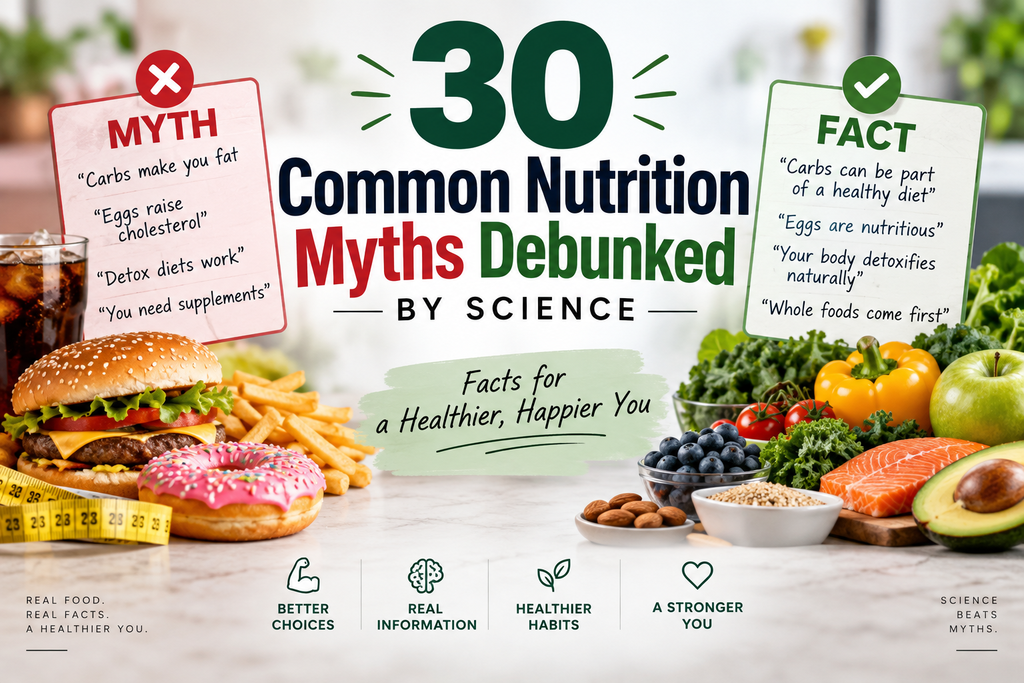
The science of nutrition is constantly evolving, leading to widespread confusion and deeply ingrained misconceptions. The truth is that healthy eating is highly individualized, and many popular beliefs, such as fearing carbohydrates or relying on restrictive detox diets, are simply not supported by current scientific evidence. Let us clearly set the record straight by exploring 30 common nutrition myths debunked by science to make informed dietary choices.
Macronutrients and Energy Sources
Our understanding of proteins, fats, and carbohydrates has shifted significantly over the years, rendering old advice obsolete.
Carbs make you fat.
Verdict: Excess calories cause weight gain, not carbohydrates themselves. Whole grains provide vital essential energy.
All dietary fat is bad.
Verdict: Fats are crucial for hormone production and brain health. Focus on healthy unsaturated sources.
Saturated fat causes heart attacks.
Verdict: The link is highly nuanced; strict moderation is key, rather than total elimination.
Low-carb diets are the only way to lose weight.
Verdict: Calorie deficits drive weight loss regardless of the specific daily macro ratio.
You must eat protein immediately post-workout.
Verdict: The anabolic recovery window lasts several hours. Total daily intake matters most.
More protein always equals more muscle.
Verdict: Your body has an absolute upper limit for protein synthesis per single meal.
Fruit contains too much sugar.
Verdict: The natural sugars in fruit are packaged with fiber, which properly regulates your digestion.
All sugar is completely toxic.
Verdict: The dose makes the poison. Small amounts of added sugar won’t derail your health.
Meal Timing, Frequency, and Hydration
When you eat and drink is often emphasized just as much as what you consume.
Breakfast is the most important meal.
Verdict: It is entirely optional. Skip it if you are truly not hungry.
Eating late causes instant weight gain.
Verdict: Your metabolism does not stop at night. Total daily calories dictate your weight.
Frequent meals boost metabolism.
Verdict: The thermic effect of food depends on total intake, not arbitrary meal frequency.
Detox diets cleanse your body.
Verdict: Your liver and kidneys are highly efficient built-in detoxification systems.
Lemon water burns body fat.
Verdict: It is hydrating and provides vitamin C, but has zero inherent fat-burning properties.
You need exactly eight glasses of water.
Verdict: Hydration needs vary based on activity, climate, and overall body size.
Coffee dehydrates you.
Verdict: Moderate coffee consumption contributes positively to your net daily total fluid intake.
Salt is universally bad for you.
Verdict: Sodium is an essential electrolyte, especially important for athletes and highly active individuals.
Food Quality, Categories, and Restrictions
- Myth 17: Eggs raise your bad cholesterol. Dietary cholesterol has a minimal impact on blood cholesterol for the majority of people.
- Myth 18: All processed foods are harmful. Processing includes freezing, canning, and fortifying. Not all processing reduces nutritional value.
- Myth 19: Fresh vegetables are always superior. Frozen vegetables are flash-frozen at peak ripeness, retaining more nutrients than fresh options.
- Myth 20: Organic food is significantly more nutritious. The nutritional differences between organic and conventional produce are generally quite marginal.
- Myth 21: Gluten-free diets are healthier for everyone. Unless you have celiac disease or a specific sensitivity, gluten is safe.
- Myth 22: Dairy is inherently inflammatory. For those without lactose intolerance or dairy allergies, dairy is a highly nutritious protein source.
- Myth 23: Soy consumption disrupts hormones. The phytoestrogens in soy do not function like mammalian estrogen and are safe.
- Myth 24: “Superfoods” will cure disease. This is largely a marketing term. A diverse, balanced diet is far more important.
Supplements and Popular Diet Plans
- Myth 25: Supplements can replace a poor diet. Pills cannot replicate the complex matrix of nutrients and fiber found in whole foods.
- Myth 26: Individualized DNA diets are highly accurate. While promising, current science cannot accurately dictate a perfect diet based solely on generic DNA.
- Myth 27: Foods burn fat. “Negative calorie” foods do not exist. Foods like celery are low in calories, but do not burn fat.
- Myth 28: Fasting puts you in starvation mode instantly. Short-term fasting does not slow your metabolism; true metabolic adaptation requires prolonged restriction.
- Myth 29: Plant milks are always healthier than dairy. Many plant milks contain sugars and lack the protein density of cow’s milk.
- Myth 30: There is one perfect diet for everyone. Bio-individuality is real. The best diet is one that meets your nutritional needs and fits your lifestyle sustainably.
Evidence-Based Principles of Healthy Eating
Instead of stressing over restrictive rules, focus on sustainable habits. Prioritize whole foods, ensure adequate protein intake, eat plenty of fiber-rich plants, and maintain a caloric intake that aligns with your goals.