
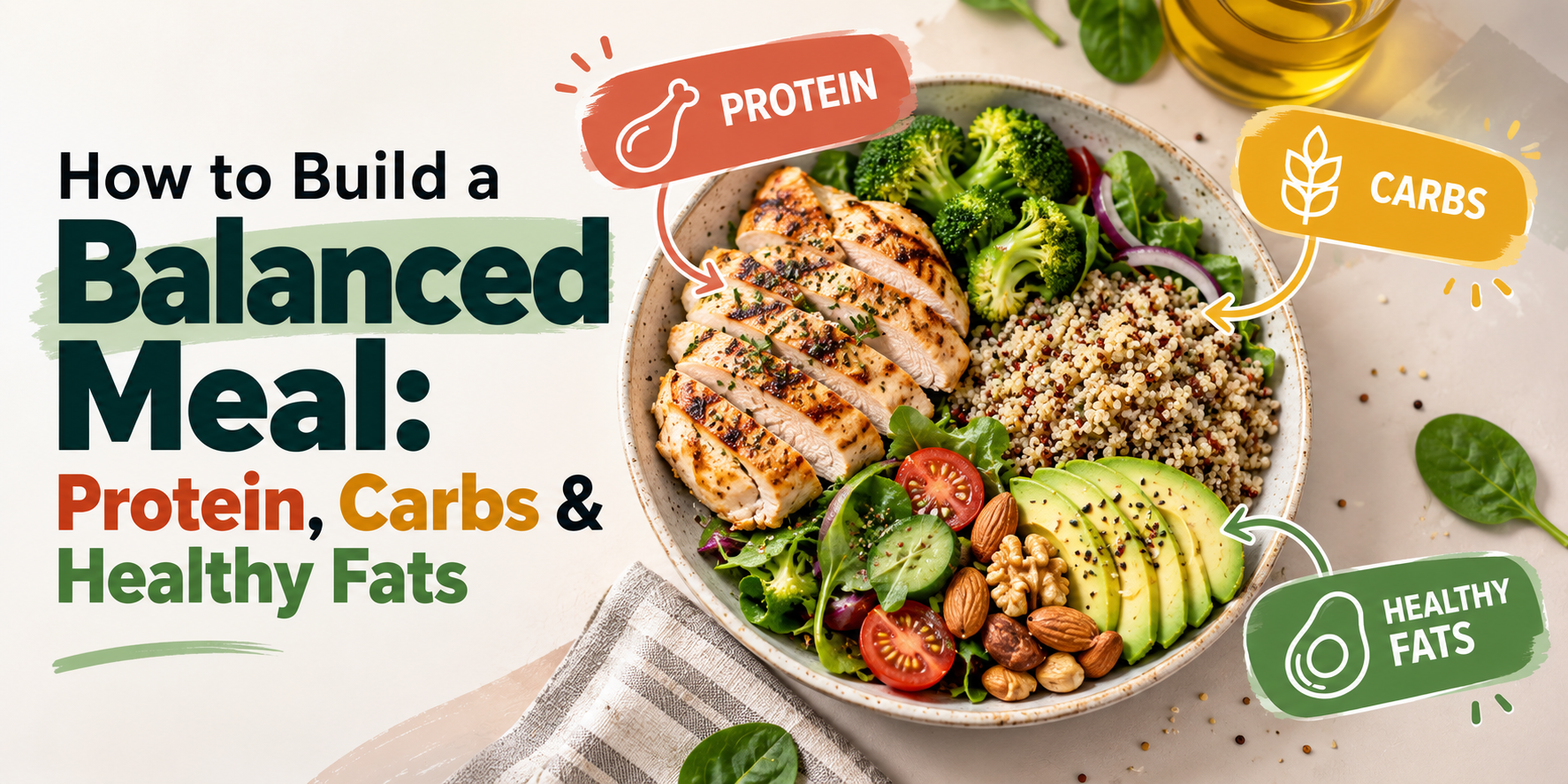
A balanced meal does not require perfect macro tracking or a complicated formula. A practical balanced meal combines a meaningful source of protein, a high-quality carbohydrate, a source of unsaturated fat, and plenty of vegetables or fruit. The right portions depend on your energy needs, body size, activity level, goals, and dietary preferences.
That approach is consistent with major nutrition guidance. The World Health Organization’s healthy-diet guidance emphasizes adequacy, balance, moderation, and dietary diversity, while Harvard’s Healthy Eating Plate provides a simple visual model built around vegetables and fruit, whole grains, healthy protein, and healthy plant oils.
What Is a Balanced Meal?
A balanced meal is a meal that combines different food groups in proportions that help you meet your energy and nutrient needs. In the context of protein, carbohydrates, and fats, the goal is not to make every meal contain an identical percentage of each macronutrient. Instead, think about what each component contributes and choose foods that work together.
- Protein supplies amino acids needed for maintaining and repairing tissues and is especially important for people who exercise regularly.
- Carbohydrates provide readily available energy and can also bring fiber, vitamins, minerals, and other beneficial compounds when they come from whole grains, fruits, vegetables, and pulses.
- Healthy fats provide concentrated energy and essential fatty acids and help the body absorb fat-soluble vitamins.
- Vegetables and fruit add fiber, vitamins, minerals, and a wide range of plant compounds.
For healthy adults, the National Academies’ established Acceptable Macronutrient Distribution Ranges are 45–65% of energy from carbohydrate, 20–35% from fat, and 10–35% from protein. These are population-level ranges, not a prescription that every individual meal must follow. The National Academies’ reference tables also make clear that individual nutritional needs vary.
The Simple Formula: Protein + Quality Carbs + Healthy Fat + Plants
If you want a practical way to build a meal without weighing every ingredient, start with four questions:
- Where is the protein?
- What is the main carbohydrate source?
- Where does the healthy fat come from?
- What vegetables or fruit will provide fiber and micronutrients?
This gives you a much more useful framework than simply asking whether a food is “good” or “bad.” A bowl of rice, for example, is not inherently an unbalanced meal. Rice becomes part of a more complete meal when you pair it with dal or another protein source, vegetables, and a sensible amount of nuts, seeds, or plant oil.
Step 1: Start With Protein
Protein is often the easiest component to under-serve, particularly when a meal is built mostly around grains or vegetables. Starting with the protein source helps make the rest of the meal easier to assemble.
Good protein choices
- Eggs
- Fish and poultry
- Beans, lentils, chickpeas, and other pulses
- Greek yogurt or plain yogurt
- Milk and other dairy foods
- Paneer or other minimally processed dairy-based options
- Tofu and other soy foods
- Nuts and seeds, recognizing that they also contribute substantial fat
For people who lift weights, protein deserves particular attention. A systematic review and meta-analysis published in the British Journal of Sports Medicine examined 49 studies involving 1,863 participants and found that protein supplementation increased gains in strength and fat-free mass during prolonged resistance training. Its analysis suggested that, in the studies examined, benefits to fat-free mass did not continue to increase beyond total protein intakes of about 1.6 g/kg/day. The PubMed record for the meta-analysis provides the study details and limitations.
That does not mean everyone needs 1.6 g/kg of protein, nor does it mean a protein supplement is necessary. It means that active people should pay attention to total protein intake rather than assuming a meal is balanced simply because it contains some protein.
Step 2: Choose a High-Quality Carbohydrate
Carbohydrates are not just a source of calories. The food carrying the carbohydrate matters because it can also determine how much fiber, micronutrients, and other beneficial compounds you get from the meal.
The WHO’s 2023 guideline on carbohydrate intake places particular emphasis on carbohydrate quality. It recommends that carbohydrates come primarily from whole grains, vegetables, fruits, and pulses, and recommends that adults consume at least 25 grams of naturally occurring dietary fiber per day.
Examples of useful carbohydrate sources
- Oats
- Brown rice or other whole grains
- Whole-wheat roti
- Millets
- Quinoa
- Potatoes and other starchy vegetables
- Fruit
- Beans, chickpeas, and lentils
Refined grains are not automatically forbidden. White rice or regular roti can still fit into a balanced diet. The bigger question is what the overall meal looks like and whether your diet consistently provides enough fiber and minimally processed foods.
Step 3: Add a Source of Healthy Fat
Fat is energy-dense, so it is easy to add more than you realize. But eliminating fat is not the answer. The quality of the fat matters.
The WHO recommends that dietary fat come primarily from unsaturated fatty acids and recommends limiting saturated fat to no more than 10% of total energy and trans fat to no more than 1%. WHO’s updated guidance on fats and carbohydrates explains the distinction and the foods that commonly contribute these fats.
Practical sources of unsaturated fats
- Almonds, walnuts, peanuts, and other nuts
- Seeds such as chia, flax, pumpkin, and sunflower seeds
- Avocado
- Olive, canola, sunflower, soybean, or other unsaturated vegetable oils
- Fatty fish, when included in your diet
You do not need to pour oil over a meal simply to “complete” the macros. If your meal already contains nuts, seeds, avocado, or another fat-rich food, additional oil may not be necessary.
Step 4: Make Vegetables or Fruit a Major Part of the Meal
Protein, carbs, and fats are useful for thinking about macronutrients, but a balanced meal is bigger than three numbers. Vegetables and fruit contribute fiber, vitamins, minerals, and numerous plant compounds.
Harvard’s Healthy Eating Plate suggests making about half the plate vegetables and fruit, with the other half divided between whole grains and healthy protein. It also recommends healthy plant oils in moderation. The guide is deliberately visual rather than calorie-specific because calorie and nutrient needs vary between people. Harvard’s Healthy Eating Plate explains the model in more detail.
The WHO similarly recommends at least 400 grams of fruits and vegetables per day for people older than 10 years and at least 25 grams of naturally occurring dietary fiber per day. These are daily targets, not requirements that must be achieved in every meal.
How Much of Each Food Should You Eat?
There is no single portion size that creates a perfect balanced meal for everyone. Someone training for a marathon, someone trying to gain weight, and someone with a sedentary lifestyle will not have identical energy needs.
A useful starting point is the plate method:
| Part of the meal | Practical starting point | Examples |
|---|---|---|
| Vegetables and fruit | About half the plate, adjusted for the meal | Mixed vegetables, spinach, tomatoes, carrots, salad, fruit |
| Protein | About one-quarter of the plate or a clearly defined protein serving | Eggs, dal, beans, yogurt, paneer, fish, chicken |
| Quality carbohydrates | About one-quarter of the plate | Rice, oats, whole grains, roti, potatoes, millet |
| Healthy fat | A modest addition, depending on the foods already present | Nuts, seeds, avocado, or unsaturated cooking oil |
This is a framework, not a medical prescription. Your portions can move up or down based on hunger, body size, activity, goals, and the rest of your day’s food intake.
Balanced Meal Examples
Indian vegetarian meal
Try dal, brown or regular rice, a large serving of mixed vegetables, plain curd, and a small portion of nuts or seeds. The dal contributes protein and carbohydrate, rice supplies additional carbohydrate, vegetables add fiber and micronutrients, and nuts or seeds provide unsaturated fat.
Egg-based meal
Build a plate with eggs, whole-wheat roti, a large serving of sautéed or steamed vegetables, and a small serving of fruit. If the cooking method uses very little fat, a modest amount of an unsaturated vegetable oil can complete the meal.
Breakfast
Oats cooked with milk or yogurt, fruit, and nuts or seeds can work as a balanced breakfast. If you need more protein, add eggs or increase the portion of a protein-rich dairy food.
Post-workout meal
A post-workout meal can combine a substantial protein source with carbohydrate and vegetables. For example, eggs or paneer with rice or roti and vegetables can work well. The exact meal does not need to be consumed within an arbitrary “anabolic window”; what matters more is meeting your overall energy and protein needs across the day.
How to Adjust a Balanced Meal for Different Goals
For weight loss
Keep the basic structure but pay closer attention to energy-dense ingredients such as oils, nuts, cheese, creamy sauces, and large portions of refined carbohydrates. Vegetables can provide volume and fiber without adding as much energy as many calorie-dense foods.
Weight loss ultimately requires sustained energy intake below energy expenditure, but food quality and portion composition can make that easier to maintain. Harvard’s Nutrition Source emphasizes that both calories and food quality matter when considering healthy weight management. Harvard’s discussion of diet quality and weight explains this distinction.
For muscle gain
Keep protein consistently high enough for your needs and increase overall food intake when necessary. Carbohydrates can be particularly useful for supporting training volume and replenishing energy. If you struggle to eat enough, adding calorie-dense foods such as nuts, seeds, dairy, or healthy oils can increase energy intake without dramatically increasing food volume.
For endurance training
Carbohydrate needs can rise substantially as training volume increases. In that situation, a meal may contain a larger carbohydrate portion while still including adequate protein and some fat. The right balance is determined by the training demand rather than by a fixed plate ratio.
Common Mistakes When Building Balanced Meals
1. Treating every meal like a macro math problem
You do not need to calculate the exact protein, carbohydrate, and fat percentage of every plate. Use the framework consistently and look at your overall dietary pattern.
2. Choosing “healthy” foods but ignoring portions
Nuts, seeds, oils, nut butters, cheese, and other nutritious foods can still contribute substantial calories. Nutritional quality and quantity are separate questions.
3. Cutting carbohydrates unnecessarily
Carbohydrate quality matters, but carbohydrates are not inherently unhealthy. Whole grains, fruit, vegetables, and pulses can be valuable parts of a balanced diet.
4. Focusing on protein while forgetting fiber
A high-protein meal made almost entirely from protein-rich foods can still be nutritionally incomplete. Include vegetables, fruit, pulses, or whole grains as appropriate.
5. Assuming “low fat” means healthier
Healthy fats have an important place in the diet. The goal is to emphasize unsaturated sources and limit trans fats and excessive saturated fat rather than eliminating dietary fat altogether.
A 30-Second Balanced Meal Checklist
Before eating, ask:
- Do I have a meaningful protein source?
- Is my main carbohydrate source reasonably nutrient-dense?
- Have I included vegetables or fruit?
- Is there a sensible source of unsaturated fat?
- Does the portion fit my hunger, activity, and goal?
- Will this meal help me meet my overall protein and fiber needs for the day?
If the answer is yes to most of these questions, you are probably much closer to a balanced meal than you would be by chasing a perfect macro ratio.
Frequently Asked Questions
What is the ideal ratio of protein, carbs, and fat in a meal?
There is no universal ideal ratio for every meal. The National Academies’ adult Acceptable Macronutrient Distribution Ranges are 45–65% carbohydrate, 20–35% fat, and 10–35% protein across total energy intake. Individual meals can vary considerably within an overall balanced diet.
Should every meal contain protein, carbohydrates, and fat?
Including all three can be a useful default, but it is not a strict requirement. Some meals or snacks may naturally emphasize one or two macronutrients. What matters most is the overall pattern across the day and week.
Are carbs necessary for a healthy diet?
Carbohydrates can be an important part of a healthy diet. WHO guidance emphasizes carbohydrate quality and recommends getting carbohydrates primarily from whole grains, vegetables, fruits, and pulses rather than relying heavily on foods high in free sugars and refined carbohydrates.
What are the healthiest fats to include in meals?
Prioritize sources of unsaturated fats such as nuts, seeds, avocado, and unsaturated vegetable oils. Fatty fish is another source of unsaturated fat for people who eat fish. Keep trans fats as low as possible and limit saturated fat.
How much protein should a meal contain?
The appropriate amount depends on your total daily protein requirement, body size, age, health status, and activity. People who resistance train often have higher protein needs than sedentary adults. A useful strategy is to distribute adequate protein across meals rather than trying to consume almost all of it at one sitting.
Can rice be part of a balanced meal?
Yes. Rice can be part of a balanced meal when combined with a protein source, vegetables or fruit, and an appropriate amount of fat. Brown rice and other whole grains provide more fiber, but white rice can also fit into a healthy dietary pattern.
Is a balanced meal the same as a low-calorie meal?
No. A balanced meal is about nutritional composition and adequacy, not simply having few calories. Someone with high energy demands may need a substantially larger balanced meal than someone with lower energy needs.
The Bottom Line
The easiest way to build a balanced meal is to stop looking for a perfect macro percentage and start building from food groups. Choose a reliable protein source, add a high-quality carbohydrate, include vegetables or fruit, and use a modest amount of healthy unsaturated fat. Then adjust portions to match your energy needs and goals.
The most useful meal is one you can repeat consistently. A simple plate of dal, rice, vegetables, curd, and a few nuts can be balanced. So can eggs with roti and vegetables, or oats with yogurt, fruit, and seeds. The foods can change; the underlying structure stays the same.
Balanced eating is therefore less about precision and more about pattern: adequate protein, quality carbohydrates, healthy fats, plenty of plant foods, sensible portions, and enough variety to cover your nutritional needs over time.