
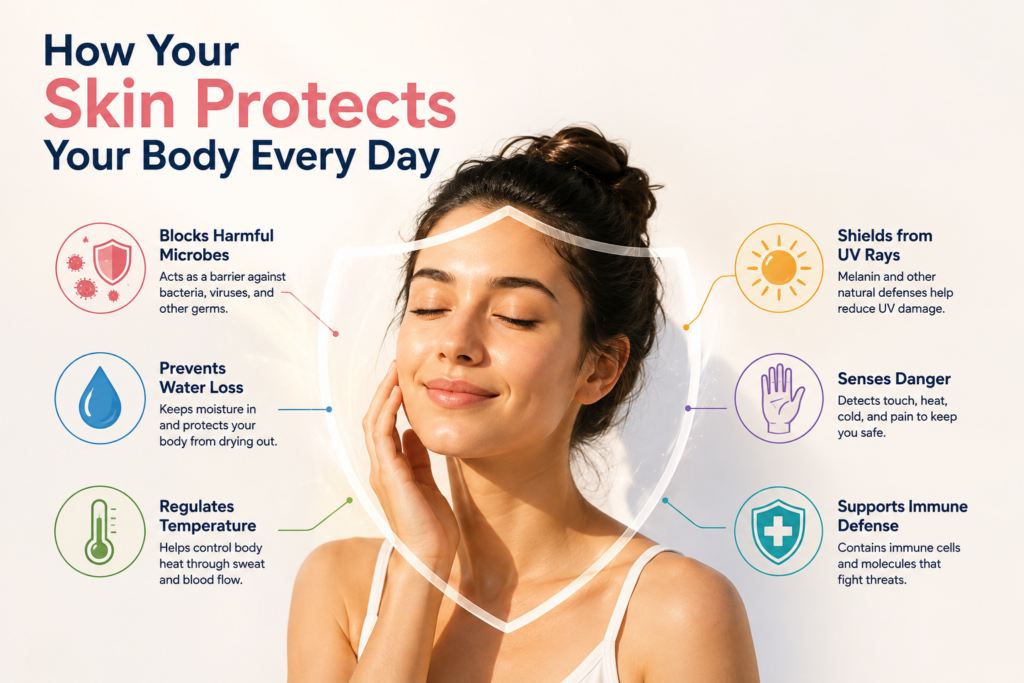
Your skin does far more than cover your body. Every minute of every day, it stands between your internal organs and the outside world, helping prevent water loss, limiting the entry of harmful microorganisms and chemicals, reducing damage from ultraviolet radiation, sensing potentially dangerous changes in your surroundings, regulating body temperature, and repairing itself when injured.
The skin is the body’s first line of defense, but calling it a simple protective covering doesn’t capture how sophisticated it really is. It is a living organ made up of multiple layers, specialized cells, blood vessels, nerves, glands, immune components, and microorganisms that work together to maintain the body’s internal environment.
According to NCBI’s overview of how skin works, skin acts as a flexible protective covering against environmental threats including cold, sunlight, germs and toxic substances. It also contributes to temperature regulation and sensation.
That means your skin is working even when you are asleep.
What Is the Skin’s Main Job?
The primary job of skin is to create a controlled boundary between the body’s internal environment and the outside world.
That boundary performs several functions at once:
- Preventing excessive water loss
- Limiting the entry of microorganisms
- Reducing penetration of chemicals and irritants
- Protecting deeper tissues from mechanical injury
- Reducing some of the effects of ultraviolet radiation
- Helping regulate body temperature
- Detecting pain, pressure, heat, cold and touch
- Participating in immune defense
- Repairing damaged tissue
- Contributing to vitamin D production
A review of the epidermal barrier published in PMC’s Five Functional Aspects of the Epidermal Barrier describes the skin barrier as having physical, chemical, microbial, neuronal and immune components. In other words, skin protection isn’t provided by one mechanism. It is a coordinated system.
The Three Layers of Skin Work Together
Understanding how skin protects the body becomes easier when you understand its basic structure.
Skin has three major layers:
- Epidermis
- Dermis
- Hypodermis, or subcutaneous tissue
Each contributes differently to protection.
| Skin layer | Main protective contribution |
|---|---|
| Epidermis | Physical, chemical, microbial and environmental barrier |
| Dermis | Strength, elasticity, blood supply, sensation and temperature regulation |
| Hypodermis | Cushioning, insulation and energy storage |
The NCBI Bookshelf’s anatomy reference for the epidermis explains that skin plays important roles in temperature and water balance, sensation, protection and secretion.
The epidermis: your outer defensive wall
The epidermis is the outermost layer of skin. It is constantly renewing itself.
One of its most important structures is the stratum corneum, the outermost part of the epidermis.
The stratum corneum is often described using a “bricks and mortar” model. The bricks are flattened cells called corneocytes, while the mortar consists largely of specialized lipids between them.
Together, they form an effective permeability barrier.
Research reviewed in Five Functional Aspects of the Epidermal Barrier explains that the epidermis limits passive water loss, protects against environmental aggression and helps prevent microbial infection.
The epidermis therefore isn’t simply a dead outer coating. It is a constantly maintained defensive system.
The dermis: the supportive layer underneath
Below the epidermis is the dermis.
The dermis contains collagen, elastin, blood vessels, lymphatic vessels, nerves, hair follicles and sweat glands. Its connective-tissue framework gives skin much of its strength and flexibility.
The dermis also contributes to temperature regulation because its blood vessels can change how much blood reaches the skin’s surface.
The hypodermis: built-in cushioning and insulation
The deepest layer is the hypodermis, also called subcutaneous tissue.
It contains fat and connective tissue. This layer helps anchor the skin to underlying structures, provides cushioning against physical impact and contributes to insulation.
So rather than thinking of the three layers as separate pieces, it is more useful to see them as a coordinated system. The epidermis creates much of the external barrier, the dermis provides structural and physiological support, and the hypodermis adds cushioning and insulation.
1. Your Skin Prevents You From Losing Too Much Water
One of the skin’s most important jobs happens without you noticing it: preventing excessive water loss.
Your body contains a large amount of water, while the surrounding environment can be considerably drier. Without an effective barrier, water would continuously move outward through the skin.
The stratum corneum helps prevent that.
Its tightly organized cells and lipids make it difficult for water to escape rapidly. This allows the body to maintain hydration despite constant exposure to air.
The skin barrier therefore works in two directions.
Inside → outside: It limits the loss of water and other substances from the body.
Outside → inside: It limits penetration of unwanted substances and microorganisms.
Research summarized in NCBI’s review of the epidermal barrier identifies limiting passive water loss as one of the fundamental functions of the epidermis.
This is also why a damaged skin barrier can cause problems.
When the barrier becomes impaired, water can escape more easily and external irritants may penetrate more readily. Barrier dysfunction is associated with a range of inflammatory skin conditions, although the relationship between barrier disruption and disease varies between conditions.
In practical terms, your skin isn’t simply trying to keep your body dry on the inside.
It is helping your body maintain a stable internal environment.
2. Your Skin Creates a Physical Barrier Against Microbes
Every day, your skin encounters bacteria, fungi, viruses and other microorganisms.
Yet most of the time, these organisms don’t get through healthy skin and establish an infection.
That is because healthy skin creates several obstacles.
The physical structure of the epidermis makes it difficult for microorganisms to reach deeper tissues. Its cells and intercellular lipids create a barrier that pathogens have to overcome before reaching the living layers underneath.
But physical protection is only the first defense.
The skin also creates a chemical environment that can make colonization by some harmful organisms more difficult.
As explained in the Nature Reviews Microbiology review of the human skin microbiome, the skin’s dry, nutrient-poor and acidic environment itself presents challenges for microorganisms attempting to colonize it.
This gives the skin multiple overlapping defenses:
Physical barrier → chemical environment → antimicrobial molecules → immune response
If one defense is breached, another can respond.
3. Your Skin Has Its Own Immune Defense System
One of the most interesting things about skin is that it isn’t merely a passive wall.
It can actively detect threats.
Keratinocytes, the predominant cells in the epidermis, are particularly important. They contribute to the physical barrier while also participating in immune responses.
Research published in Nature Reviews Immunology describes the skin as a complex immune environment in which microorganisms, immune cells and tissue responses interact to maintain protection and tissue health.
Keratinocytes can detect signals associated with pathogens and respond by producing signaling molecules and antimicrobial substances.
For example, research indexed in PubMed on keratinocyte production of cathelicidin found that keratinocytes can produce antimicrobial peptides that contribute to defense against bacterial pathogens.
These molecules are part of what makes skin an active immune interface rather than an inert wall.
So the skin’s defense system is not simply:
“Keep microbes out.”
It is closer to:
Keep them out, detect threats, respond when necessary, and help repair the resulting damage.
4. Your Skin Microbiome Helps Defend You
Your skin is home to enormous communities of microorganisms.
That might sound contradictory. If skin protects you from microbes, why does it deliberately host them?
Because not every microorganism is harmful.
The skin microbiome includes communities of bacteria, fungi, viruses and other microorganisms that live on and around the skin.
Modern research shows that these communities can contribute to skin health and immune function.
A 2025 review in Nature Reviews Microbiology on the human skin microbiome describes the skin microbiome as a diverse ecosystem that contributes to skin health, protection against pathogens and modulation of immune responses.
Earlier research published in Nature also emphasizes that interactions between skin microorganisms and the host can range from mutually beneficial relationships to situations where microorganisms contribute to disease, depending on factors such as barrier status and immune activity.
This is an important distinction.
Healthy skin is not sterile.
Instead, it maintains a controlled ecosystem.
Some resident microorganisms can occupy ecological niches and produce molecules that influence other microorganisms. According to the Nature Reviews Microbiology review of the human skin microbiome, some skin microorganisms can produce molecules that inhibit colonization by other microorganisms.
The goal, therefore, isn’t to eliminate every microbe from your skin.
It is to maintain a healthy barrier and a balanced skin environment.
5. Melanin Helps Protect Your Skin From UV Radiation
Sunlight is essential for life, but ultraviolet radiation can damage skin cells.
The skin has a natural defense against some of this radiation: melanin.
Melanin is produced by specialized cells called melanocytes in the epidermis.
When skin is exposed to UV radiation, melanin production can increase, contributing to tanning. Melanin absorbs and scatters some UV radiation, reducing the amount that reaches vulnerable cellular structures.
Research on the photoprotective role of melanin describes melanin as an important component of the skin’s natural defense against ultraviolet radiation.
But melanin is not an impenetrable sunscreen.
People with darker skin generally have greater natural photoprotection because of differences in melanin quantity, type and distribution. However, people of all skin tones can experience UV damage and develop skin cancer.
The CDC’s 2026 guidance on skin-cancer risk emphasizes that anyone can develop skin cancer and that reducing UV exposure can lower risk.
This leads to an important distinction:
Your skin has natural UV defenses, but those defenses do not eliminate the need for sun protection.
6. Your Skin Helps Keep Your Body Temperature Stable
Your skin doesn’t just respond to temperature. It actively participates in controlling it.
When you’re hot, blood vessels near the skin can dilate. More blood reaches the skin’s surface, allowing heat to move from the body’s core toward the environment.
At the same time, sweat glands produce sweat.
As sweat evaporates from the skin surface, it removes heat.
The NCBI overview of skin function explains that sweat glands contribute to cooling while skin blood vessels help regulate heat exchange with the environment.
When you’re cold, the response changes.
Blood vessels in the skin constrict, reducing blood flow near the surface and helping conserve heat.
This is why your skin can become:
- Redder when you’re hot
- Pale or colder when you’re exposed to cold
- Sweaty during exercise
- Covered in goosebumps in response to cold or other stimuli
Your skin is therefore part of your body’s temperature-control system, not simply a surface that reflects temperature.
7. Your Skin Warns You When Something Is Dangerous
Protection isn’t only about blocking things.
Sometimes your body needs to know that something potentially harmful has touched it.
That’s where the sensory function of skin becomes critical.
Nerves and sensory receptors in the skin allow you to detect:
- Touch
- Pressure
- Vibration
- Heat
- Cold
- Pain
- Itch
The NCBI’s anatomy reference on skin explains that skin contains sensory structures involved in detecting touch, heat, cold and pain.
Imagine touching a hot pan.
The protective response isn’t simply that your skin prevents heat from entering.
Your skin detects the dangerous temperature and sends signals through the nervous system. Your brain processes the information, and you rapidly withdraw your hand.
In that situation, your skin is acting like both a shield and an alarm system.
That alarm function can be just as important as the physical barrier.
8. Your Skin Cushions Your Body Against Physical Injury
Skin also protects deeper structures from everyday physical stress.
The epidermis provides a tough outer surface, while the dermis provides structural strength and elasticity through its connective-tissue network.
Beneath them, the hypodermis provides additional cushioning.
This matters because your body is constantly exposed to friction, pressure, impact and stretching.
Consider the palms of your hands.
They experience repeated pressure and friction, yet the skin can adapt. Repeated mechanical stress can stimulate thickening of the outer skin, producing a callus.
This is another example of skin functioning as a dynamic organ rather than a static covering.
The skin can respond to its environment and change its structure when repeated physical stress demands additional protection.
9. Hair, Sweat and Oil Glands Add Extra Protection
The skin doesn’t work alone.
Its accessory structures contribute to its protective functions too.
Sweat glands
Sweat is essential for evaporative cooling. It also contributes to the chemical environment of the skin surface.
The NCBI overview of the integumentary system describes sweat as part of the skin’s thermoregulatory system and notes that sweat can also discourage excessive microbial colonization.
Sebaceous glands
Sebaceous glands produce sebum, an oily substance that contributes to the condition and surface environment of the skin.
Hair
Hair can provide physical protection and influence heat transfer from the skin.
Hair also has sensory functions. Movement of hair can provide information about contact with the surrounding environment.
Nails
Nails protect the ends of fingers and toes and provide mechanical support for activities requiring precision and pressure.
Together, these structures form the broader integumentary system.
10. Your Skin Can Repair Itself After Injury
A protective barrier is only useful if it can respond when damaged.
Fortunately, skin has a sophisticated repair system.
When you scrape your knee or cut your finger, the body doesn’t simply wait for the damage to disappear.
Wound healing involves overlapping stages that include inflammation, tissue formation and remodeling.
A comprehensive review indexed in PubMed on acute skin wound healing describes wound healing as a coordinated process involving inflammatory, proliferative and remodeling phases.
A simplified version looks like this:
Step 1: Stop the bleeding
Blood vessels and clotting mechanisms work to limit blood loss and create an initial barrier.
Step 2: Control contamination
Inflammatory and immune responses help remove damaged material and defend the wound against microorganisms.
Step 3: Rebuild the tissue
New cells multiply and migrate into the damaged area. Blood vessels and connective tissue also participate in rebuilding.
Step 4: Remodel
The repaired tissue continues to reorganize and strengthen.
This is why a small cut can gradually close and become less noticeable over time.
The process isn’t perfect, however. Deeper injuries can result in scars because the body prioritizes restoring structural integrity rather than recreating completely identical original tissue.
11. Your Skin Also Participates in Vitamin D Production
The relationship between skin and sunlight is more complicated than simply saying that sunlight is harmful.
UVB radiation can initiate vitamin D synthesis in the skin.
When UVB reaches uncovered skin, it converts 7-dehydrocholesterol into previtamin D3, which is subsequently converted into vitamin D3 and further processed by the body.
The NIH Office of Dietary Supplements’ vitamin D fact sheet explains the skin’s role in vitamin D production and notes that factors such as season, time of day, cloud cover, skin pigmentation and sunscreen use can influence the amount produced.
But this doesn’t mean more sun exposure is better.
UV radiation can damage skin and increase skin-cancer risk. The CDC’s 2026 guidance on reducing skin-cancer risk recommends limiting excessive UV exposure and avoiding artificial sources such as tanning beds and sunlamps.
The practical lesson is simple:
The skin uses sunlight as part of a biological process, but that doesn’t make intentional excessive UV exposure healthy.
Vitamin D can also be obtained through food and supplements when appropriate.
What Happens When the Skin Barrier Is Damaged?
A healthy skin barrier keeps many processes under control.
When it is significantly damaged, several things can change at once.
You may experience:
- Increased water loss
- Dryness
- Greater sensitivity
- Increased penetration of irritants
- Greater vulnerability to infection
- Inflammation
- Slower barrier recovery
Research reviewed in Five Functional Aspects of the Epidermal Barrier shows that barrier integrity is closely connected to physical protection, microbial defense, immune activity and the skin’s ability to respond to injury.
This is one reason why “skin health” isn’t merely about appearance.
Healthy-looking skin can reflect a functioning barrier, but appearance alone doesn’t tell you everything happening biologically beneath the surface.
How Can You Support Your Skin’s Natural Protection?
You don’t need an elaborate skincare routine to support the skin’s basic protective functions.
The fundamentals matter.
1. Protect your skin from excessive UV exposure
Use shade, protective clothing and appropriate broad-spectrum sunscreen when you’re exposed to significant UV radiation.
The CDC’s current skin-cancer prevention guidance recommends making sun protection an everyday habit and avoiding artificial UV sources such as tanning beds.
2. Avoid unnecessarily aggressive cleansing
Cleansing removes sweat, dirt and substances from the skin, but excessive or harsh cleansing can contribute to irritation and interfere with the skin’s surface environment.
The goal isn’t to remove everything from your skin.
It’s to remove what needs to be removed while preserving the barrier.
3. Moisturize when your skin needs it
Moisturizers can help reduce water loss and improve the condition of the outer skin layer, particularly when skin is dry or the barrier is compromised.
The most appropriate product depends on the individual’s skin type and the reason for dryness.
4. Don’t treat every microorganism as an enemy
Your skin microbiome is part of normal skin biology.
The objective isn’t to make the skin sterile. Research in Nature Reviews Microbiology shows that the skin microbiome is involved in maintaining skin health, interacting with pathogens and modulating immune responses.
5. Pay attention to persistent changes
Persistent cracking, bleeding, unexplained rashes, rapidly changing moles, non-healing wounds or significant changes in skin texture deserve appropriate medical evaluation.
Skin is an organ, and persistent changes can sometimes signal problems that have little to do with ordinary dryness.
Common Misconceptions About Skin Protection
“A tan means my skin is healthy.”
No.
A tan is a biological response to UV exposure. The CDC explains that a change in skin color following UV exposure is a sign of skin injury, not health.
“People with dark skin don’t need sun protection.”
Incorrect.
Higher melanin levels provide greater natural protection against UV radiation, but they don’t eliminate UV-related damage or skin-cancer risk.
The CDC specifically states that anyone can develop skin cancer, regardless of whether they have the risk factors traditionally associated with lighter skin.
“The skin is just a physical barrier.”
Not at all.
It is also an immune organ, sensory organ and thermoregulatory organ. Keratinocytes, immune cells, antimicrobial peptides, blood vessels, nerves and microorganisms all participate in its functions.
The Nature Reviews Immunology review of skin microorganisms and cutaneous immunity illustrates how closely the skin’s barrier and immune functions interact.
“Clean skin should have no bacteria.”
Healthy skin normally contains a diverse microbial community.
The objective is not sterility. It is a stable relationship between the skin, its resident microorganisms and the external environment.
Research in Nature Reviews Microbiology describes the skin as both a physical barrier and an ecosystem supporting diverse microbial communities.
“Moisturizing is just cosmetic.”
Not necessarily.
The outer skin barrier is involved in controlling water loss, so maintaining adequate hydration can have a functional purpose as well as an aesthetic one.
The Bigger Picture: Your Skin Is a Living Defense System
Your skin protects you through several systems operating simultaneously.
Physical protection: The epidermis and underlying tissues help block mechanical, chemical and environmental threats.
Water protection: The stratum corneum limits excessive water loss.
Microbial protection: The physical barrier, skin chemistry, antimicrobial peptides, immune cells and microbiome work together against pathogens.
UV protection: Melanin and other components of the epidermis reduce some UV-related damage.
Temperature control: Blood flow and sweating help transfer and dissipate heat, while reduced skin blood flow helps conserve heat in cold conditions.
Sensory protection: Nerves allow you to detect pain, temperature, pressure and touch before damage becomes worse.
Repair: When the barrier is breached, coordinated wound-healing mechanisms work to restore it.
Metabolic function: The skin also participates in vitamin D production following UVB exposure.
None of these systems operates in isolation.
That is the most useful way to understand skin: it is an integrated organ that constantly manages the boundary between you and your environment.
You don’t consciously notice most of this work because a healthy skin barrier is remarkably good at doing its job in the background.
The next time you wash your hands, walk outside, exercise, feel a hot surface, get a small scrape or simply sit in an air-conditioned room, your skin is responding to the environment.
It is protecting you, sensing the world around you, regulating your internal conditions and repairing itself when necessary.
That is why taking care of your skin isn’t only about having clearer or better-looking skin. Maintaining a healthy skin barrier is part of maintaining one of your body’s most important lines of defense.
Frequently Asked Questions
1. How does skin protect the body?
Skin protects the body by forming a physical and chemical barrier against microorganisms, chemicals, excessive water loss, UV radiation and mechanical injury. It also supports immune defense, regulates temperature and detects potentially harmful stimuli such as heat and pain. The NCBI overview of skin function provides an overview of these protective and regulatory roles.
2. Which layer of skin provides the main protective barrier?
The epidermis, particularly its outermost layer called the stratum corneum, provides much of the skin’s permeability barrier. It helps limit water loss and restrict the movement of substances and microorganisms through the skin. The mechanisms of this barrier are discussed in detail in Five Functional Aspects of the Epidermal Barrier.
3. Does skin protect against bacteria and viruses?
Yes. Healthy skin provides a physical barrier while also producing antimicrobial molecules and supporting immune responses. The skin microbiome can also influence protection against pathogens and immune function, as described in research published in Nature Reviews Immunology and Nature Reviews Microbiology.
4. How does skin regulate body temperature?
When the body needs to lose heat, blood flow to the skin can increase and sweat production rises. Evaporation of sweat removes heat. In cold conditions, skin blood vessels constrict, reducing heat loss and helping conserve core temperature. The NCBI explanation of the integumentary system describes these temperature-regulation functions.
5. Does melanin completely protect skin from the sun?
No. Melanin provides natural photoprotection and reduces some UV penetration, but it doesn’t completely prevent UV damage. People of all skin tones can experience UV-related skin damage and skin cancer. The CDC’s skin-cancer guidance emphasizes that anyone can develop skin cancer.
6. Why does skin heal after a cut?
Skin activates a coordinated wound-healing response involving inflammation, tissue formation and remodeling. These processes help control contamination, rebuild damaged tissue and restore the skin barrier. A detailed review of this process is available through PubMed’s review of acute skin wound healing.
7. Is the skin microbiome good or bad?
Neither description is sufficient. The skin microbiome is a complex ecosystem containing microorganisms that can contribute to normal skin physiology and immune defense. However, some microorganisms can contribute to disease under particular conditions. Research in Nature explains how these host-microbe interactions depend on factors including barrier status, immune activity and microbial location.
8. Why is protecting the skin barrier important?
A functioning skin barrier helps control water loss and limits exposure of deeper tissues to external substances and microorganisms. It also works together with immune, microbial and sensory defenses. The review of epidermal barrier functions explains how these different protective mechanisms interact.