
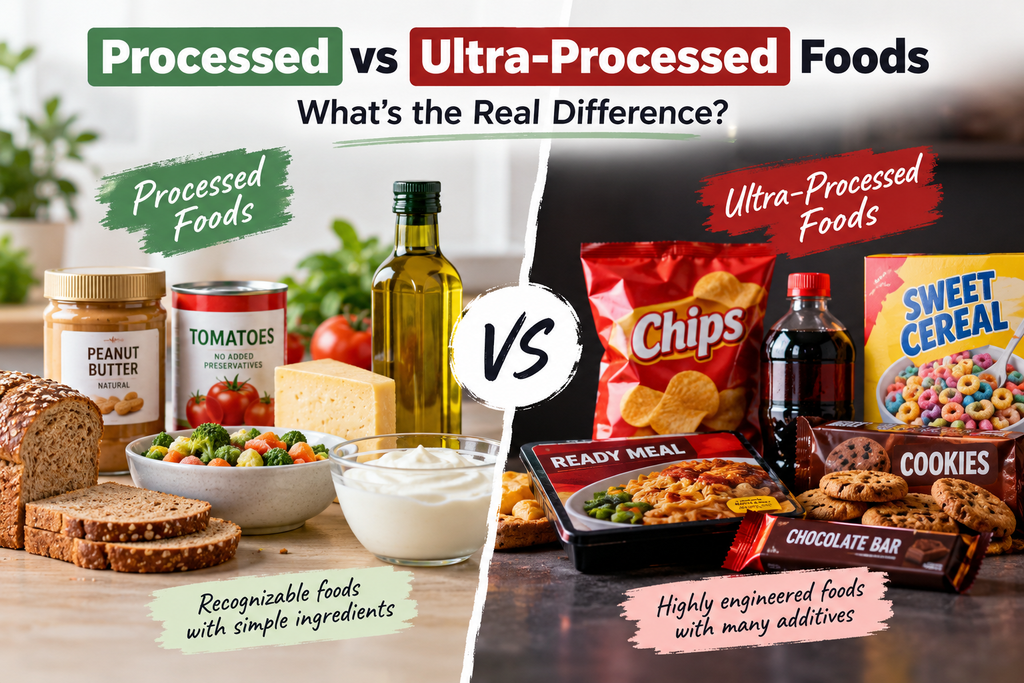
Walk through a supermarket and you will find thousands of foods that have been changed in some way before reaching your plate.
Milk may be pasteurized. Tomatoes may be canned. Wheat may be milled into flour. Cheese may be fermented and aged. Bread may be baked. A frozen vegetable may simply be washed, cut and frozen.
Then there are soft drinks, packaged cookies, instant noodles, sweetened breakfast cereals, packaged cakes, chicken nuggets and many ready-to-eat meals.
All of these foods are “processed” in some sense. But that does not mean they belong in the same nutritional category.
This is where the distinction between processed foods and ultra-processed foods becomes useful.
The simplest way to think about it is this:
Processed food is usually a recognizable food that has been modified or preserved, often using relatively simple ingredients such as salt, sugar or oil. Ultra-processed food is generally an industrial formulation made from multiple ingredients and substances that are rarely used in ordinary home cooking.
The distinction comes largely from the NOVA food classification system, which groups foods according to the nature, extent and purpose of processing.
But there is an important catch: “processed” does not automatically mean unhealthy, and “ultra-processed” is not simply another word for junk food.
Understanding that difference can make grocery shopping and everyday eating much easier.
Processed vs Ultra-Processed Foods: The Quick Difference
Here is the practical comparison:
| Processed foods | Ultra-processed foods | |
|---|---|---|
| What they are | Recognizable foods modified or preserved through processing | Industrial formulations made from multiple ingredients and food-derived substances |
| Typical purpose | Preserve food, improve shelf life or alter taste | Create convenient, highly palatable, durable and ready-to-eat products |
| Typical ingredients | Food + salt, sugar, oil or other culinary ingredients | Multiple ingredients, including refined ingredients and additives |
| Examples | Canned beans, cheese, salted nuts, some breads | Soft drinks, packaged snacks, instant noodles, confectionery, many ready meals |
| Usually recognizable as the original food? | Often yes | Often difficult to recognize as the original food |
| Automatically unhealthy? | No | Not necessarily, but higher consumption is consistently associated with poorer health outcomes |
| Main concern | Often depends on nutrients such as sodium, sugar and saturated fat | Nutrient profile plus formulation, palatability, energy density and the broader dietary pattern |
The most important point is that the degree of processing and nutritional quality are related concepts, but they are not identical.
What Does “Processed Food” Actually Mean?
Processing is not new, and it is not inherently bad.
Humans have processed food for thousands of years. Drying, fermenting, grinding, milling, cooking, preserving and salting all change food in ways that can make it safer, last longer or become easier to eat.
The NOVA framework separates food into four groups:
- Unprocessed or minimally processed foods
- Processed culinary ingredients
- Processed foods
- Ultra-processed foods
Processed foods are Group 3. They are generally made by taking a relatively recognizable food and adding ingredients such as salt, sugar or oil. Processing may be used to preserve the food or make it more palatable.
Examples can include:
- Canned vegetables
- Canned beans
- Fruit preserved in syrup
- Salted nuts
- Canned fish
- Some cheeses
- Salted, smoked or cured meats
- Some traditional breads
For example, imagine a jar of chickpeas containing:
Chickpeas + water + salt
That is very different from an industrial snack containing refined starches, oils, flavorings, emulsifiers, sweeteners and several other ingredients.
Both foods have undergone processing. But the nature and purpose of that processing are different.
What Are Ultra-Processed Foods?
Ultra-processed foods, commonly abbreviated as UPFs, occupy Group 4 of the NOVA classification.
They are generally industrial formulations made from several ingredients, including substances extracted or derived from foods and additives that are uncommon in ordinary culinary preparation. Examples include modified starches, protein isolates, hydrogenated oils, certain sweeteners, flavors, colors and emulsifiers.
Common examples include:
- Soft drinks
- Packaged cookies and biscuits
- Candy and confectionery
- Many packaged cakes
- Sweetened breakfast cereals
- Instant noodles
- Packaged savory snacks
- Some frozen ready meals
- Chicken nuggets and other reconstituted meat products
- Some mass-produced packaged breads
- Many sweetened flavored products
The key idea is not simply that the food passed through a factory.
The key is that the final product is often an industrial formulation rather than a straightforward version of a recognizable food.
A useful mental test is:
Does this look like a food that has been preserved or modified, or does it look more like a formulation assembled from food-derived ingredients and additives?
It is not a perfect test, but it can help.
The Four NOVA Food Groups Explained
1. Unprocessed and Minimally Processed Foods
These are foods that remain close to their original form.
- Fresh fruit
- Vegetables
- Eggs
- Milk
- Meat
- Fish
- Beans and lentils
- Nuts and seeds
- Rice
- Whole grains
Minimal processing can include washing, freezing, drying, grinding, pasteurizing, roasting or other processes designed primarily to preserve food, improve safety or make it easier to prepare.
Frozen peas, for example, are processed in a technical sense. But freezing does not turn peas into an ultra-processed food.
This is an important distinction because processing itself is not the problem.
2. Processed Culinary Ingredients
These are ingredients used to prepare other foods.
- Cooking oils
- Butter
- Salt
- Sugar
- Vinegar
They may undergo significant industrial processing themselves. But within NOVA, their primary role is as ingredients used to prepare meals rather than ready-to-eat products.
3. Processed Foods
These are generally recognizable foods modified by adding culinary ingredients.
- Canned vegetables with salt
- Cheese
- Salted nuts
- Canned fish
- Some traditional breads
- Fruit preserved with sugar
A traditional loaf made from flour, water, yeast and salt can fall into the processed-food category under NOVA. That does not mean a slice of traditional bread should be treated nutritionally like a packaged snack cake.
4. Ultra-Processed Foods
These are industrial formulations containing multiple ingredients and, frequently, substances or additives that are uncommon in home kitchens.
- Soft drinks
- Packaged confectionery
- Many packaged snack foods
- Instant noodles
- Some ready-to-heat meals
- Many industrially formulated desserts
- Some reconstituted meat products
The distinction is therefore not simply about how many times something was cooked, heated or packaged. It is about the character and purpose of the processing and formulation.
Processed Does Not Automatically Mean Unhealthy
This is probably the most important misconception to remove.
A food can be processed and still fit comfortably into a healthy diet.
Consider cheese. It is a processed food under NOVA. But cheese can provide protein, calcium and other nutrients. The nutritional question then becomes more specific: how much are you eating, what type of cheese is it, and how does it fit into the rest of your diet?
The same principle applies to canned beans or vegetables. A can of beans with beans, water and salt is processed. But it can be a practical source of protein, carbohydrates and fiber.
Processing can also provide genuine benefits. Freezing can extend the shelf life of vegetables. Pasteurization improves the microbiological safety of milk. Canning can make foods available long after harvest.
The World Health Organization’s current healthy-diet guidance emphasizes minimally processed and unprocessed foods as the foundation of a healthy diet, while recognizing that healthy diets can contain a variety of foods depending on individual and cultural circumstances.
So “processed” should not be used as a synonym for “bad.”
Why Are Ultra-Processed Foods a Bigger Concern?
The concern around ultra-processed foods comes from several overlapping observations.
First, many UPFs have nutritional characteristics that make them easy to overconsume. They can be energy-dense while providing relatively little fiber and may contain substantial amounts of free sugars, sodium or saturated fat.
Second, they are often extremely convenient and highly palatable.
Third, population studies repeatedly find that diets containing more ultra-processed food are associated with a range of adverse health outcomes.
A major 2024 umbrella review published in The BMJ examined 45 pooled analyses covering nearly 9.9 million participants. Greater exposure to ultra-processed foods was associated with higher risks across numerous health outcomes, with the strongest evidence involving outcomes including cardiovascular-disease-related mortality, type 2 diabetes and some mental-health outcomes.
But there is an important qualification.
Most of this evidence is observational. Observational research can identify associations, but it cannot always establish that ultra-processing itself caused the disease.
People who eat large amounts of UPFs may also differ in other ways. They may exercise less, sleep differently, smoke more, have different socioeconomic circumstances or consume fewer fruits and vegetables.
That does not make the findings meaningless. It means they need to be interpreted correctly.
Does Ultra-Processed Food Actually Make You Eat More?
One of the most interesting pieces of evidence comes from a controlled feeding study.
In a randomized controlled trial published in Cell Metabolism, researchers provided participants with either an ultra-processed diet or an unprocessed diet for two weeks at a time. Participants could eat as much as they wanted.
The meals were matched relatively closely for presented calories, sugar, fiber, fat, carbohydrate, protein and several other characteristics.
Despite that, participants ate substantially more calories during the ultra-processed diet and gained weight over the study period.
That matters because it suggests the relationship may not be explained simply by saying:
“People who eat UPFs eat too much sugar.”
The foods themselves may influence eating behavior through factors such as eating rate, texture, palatability, energy density and how quickly a person feels full.
However, this was a small, short-term controlled feeding study. It does not prove that every ultra-processed food causes weight gain or that processing alone explains obesity.
It does provide an important piece of the puzzle.
What Does the Research Say About Weight Gain?
Large observational research also points in the same direction.
A multinational cohort study involving almost 350,000 people across nine European countries found that higher consumption of ultra-processed foods was associated with greater five-year weight gain and a higher risk of becoming overweight or obese.
Compared with people in the lowest consumption group, participants in the highest group had a 15% greater risk of becoming overweight or obese if they were initially at normal weight, and a 16% greater risk of becoming obese among those who were already overweight.
Again, these are associations, not proof that UPFs independently caused those outcomes.
But when observational evidence and controlled feeding research point in a similar direction, the question becomes more compelling.
Are All Ultra-Processed Foods Equally Bad?
No.
This is where discussions about UPFs can become unnecessarily simplistic.
A category can contain products with very different nutritional profiles.
For example, two products may both qualify as ultra-processed while differing substantially in:
- Protein
- Fiber
- Added sugar
- Sodium
- Saturated fat
- Energy density
- Portion size
- Micronutrient content
The NOVA system is useful because it captures something that nutrient labels alone may miss: the degree and purpose of industrial formulation.
But it should not be treated as a perfect measure of nutritional quality.
Researchers have also debated the classification itself. Studies have found that assigning individual foods to NOVA categories can sometimes be difficult or inconsistent, particularly for foods that sit near category boundaries.
A recent 2026 perspective in Nature Food argues that the concept remains useful for research and policy while acknowledging that ultra-processed food is a multidimensional construct involving ingredients, processing methods, nutritional composition and additives.
That is a more useful position than either extreme:
“All processed food is bad.”
or
“Ultra-processing doesn’t matter at all.”
The evidence is more nuanced than either statement.
How to Tell If a Food Is Ultra-Processed
You do not need to memorize the NOVA classification before going grocery shopping.
Start with the ingredient list.
Look for products that contain a long combination of ingredients, particularly substances that are rarely used in ordinary home cooking.
- Protein isolates
- Hydrolyzed proteins
- Modified starches
- Hydrogenated oils
- Certain sweeteners
- Artificial or added flavors
- Color additives
- Emulsifiers
- Multiple stabilizers or texturizing agents
One ingredient does not automatically make a food unhealthy. Nor does a long ingredient list automatically prove that something is ultra-processed.
The better approach is to look at the overall formulation and purpose of the product.
You should also read the nutrition panel. Pay particular attention to:
- Added or free sugars
- Sodium
- Saturated fat
- Fiber
- Protein
- Calories per serving
- Serving size
This gives you two useful perspectives:
How is the food formulated?
and
What does the food contribute nutritionally?
Those questions complement each other.
Processed vs Ultra-Processed Foods: Real-World Examples
Canned chickpeas
Chickpeas + water + salt
This is generally a processed food. It can still be a useful source of plant protein and fiber. Rinsing canned chickpeas can also reduce some of the sodium.
Plain frozen vegetables
Frozen vegetables are minimally processed rather than ultra-processed. Freezing is primarily a preservation method. There is no reason to avoid them simply because they came from a freezer rather than a vegetable market.
Cheese
Cheese is processed. It can be nutritious, but some varieties are relatively high in sodium and saturated fat. The appropriate question is not “Is cheese processed?” but “How much cheese fits into my overall diet?”
Instant noodles
Many instant noodle products fall into the ultra-processed category because they are industrial formulations containing refined ingredients, fats, seasonings and additives. They can also be high in sodium and relatively low in fiber.
A homemade potato
A boiled or baked potato is minimally processed.
Packaged potato snack
A packaged flavored potato snack may be ultra-processed because it is formulated using refined ingredients, oils, seasonings and additives to create a shelf-stable, highly palatable product.
The potato itself is not the issue. What happens to it during formulation matters.
Should You Avoid All Ultra-Processed Foods?
For most people, a better goal is to reduce reliance on ultra-processed foods rather than pursue a perfect zero-UPF diet.
That distinction matters because food is not eaten in a laboratory. People have jobs, families, budgets, travel schedules and limited time.
A packaged food that saves someone 20 minutes on a busy evening is not automatically a dietary failure.
The bigger issue is what happens when ultra-processed products become the foundation of the diet.
The WHO recommends diets built around a wide variety of foods, including vegetables, fruits, legumes, whole grains and appropriate protein sources, while limiting foods high in unhealthy fats, free sugars and sodium.
A practical approach is therefore:
- Build most meals around minimally processed foods.
- Use processed foods strategically.
- Treat ultra-processed foods as occasional or convenience foods rather than dietary staples.
- Read labels instead of judging a food solely by its packaging.
- Look at the overall dietary pattern rather than obsessing over one ingredient or one meal.
A Simple Grocery Rule: Start With the Food, Not the Label
Step 1: Ask what the original food is
Is it a bean, vegetable, grain, fruit, egg, milk, fish, meat or nut? If yes, that is usually a good starting point.
Step 2: Ask what processing was done
Was it frozen, dried, milled, pasteurized, cooked or canned? Those processes can be completely compatible with healthy eating.
Step 3: Check what was added
Look at salt, sugar, oils and other ingredients.
Step 4: Look at the nutrition panel
Consider fiber, protein, sodium, saturated fat, sugar and calories.
Step 5: Think about the role of the food in your diet
A packaged cookie eaten occasionally is very different from getting a large portion of your daily calories from cookies, sweetened drinks and packaged snacks.
This final step is often overlooked. Diet quality is about patterns, not individual foods.
The Bottom Line
Processed and ultra-processed foods are not the same thing.
Processed foods are often recognizable foods that have been modified or preserved, sometimes with ingredients such as salt, sugar or oil. Many can have a legitimate place in a healthy diet.
Ultra-processed foods are generally industrial formulations made from multiple ingredients and substances that are rarely used in traditional cooking. Higher consumption of these foods is associated with a range of adverse health outcomes, and controlled research suggests they can encourage greater calorie intake.
But the science does not justify treating every packaged food as unhealthy.
The more useful question is not:
“Was this food processed?”
Almost everything we eat has been processed somehow.
Instead, ask:
“How was it processed, what was added, what does it provide nutritionally, and how much of my overall diet does it represent?”
That shift makes food choices much less confusing.
You do not need to fear canned beans because they are processed. You do not need to assume that every product with a complicated ingredient list is automatically toxic. And you do not need to eliminate every packaged food to eat well.
Build your diet primarily around minimally processed foods, use processed foods where they make sense, and keep ultra-processed products from becoming the default foundation of your meals.
That is a much more practical interpretation of what the evidence actually tells us.
FAQs About Processed and Ultra-Processed Foods
Is processed food the same as ultra-processed food?
No. Processed foods are generally recognizable foods that have been modified or preserved, often with ingredients such as salt, sugar or oil. Ultra-processed foods are industrial formulations containing multiple ingredients and substances that are less commonly used in ordinary cooking. The distinction is based largely on the NOVA classification system.
Is all processed food unhealthy?
No. Foods such as canned beans, canned fish, cheese and some traditional breads can be classified as processed while still contributing useful nutrients. The nutritional quality of the food and its role in the overall diet matter.
Is frozen food ultra-processed?
Not necessarily. Plain frozen fruits and vegetables are generally considered minimally processed. Freezing is primarily a preservation method. However, a frozen ready meal containing numerous refined ingredients and additives may be classified as ultra-processed.
What are the most common ultra-processed foods?
Common examples include soft drinks, packaged snacks, confectionery, many packaged cakes and cookies, instant noodles, sweetened breakfast cereals, some ready meals and reconstituted meat products. Classification can vary depending on the exact formulation and ingredient list.
Does ultra-processed food cause obesity?
The evidence is strongest for an association between higher ultra-processed food consumption and obesity and weight gain. A controlled feeding trial also found that participants consumed more calories and gained weight during an ultra-processed diet. However, the study was short and small, while much of the broader evidence is observational, so it is too strong to claim that every UPF directly causes obesity.
Can I eat ultra-processed foods and still have a healthy diet?
Yes. Occasional consumption of an ultra-processed food does not determine the quality of your entire diet. The bigger concern is when these foods become a major source of calories and displace minimally processed foods such as vegetables, fruits, legumes, whole grains and other nutrient-rich foods.
What is the easiest way to reduce ultra-processed food intake?
Start by replacing a few regular staples rather than trying to change everything at once. For example, choose plain yogurt instead of a heavily sweetened dessert-style product, fruit instead of packaged sweets, or simple meals based on rice, vegetables and legumes instead of relying frequently on ready-to-eat meals. The goal is to improve the overall pattern, not achieve dietary perfection.