
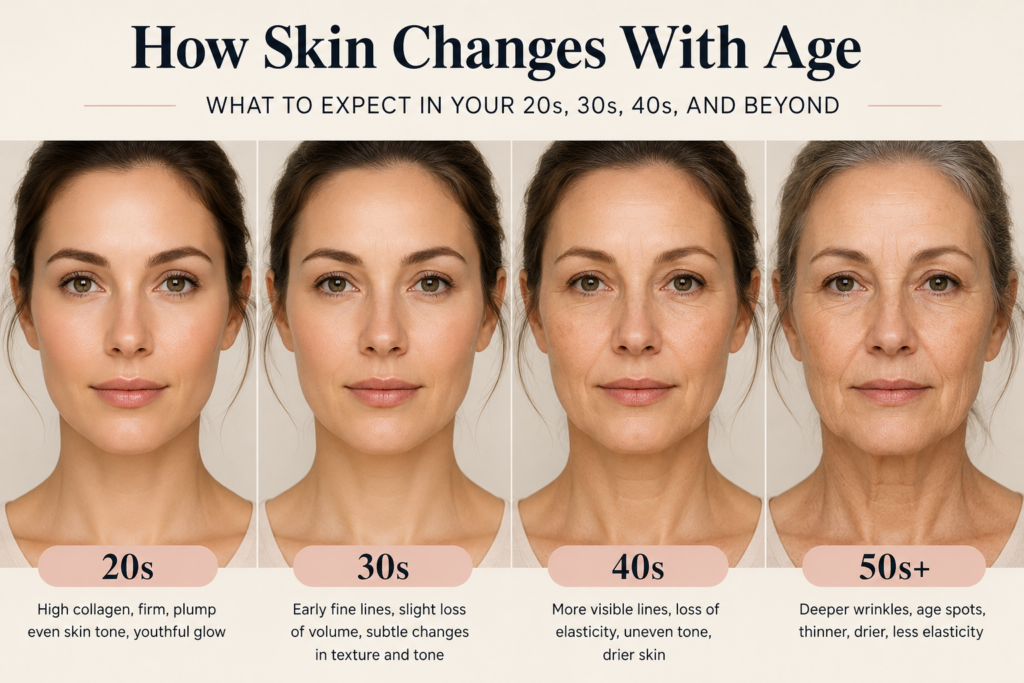
Your skin does not suddenly start “aging” on your 30th birthday.
Skin aging is a gradual process that begins long before wrinkles become obvious. Some changes happen because of the passage of time and changes in the skin itself. Others are driven by years of ultraviolet (UV) exposure, smoking, pollution, nutrition, hormones, and other environmental influences.
That is why two people of the same age can have noticeably different-looking skin.
A person in their 40s who has consistently protected their skin from the sun may have relatively little visible photoaging, while someone younger with substantial cumulative UV exposure may already have pigmentation, fine lines, or uneven texture.
Research describes skin aging as a combination of intrinsic aging, which is associated with chronological and biological aging, and extrinsic aging, which results from environmental influences layered on top of it. A systematic review and meta-analysis identified age, sun exposure, smoking, nutrition, air pollution, sex, and ethnicity among important factors associated with different skin-aging characteristics.
The practical takeaway is simple: your skin will change with age, but the timing and extent of those changes are not predetermined.
Understanding what typically happens in your 20s, 30s, 40s, 50s, and beyond can help you build a skincare routine around what your skin actually needs rather than chasing every new “anti-aging” trend.
How Does Skin Change With Age?
As skin ages, several structural and functional changes occur at the same time. Collagen production and dermal support decline, elastic fibers become altered, skin becomes thinner and less resilient, hydration and barrier function can change, and the skin becomes more susceptible to environmental damage.
A useful way to understand the process is to separate the changes into four major areas:
- Structure: Less collagen and altered elastin reduce firmness and elasticity.
- Hydration and barrier function: Aging can affect the skin’s ability to retain moisture and maintain its protective barrier.
- Pigmentation: Years of UV exposure can contribute to uneven pigmentation and age spots.
- Repair and resilience: Older skin generally has less reserve capacity and can become more fragile and slower to recover from damage.
A review of biochemical, structural, and physical changes in aging skin notes that collagen density generally decreases with age. One frequently cited body of research estimates that skin collagen declines by approximately 1% per year during adult life, although individual variation is considerable.
At the same time, aging is not simply a story of “less collagen.” The extracellular matrix, which provides structural support to the skin, undergoes remodeling. Collagen fibers can become fragmented, elastic structures change, and the biochemical environment surrounding skin cells also changes.
This distinction matters because simply replacing moisture or stimulating collagen cannot completely reverse every component of skin aging.
Intrinsic Aging vs. Photoaging: What’s the Difference?
There are two overlapping processes behind visible skin aging.
Intrinsic skin aging
Intrinsic aging is the gradual biological aging of the skin that occurs even without excessive environmental exposure.
Over time, the dermis becomes thinner, collagen decreases, elastic structures change, and the skin’s ability to maintain hydration and repair itself can decline.
The process is influenced by genetics, hormones, cellular aging, oxidative stress, and other biological mechanisms.
Extrinsic aging and photoaging
Extrinsic aging comes from external influences. UV exposure is particularly important.
A 2026 review of photoaging describes chronic sun exposure as the most important external contributor to skin aging, with common visible effects including wrinkles and pigmentary changes.
UV radiation can generate oxidative stress and activate pathways that affect the extracellular matrix. Research has linked UV exposure to changes in enzymes involved in the breakdown of collagen and other structural components of the skin.
The interesting part is that photoaging can begin at a biological level before it becomes obvious in the mirror. A proteomic study found evidence of photoaging-related molecular changes even in sun-exposed skin from people in their mid-20s, despite the absence of advanced visible aging.
In other words, your 20s are not necessarily “too early” to think about skin aging.
They are simply a stage when prevention tends to make more sense than aggressive correction.
What to Expect From Your Skin in Your 20s
For many people, their 20s are when skin still looks relatively smooth, resilient, and full.
Collagen and elastin provide substantial structural support, skin turnover is generally efficient, and the signs associated with advanced chronological aging may be minimal.
But this does not mean nothing is happening.
Your skin may still be dealing with acne and oiliness
Aging does not automatically mean the end of acne.
Hormonal fluctuations, genetics, skincare products, stress, and other factors can continue to influence oil production and breakouts well into adulthood.
This creates an important skincare mistake: assuming that someone in their 20s needs an aggressive “anti-aging” routine when their primary concern may actually be acne, pigmentation, sensitivity, or barrier damage.
Treat the skin problem you actually have.
Early sun damage can accumulate
You may not see significant wrinkles yet, but cumulative UV exposure is already contributing to long-term changes.
The fact that photoaging-related molecular changes can be detected in young adult skin is one reason daily sun protection is better understood as prevention rather than an “anti-aging treatment.”
The American Academy of Dermatology recommends broad-spectrum sunscreen with SPF 30 or higher, particularly when spending time outdoors.
American Academy of Dermatology guidance on choosing anti-aging skincare products
What your 20s skin generally needs
For many people, a straightforward routine is enough:
Morning
- Gentle cleanser if needed
- Moisturizer
- Broad-spectrum SPF 30+ sunscreen
Evening
- Cleanser
- Moisturizer
- A targeted treatment if you have a specific concern, such as acne or pigmentation
You do not need a shelf full of anti-aging products simply because you turned 25.
Your biggest long-term advantage in this decade is consistency.
What to Expect From Your Skin in Your 30s
Your 30s are often when subtle changes become easier to notice.
That does not mean your skin suddenly becomes old. Instead, some of the processes that were previously difficult to see begin becoming visible.
Fine lines may appear around the eyes or forehead. Skin may look slightly less plump. Recovery from irritation may take longer. Pigmentation accumulated from years of sun exposure can become more noticeable.
Fine lines may become more visible
Dynamic facial movements repeatedly fold the skin. As structural support and elasticity gradually change, some expression lines may become more persistent.
The appearance of wrinkles is influenced by both intrinsic aging and cumulative photoaging, so there is considerable variation between individuals.
Someone with extensive sun exposure may notice changes earlier than someone with relatively low exposure.
Skin may feel less hydrated
Aging affects several components of the skin barrier, including epidermal lipids, hydration, permeability, and other barrier functions.
This does not necessarily mean your skin will suddenly become dry in your 30s. But you may find that products or habits you previously tolerated no longer work as well.
Over-cleansing, harsh exfoliation, and constantly changing active ingredients can become more noticeable problems.
A moisturizer can help support the barrier by using combinations of humectants, emollients, and occlusives.
Pigmentation can become more noticeable
Dark spots are not exclusively an “older skin” problem.
UV exposure can contribute to uneven pigmentation over years, and these changes can become more visible with time. The AAD lists age spots and uneven complexion among common manifestations of sun-damaged skin.
This is another reason sunscreen matters even when wrinkles are not your primary concern.
Retinoids may become useful
Retinoids are among the better-studied topical ingredients for addressing several signs of skin aging.
The American Academy of Dermatology explains that retinoids can increase surface skin-cell turnover and stimulate collagen, while retinol is commonly used for concerns such as uneven tone, texture, fine lines, and wrinkles.
American Academy of Dermatology: Retinoid or retinol?
But stronger does not automatically mean better.
Retinoids can cause irritation, particularly when introduced too aggressively. The AAD recommends starting gradually and using moisturizer to help reduce irritation.
What to Expect From Your Skin in Your 40s
The 40s are often when structural changes become more apparent.
Fine lines may become deeper. Skin may lose some firmness. Texture can become less smooth, and areas such as the cheeks, jawline, neck, and around the eyes may begin to show changes in volume and elasticity.
But again, there is no universal “40-year-old skin.”
Your cumulative UV exposure, genetics, smoking history, hormonal status, lifestyle, and skincare habits all contribute.
Collagen loss becomes increasingly relevant
Collagen is a major structural protein in the dermis.
Research has consistently associated aging with reductions in collagen density and changes in collagen organization.
This helps explain why older skin can appear less firm and why wrinkles become more apparent over time.
But collagen loss is not the only reason.
The extracellular matrix also undergoes fragmentation and biochemical changes. Photoaging can additionally produce abnormal elastic material and increased activity of enzymes that damage structural proteins.
Skin may become more fragile
As skin becomes thinner and its structural support changes, it can become more vulnerable to mechanical stress.
A review of skin aging describes increased fragility and susceptibility to trauma as characteristic changes in aging skin.
This makes gentle skincare increasingly valuable.
The goal is not to “scrub away” aging. It is to maintain the skin’s barrier while addressing specific concerns.
Hormonal changes can influence skin
For women, the 40s may overlap with perimenopause and eventually menopause. Hormonal changes can therefore become an important part of the skin-aging picture.
Research has linked estrogen deficiency associated with menopause to changes in collagen, skin thickness, and elasticity.
Some studies have reported substantial declines in skin collagen following menopause, although the exact magnitude varies among studies and populations.
This is one area where chronological age alone can be misleading. Two people who are both 48 may be experiencing very different hormonal and skin changes.
What your 40s skincare routine should prioritize
At this stage, a sensible routine usually focuses on:
- Consistent sunscreen
- Adequate moisturization
- A retinoid or retinol if appropriate
- Gentle cleansing
- Targeted treatment for pigmentation or other concerns
- Avoiding unnecessary irritation
The AAD specifically recommends starting with sunscreen and moisturizer before adding multiple anti-aging products. It also warns that using several anti-aging products simultaneously can irritate the skin.
That is useful advice at any age, but particularly when the skin becomes less tolerant of aggressive routines.
What to Expect From Your Skin in Your 50s and Beyond
After 50, the effects of intrinsic aging, cumulative environmental exposure, and hormonal changes may become increasingly visible.
Skin can become thinner, drier, less elastic, and more fragile. Fine lines may deepen into wrinkles, pigmentation may become more prominent, and healing or recovery from irritation may take longer.
Dryness can become a bigger concern
The skin barrier changes with age.
Research has documented age-related changes in barrier structure, epidermal lipids, hydration, and other functions.
A systematic review examining transepidermal water loss and skin barrier function also found measurable differences between older and younger adults, although results vary depending on the body site and study conditions.
This is why mature skin often benefits from a simpler, more barrier-focused approach.
A moisturizer is not merely a cosmetic step. It can support the physical barrier and improve water retention in the outer layers of skin.
Skin becomes less forgiving
A product that caused no problem at 25 may cause irritation at 55.
That does not necessarily mean the product has suddenly become “bad.” Your skin’s barrier and repair capacity have changed.
Mature skin may therefore benefit from:
- Gentle cleansers
- Regular moisturization
- Fewer unnecessary exfoliating products
- Consistent sunscreen
- Carefully introduced active ingredients
- Professional evaluation of persistent or changing lesions
Pigmentation and sun damage deserve attention
Years of cumulative UV exposure can produce wrinkles, uneven pigmentation, rough texture, and other changes.
The AAD notes that prolonged sun damage can also contribute to actinic keratoses, which are precancerous growths, and skin cancer.
This is an important distinction: skincare should not be viewed solely through the lens of appearance.
Changes in older skin can sometimes have medical significance.
A new, changing, bleeding, crusting, or otherwise unusual spot deserves evaluation by a qualified healthcare professional rather than being dismissed as “just aging.”
Does Skin Aging Happen at the Same Rate for Everyone?
No.
Age is only one variable.
A 2021 systematic review and meta-analysis identified several factors associated with skin aging, including sun exposure, smoking, nutrition, air pollution, age, sex, and ethnicity.
Genetics also influence how an individual’s skin responds to aging and environmental exposure.
This explains why there is no reliable formula such as:
“You turn 30, then wrinkles begin.”
Or:
“Everyone loses the same amount of collagen at the same age.”
The 20s, 30s, 40s, and 50s are useful reference points, not biological deadlines.
Lifestyle matters, but don’t oversell it
Smoking has been consistently associated with premature skin aging, and environmental exposures such as air pollution have also been investigated as contributors.
Nutrition, physical activity, sleep, stress, and other lifestyle factors are also being studied in relation to skin aging.
A 2026 review of lifestyle factors found associations between skin aging and factors including nutrition, physical activity, stress, sleep, and substance use. However, evidence quality varies considerably between individual factors and outcomes.
That distinction matters.
It is reasonable to say that healthy lifestyle habits support overall health and may benefit skin health. It is not reasonable to promise that drinking a particular juice, avoiding one food, or taking one supplement will stop wrinkles.
What About Sugar and “Glycation”?
You may have heard that sugar “ages your skin.”
There is a real biological process behind the claim, but social media often makes it sound much simpler than it is.
Glycation is a chemical reaction in which sugars react with proteins and other molecules, producing compounds known as advanced glycation end products, or AGEs.
AGEs can accumulate in long-lived structural proteins such as collagen and alter their properties. Reviews of the evidence suggest that glycation contributes to changes associated with skin aging, including reduced elasticity and altered extracellular-matrix function.
However, that does not mean every dessert directly translates into a wrinkle.
Skin aging is multifactorial. UV exposure, chronological aging, genetics, hormones, smoking, pollution, and many other processes interact.
The sensible takeaway is to focus on an overall nutritious dietary pattern rather than treating individual foods as magical causes or cures for aging.
The Most Important Anti-Aging Habit Is Still Sun Protection
If there is one preventive skincare habit that consistently deserves attention, it is protecting your skin from UV exposure.
The evidence behind photoaging is extensive, and current dermatology guidance continues to emphasize sun protection. The AAD recommends broad-spectrum SPF 30 or higher and additional protective measures such as shade and protective clothing.
This matters because sunscreen does not simply protect against wrinkles.
UV exposure contributes to:
- Wrinkles
- Uneven pigmentation
- Loss of elasticity
- Rough texture
- Photodamage
- Actinic keratoses
- Skin cancer
A 2025 AAD survey also found a gap between concern about premature skin aging and consistent sunscreen use among surveyed U.S. adults, highlighting that awareness does not always translate into daily behavior.
American Academy of Dermatology’s 2025 survey on premature skin aging and sunscreen use
Should You Change Your Skincare Routine Every Decade?
Not necessarily.
A better approach is to keep the foundation stable and adjust individual products according to what your skin needs.
Think of your skincare routine as having three layers.
1. Protect
Use sunscreen consistently and reduce unnecessary UV exposure.
2. Maintain
Use a gentle cleanser and moisturizer appropriate for your skin.
3. Treat
Add targeted ingredients based on your actual concerns.
For example:
| Age | Common concerns | Practical priority |
|---|---|---|
| 20s | Acne, oiliness, early pigmentation, prevention | Sunscreen, barrier care, targeted acne treatment |
| 30s | Fine lines, pigmentation, texture | Sunscreen, moisturizer, targeted actives such as retinoids |
| 40s | Wrinkles, firmness, pigmentation, dryness | Sun protection, barrier support, retinoids if appropriate |
| 50s+ | Dryness, fragility, deeper wrinkles, pigmentation | Barrier-focused care, sun protection, carefully selected treatments |
These are not rules. They are a framework.
Someone with acne at 45 may need an acne-focused routine. Someone in their 25s with significant photoaging may need to address pigmentation and sun damage. Your skin’s condition matters more than the number on your birthday cake.
What Actually Helps Slow Visible Skin Aging?
The evidence does not support one miracle ingredient or one perfect routine.
A more defensible strategy is consistent and relatively boring:
- Protect your skin from UV radiation.
- Keep the skin barrier healthy.
- Avoid smoking.
- Use evidence-supported topical treatments when appropriate.
- Avoid unnecessary irritation.
- Maintain a generally healthy lifestyle.
- Treat specific skin conditions rather than assuming every change is normal aging.
Retinoids are among the topical treatments with meaningful evidence for addressing signs of photoaging, while moisturizers can support the skin barrier and improve the appearance of dryness and fine lines.
But skincare has limits.
No topical product can completely stop biological aging, restore every lost structural component, or make skin permanently look 20 years younger.
That is not a failure of skincare. It is simply biology.
The Bottom Line: Your Skin Doesn’t “Expire” at 30, 40, or 50
Skin aging is gradual, cumulative, and highly individual.
In your 20s, your focus can be largely preventive: protect your skin, maintain the barrier, and treat acne or pigmentation when needed.
In your 30s, subtle changes such as fine lines, pigmentation, and reduced resilience may become more noticeable.
In your 40s, structural changes involving collagen, elasticity, pigmentation, and, for many women, hormonal changes can become increasingly relevant.
In your 50s and beyond, dryness, fragility, loss of firmness, deeper wrinkles, and cumulative sun damage may become more apparent.
But the most useful way to think about aging skin is not as a countdown.
Your skin is continuously responding to biology and its environment. The habits you build earlier can influence how much environmental damage accumulates, while appropriate skincare can help maintain the skin’s barrier and address specific signs as they appear.
You do not need to fight every wrinkle.
You need to understand what is changing, protect what you can, and choose treatments based on evidence rather than fear of getting older.
Frequently Asked Questions
Does skin start aging in your 20s?
Biological aging is a gradual process rather than something that begins at a specific birthday. Research has found molecular evidence of photoaging in sun-exposed skin even in people in their mid-20s, although visible signs may not yet be obvious.
What happens to your skin in your 30s?
Fine lines, pigmentation, subtle changes in texture, and reduced resilience may become more noticeable. These changes vary considerably depending on genetics, UV exposure, lifestyle, hormones, and skincare habits.
What happens to your skin in your 40s?
Collagen loss, changes in elasticity, pigmentation, and dryness can become more noticeable. Hormonal changes can also influence skin, particularly around perimenopause and menopause.
Does collagen decrease as you age?
Yes. Research generally shows that collagen density and content decline with age, although the rate varies between individuals and anatomical sites. One commonly cited estimate is approximately 1% per year during adult life.
Can sunscreen slow skin aging?
Sunscreen can help reduce cumulative UV damage, which is a major contributor to extrinsic skin aging. Dermatologists recommend broad-spectrum SPF 30 or higher alongside other sun-protective measures.
Is retinol useful for aging skin?
Retinol is a form of retinoid commonly used to improve concerns such as uneven skin tone, texture, fine lines, and wrinkles. Prescription retinoids are also used for photoaging. Retinoids can cause irritation, so they should be introduced appropriately for the individual’s skin.
Does menopause affect skin aging?
Yes. Declining estrogen around menopause is associated with changes in skin thickness, collagen, elasticity, and other connective-tissue properties. However, individual experiences vary, and research on hormone-based interventions has produced differing results depending on treatment and study design.
Can you prevent skin aging completely?
No. Intrinsic aging is a normal biological process. However, you can reduce some forms of premature or extrinsic aging by protecting your skin from UV radiation, avoiding smoking, maintaining the skin barrier, and using evidence-supported treatments when appropriate.